Saturday, November 28, 2026
Home Blog Page 962

Fayemi calls for scrapping of Senate

0

The Ekiti State Governor, Kayode Fayemi, has advocated the scrapping of the Senate in order to save cost and reduce financial burden on the government.

He also advocated for the adoption of Stephen Orosaye report which recommended the merging of federal government’s agencies that perform similar functions in order to save the country’s resources and ensure effectiveness.

Mr Fayemi spoke at one of the panel sessions on the sidelines of the 25th edition of the Nigerian Economic Summit with the theme, ‘Nigeria 2050: Shifting gears,’ as reported by the Punch.

Mr Fayemi said the type of legislative system that would be more productive for Nigeria in this current economic situation “is a unicameral legislature.”

In the previous week we reported how Rochas Okorocha, a senator representing Imo West Senatorial District, expressed a similar idea.

Mr Okorocha lamented the cost of running the Senate and suggested the reduction in number of senators in each state to one so as to save cost.

As it stands, the country’s legislative arm consisting of 109 Senate members and a 360-member House of Representatives, on yearly basis gulps millions of naira.

In the recently presented 2020 Budget proposals, N125 billion has been set aside for the National Assembly.

Fayemi’s argument

Governor Fayemi in his argument said, “We do need to look at the size of government in Nigeria and I am an advocate of a unicameral legislature. What we really need is the House of Representatives, because that is what represents.

“You have three senators from little Ekiti and you have three senators from Lagos State.

“It’s a no-brainer that it’s unequal, I guess the principle is not proportionality but that if you are a state, you get it automatically.

“But I think that we can do away with that. There are several things that we can do away within the government,” he said.

Oronsaye report, insecurity

“The Oronsaye report that proposed mergers of several Ministries Departments and Agencies that are doing the same thing is something that the government should pay serious attention to and reduce the resources being expended on them,” Mr Fayemi said.

On the state of the country’s security, he said insecurity is not only peculiar to Nigeria but threatens the world.

“The important thing is the government utilises a wide range of mechanisms to guarantee security in a state and it is not just ammunition and weapons that I am talking about.”

Other dignitaries in attendance during the session include the Executive Chairman of the Federal Inland Revenue Service, Babatunde Fowler; Managing Director of Nigerian Breweries, Jordi Borrut Bel, and the Country Manager of the International Finance Corporation, Eme Essien.

Mr Okorocha lamented the cost of running the Senate and suggested the reduction in number of senators in each state to one so as to save cost.

As it stands, the country’s legislative arm consisting of 109 Senate members and a 360-member House of Representatives, on yearly basis gulps millions of naira.

In the recently presented 2020 Budget proposals, N125 billion has been set aside for the National Assembly.

Fayemi’s argument

Governor Fayemi in his argument said, “We do need to look at the size of government in Nigeria and I am an advocate of a unicameral legislature. What we really need is the House of Representatives, because that is what represents.

Advertisement

“You have three senators from little Ekiti and you have three senators from Lagos State.

“It’s a no-brainer that it’s unequal, I guess the principle is not proportionality but that if you are a state, you get it automatically.

“But I think that we can do away with that. There are several things that we can do away within the government,” he said.

Oronsaye report, insecurity

“The Oronsaye report that proposed mergers of several Ministries Departments and Agencies that are doing the same thing is something that the government should pay serious attention to and reduce the resources being expended on them,” Mr Fayemi said.

On the state of the country’s security, he said insecurity is not only peculiar to Nigeria but threatens the world.

“The important thing is the government utilises a wide range of mechanisms to guarantee security in a state and it is not just ammunition and weapons that I am talking about.”

Other dignitaries in attendance during the session include the Executive Chairman of the Federal Inland Revenue Service, Babatunde Fowler; Managing Director of Nigerian Breweries, Jordi Borrut Bel, and the Country Manager of the International Finance Corporation, Eme Essien.


JUST IN: Gunmen attack another Kaduna school, kidnap principal

0

Some gunmen have reportedly attacked the Government Technical Secondary School, Mararaban Kajuru in Kajuru Local Government Area of the state, abducting the principal of the school.

This is coming barely a week after the abduction of six female pupils and two staff members of the Engravers College, Chikun Local Government Area of the State.

The State Police Command is yet to confirm the incident.


10 Filling Stations Sealed for Irregularities

0

The Department of Petroleum Resources (DPR) in Bayelsa says it has sealed ten petrol stations and an illegal liquefied petroleum gas (LPG) station in Yenagoa for expired licences and lack of basic operational equipment.

The DPR on Wednesday, with a team of its officials, led by Mr Ibinabo Jack, Head of Operations in the state field office, paid unscheduled visit to some retail petrol outlets.

The affected filling stations were Tamic Oil and Gas, Paudsiman Nigeria Limited, Ido Oil and Gas, De Arizona Nigeria limitedlimited and Keniyan Oil and Gas limited.

Others were Sohwo Oil and Gas limited, in Swali, Paulo Oil and Gas Sea Bird Oil and Gas, RSK Oil and Gas limited, Emily Oil and Gas.

Jack said: “The sealing of filling stations is not new and it’s not going to be a one-off thing rather, it will be a continuous exercise. We caught some of them dispensing to customers below the variation.

“For instance, a station that is selling at point 41CL of every 10 litres is short-changing the public.

“In other words, where they ought to get 10 litres, they are given maybe six or seven litres. This is not fair,” he said.

The DPR chief said that the stations that were placed under seal had committed so many irregularities, which were punishable, adding that while some were under dispensing, others did not have fire extinguishers.

According to him, some did not even have sand buckets and these are things needed for their safety and that of their facilities as well as their customers.

“The penalties depend on their offences. When they report at DPR’s office, appropriate penalties will be spelt out to each of them.

“The DPR is a regulatory body and there are regulations binding the operations of retail outlets which need to be maintained by the operators.

“The new policy now, is that no gas station should be inside a fueling station, it is wrong; So, the Federal Government is against it,” he said.

He said the Federal Government has urged those in the gas business to look for an alternative by removing the retail outlet to another place that will be more secured.

Jack urged those sealed to always adhere to the rules and regulations of DPR in the interest of the general public.


Tanzanian Govt gives contractor 37 days to electrify Arusha, Mwanza villages

0

THE government has given 37 days to a contractor, Nipo Group Company Limited, to complete electrification in some villages in Arusha and Mwanza regions.

Chairman of the Technical Committee of the Board of Directors of Rural Energy Agency (REA) Styden Rwabangila gave the directive to the company’s Managing Director Wilson Chilewa yesterday.

The directive comes after it was learnt that various REA projects implemented by the contractor in the two regions were progressing slowly.

“We told the contractor that he cannot suspend work by pretending he is delayed to be paid and if he does not complete those projects on time, we will take action against him, including terminating his contract and blacklisting him,” he explained.

He added: “Everywhere we hear regional and district commissioners complaining about the implementation of these projects.

That is why you have seen it is very rare for the board to follow the contractor to the sites to inspect the progress and the implementation of these REA projects to ensure they are completed on time, but we have to do so.”

Acting REA Technical Service Director, Jones Olotu commented that the implementation of REA projects in the country were progressing well and the government aimed at ensuring all projects were completed on time and even when they were handed over to Tanesco, customers would continue being charged 27,000/- to enable all residents to be connected.

“The goal of the government is to supply power to all villages by 2021,” he stressed.

For his part, Nipo Company Limited managing director, the contractor of the projects, assured the board that he would comply with the board’s directive and that his company was preparing a work plan to ensure the implementation of the projects was completed by December 30, this year.

“We are going to increase the number of teams to ensure all projects are completed as directed by the government,” he said.

Teacher docked for aiding student write WAEC

0

A 40- year-old teacher, Charles Adetunji, on Thursday appeared before an Ikeja Chief Magistrates’ Court for allegedly aiding a student to write her West Africa Senior School Certificate Examinations (WAEC).

Adetunji, who resides at No. 7, Oyewole St., Abule Egba, Lagos, is facing a two-count charge of conspiracy and examination malpractice, to which he pleaded not guilty.

The prosecutor, ASP Benson Emuerhi told the court that the defendant committed the offences on Sept. 16 at Meiran Community Junior High School, Meiran, Lagos.

Emuerhi said that the defendant assisted a teenage girl to solve all the questions on Literature in English during WAEC by sending the answers to her mobile phone.

“The examiner caught the girl using her phone, when it was checked the answers to the questions were there; when she was asked, she said the defendant sent them to her,” he said.

Emuerhi said the offences contravened Sections 324 and 411 of the Criminal Law of Lagos State, 2015.

The Chief Magistrate, Mrs Olufunke Sule-Amzat granted the defendant bail in the sum of N100,000 with two sureties in like sum.

Sule-Amzat adjourned the case until Dec. 5 for mention.


NAN

Sex for Grades: UNILAG sets up panel to probe lecturers

0

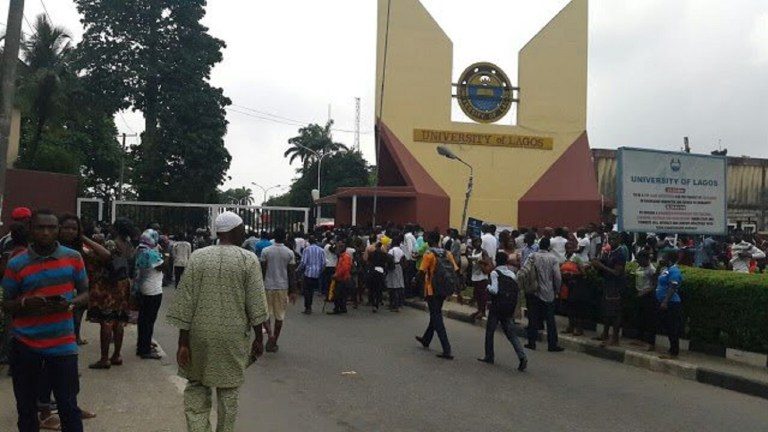
The management of the University of Lagos (UNILAG) has set up a panel to investigate the allegations against two of its lecturers indicted in the sex-for-grades scandal.

UNILAG, Sex for grade, Panel, Boniface Igbeneghu, a senior lecturer, and Samuel Oladipo, a lecturer in the department of economics, were exposed in a documentary on sexual harassment released by the BBC Africa Eye on Monday.

The two lecturers have been suspended by the university. In a statement on Wednesday, Taiwo Oloyede, principal assistant registrar, communication unit of UNILAG, said the panel is headed by Ayodele Atsenuwa, a professor and dean of the faculty of law.

The school said the process will be transparent and appropriate sanctions would be meted out if the need arises.

The university also encouraged students and members of staff that have relevant information concerning the incidents to come forward, assuring that their security is guaranteed.

“The Panel will probe into the allegations of sexual harassment levelled against Dr. Boniface Igbeneghu of the Department of European Languages and Integrated Studies, Faculty of Arts and Dr. Samuel Oladipo of the Department of Economics, Faculty of Social Sciences as well as other related cases,” the statement read.

Sexual harrassment bill bounces back in senate

As previously announced in the University’s Press Release dated Monday, October 7, 2019, Dr. Samuel Oladipo who was featured in the full version of the BBC broadcast, has been suspended from work with immediate effect and barred from the University academic areas until the conclusion of the Panel’s assignment.

Students and members of staff who have relevant information are encouraged to come forward. Their protection is assured. We firmly reassure all our students, staff, alumni, parents and guardians that this matter will be tackled with every sense of responsibility, and the seriousness it deserves. The whole process will be transparent and appropriate sanctions will be meted out to anyone found culpable.”

The statement added that the panel (pictured) set up to investigate another allegation of sexual harassment involving a professor in the university in June 2018 still subsists and is awaiting further information that will aid in concluding the investigation.


We’ve opted for negotiations with kidnappers of Kaduna students, police say

0

The Kaduna State Police Command said on Wednesday it has opted for negotiations to free six abducted female students and two teachers of Engravers College, Kaduna.

The command said they opted to negotiate the release of the victims with the kidnappers despite knowing the location of the gang, but cannot infiltrate their hideout or use a force to free the victims.

The State Commissioner of Police, Ali Janga, stated this at a press briefing at the command headquarters in Kaduna.

He said: “We are negotiating with the kidnappers to rescue these students and their teachers. We know the location of the kidnappers but we do not want to endanger the lives of the victims.

“Most of these kidnappers are operating under the influence of hard drugs, so killing is nothing to the. This is why we are still negotiating with them and as soon as the victims are released, we will go after them.

“We are assuring the people of Kaduna State that we will arrest these kidnappers very soon.”

Some unidentified gunmen had abducted six school girls alongside their vice principal and a housemistress in the early hours of last Thursday at the school premises in Kakau Daji, Chikun local government area of Kaduna State.

The kidnappers had earlier demanded a N10 million ransom to release the eight victims and later raised their demand to N80 million.


Zimbabwe quadruples electricity tariffs amid blackouts

0

Zimbabwe has raised its average electricity tariff by 320 percent to ramp up power supplies at a time of daily blackouts but the move will likely anger consumers already grappling with soaring inflation and stagnant wages.

The southern African country is experiencing its worst economic crisis in 10 years, seen in triple-digit inflation, 18-hour power cuts and shortages of US dollars, medicines and fuel that have evoked the dark days of the 2008 hyperinflation under late President Robert Mugabe.

Wednesday’s was the second increase in the price of electricity inside three months and follows sharp rises in fuel and basic goods prices in the last week. Salaries have not kept pace, prompting citizens to blame President Emmerson Mnangagwa’s policies for the crisis.

The Zimbabwe Energy Regulatory Authority (ZERA) said it had approved an application by Zimbabwe Electricity Transmission and Distribution Company (ZETDC) to raise the tariff to 162.16 cents ($0.11) from 38.61 cents.

ZERA said the tariff rise was necessary after inflation soared – the International Monetary Fund (IMF) says it was about 300 percent in August. Zimbabwe introduced an interim sovereign currency – the Real Time Gross Settlement dollar or Zimdollar – in February which quickly fell prey to black market speculation.

In an effort to support the Zimdollar, the government in June outlawed the use of foreign currencies in local transactions. But the move failed to curb the Zimdollar’s slide.

Consumers seem set for more price increases after the energy regulator said that, starting November, the power utility would index its tariff to the US dollar to enable it “to recover from inflation and exchange rate changes”.

The new tariff would allow ZETDC to raise money to repair its generators, as well as pay for imports from South Africa’s Eskom and Mozambique which cost $19.5m every month, the regulator said.

Hopes that Zimbabwe’s economy would quickly rebound under Mnangagwa, who took over after the late Robert Mugabe was deposed in a coup in November 2017, have faded fast as ordinary people grapple with eye-watering inflation that has eroded earnings and savings.

On Monday, treasury data showed the economy was worse off than initially thought. It is now projected to contract by up to six percent this year due to the power cuts, which have hit mines, industry and homes and an El Nino-induced drought that has left the country needing to import food.

Mnangagwa, whom critics accuse of lacking commitment to political reforms and using his predecessor’s heavy-handed tactics to stifle dissent, has pleaded for time and patience to bring the economy back from the “dead.”


Source: Al Jazeera


Nigeria’s rising fiscal deficits distorting monetary policy, say IMF officials

0

The officials of the International Monetary Fund (IMF), on economic assessment visit to Nigeria, have said serial deficits in the country’s yearly budgets are distorting monetary policies.Specifically, when the revenue projections failed, the officials noted that government had to fall back on the Central Bank of Nigeria (CBN), to raise revenue, which is expensive and results in huge interest payments.

The observations, coincidentally, came barely 24 hours after the Nigeria’s 2020 budget, with another N2.8 trillion fiscal deficit was presented to the lawmakers by President Muhammadu Buhari. Presently, it would be difficult to point which year in the last 15 years that the country recorded a balanced budget.

The IMF staff team, led by the Senior Resident Representative and Mission Chief for Nigeria, Amine Mati, visited Lagos and Abuja, from September 25 to October 7, to discuss recent economic and financial developments, update macroeconomic projections, and review reform implementation.He said revenue initiatives planned under the 2020 budget like increase in Value Added Tax (VAT) rate, introduction of a minimum registration threshold and exemption of basic food products, will help partially to offset declining oil revenues and impact of higher minimum wages.

According to IMF, the carryover from 2018 to 2019 helped to increase public investment spending in the first half (H1) of 2019, but revenue underperformed significantly relative to the budget target during the period.They also noted the “over-optimistic revenue projections”, which have led to higher financing needs than initially envisaged, resulting in over-reliance on expensive borrowing from the CBN to finance the fiscal deficits.

Presently, the Federal Government’s interest payments continue to absorb more than half of revenues in 2019.Amine said the pace of economic recovery remains slow, as depressed private consumption and investors’ “wait-and-see” attitude kept growth in H1 at two per cent.He said the growth rate is significantly below population growth, although headline inflation has fallen, reaching its lowest level since January 2016, helped by lower food price inflation.

“Spurred by one-off increases in imports, the current account turned into a deficit in the first half of 2019 after three years of surpluses.“Gross international reserves have fallen to below $42 billion at end of August 2019, mainly reflecting a decline in foreign holdings of short-term securities and equity.

“The exchange rate in various windows remained stable, helped by steady sales of foreign exchange by CBN. “The outlook under current policies remains challenging. Growth is expected to pick up to 2.3 percent this year on the strength of a continuing recovery in the oil sector and the regaining of momentum in agriculture, following a good harvest,” he said.

While speaking on other findings, he said the deficit is expected to persist, while the pace of capital outflows continues to weigh on international reserves. “Inflation will likely pick up in 2020, following rising minimum wages and a higher VAT rate, despite a tight monetary policy.

“A comprehensive package of measures—whose design and implementation will require close coordination within the economic team and the newly-appointed Economic Advisory Council, is urgently needed to reduce vulnerabilities and raise growth.

“The increasing CBN financing of the government reinforces the need for an ambitious revenue-based fiscal consolidation that should build on the initiatives laid out in the Strategic Revenue Growth Initiative.“A tight monetary policy should be maintained through more conventional tools. Managing vulnerabilities arising from large amounts of maturing CBN bills, including those held by non-residents, requires stopping direct central bank interventions, the introduction of longer-term government instruments to mop up excess liquidity and moving towards a uniform market-determined exchange rate,” he added.


Navy alleges conspiracy against African over illegal fishing

0

Piqued by the manner at which foreign trawlers get away with illegal and irresponsible fishing in the Gulf of Guinea (GOG), the Nigerian Navy has affirmed that Nigeria and other member countries may be dealing with international conspiracy.

Hence, Maritime stakeholders from about 70 countries at the Global Maritime Security Conference, agreed that GOG states and the international community should put in place mechanisms that would ensure that resources that are illegally harvested or explored including stolen oil, and illegal fishery are internationally banned as the case of blood diamonds.

A communiqué issued at the end of the 3-day Global conference, yesterday, in Abuja, also stressed the need for GOG states to explore the possibility of designated maritime court to handle cases of sea robbery, piracy, and other maritime offences.The move, according to them, would ensure quick dispensation of cases, adding that they should also sensitise and build capacity of the judiciary on crucial relevant legislation.

The representative of the Chief of Naval staff, Rear Admiral Begroy Ibe-Ensor, while briefing journalists, said the Navy is also suspicious of the international conspiracy against African countries, and encouraged international communities to discourage their own people from participating in this kind of illegality. He said: “and that is why one of the recommendations clearly stated that we should designate it same status as blood diamond; maybe blood fish or bad fish.”

Affirming that the Nigerian Navy is incapacitated to effectively police the nation’s territorial waters given the large expanse, he said to improve surveillance they require ships, and maybe helicopters to sail out to sea and use their radar to see what is going on there. He added that beyond seeing what is going on at the sea, they are also not able to deploy ships and helicopters to effect arrest.

“It’s a work in progress; more ships are being bought by the government. Some other levels of collaborations even the fishery department is coming on board fully. To this extent, the Fishery Department of the Federal Ministry of Agriculture, had acquired two ships to be dedicated for anti-fishery operations.”