Friday, November 27, 2026
Home Blog Page 972

Legal and institutional restructuring for the next Nigeria

0

Introduction: President Mohammadu Buhari’s 2019 Independence Day address to the nation may have created an enabling platform to encourage new discussions on how to transform Nigeria’s economy. The President’ssetting up of an Economic Advisory Council, EAC, is an important tool in this regard.  At the Platform, a biannual televised conference organized by Covenant Christian Centre in Lagos, Prof Chukwuma Soludo and Bismarck Rewane laid out a strategy upon which economic transformation can work.  Prof. Soludo aptly likened Nigeria’s current reality to building a 100-storey building upon the foundation of an old bungalow. I agree entirely with Prof. Soludo that it is not feasible to build a 100-storey building on the foundation of an old bungalow.  Likewise, economic transformation can’t be built on Nigeria’s outmoded economic development model. It is crucial to design a comprehensive institutional development design, which is like an architectural plan to transform Nigeria. It is important that the design take into account development law as it is a vital element of any successful model. Some thoughts.

Development Law as part of economic reforms

Development law is a public policy tool that intersects law and economic development.   Development law scholars agree that there is a strong link between law, regulatory institutions, governance, economic development and national welfare. It is argued that the Nigerian legal and judicial framework is hopelessly outdated and needs an urgent review to meet current challenges. Yet governments generally fail to link legal policy, economic development and governance. The late Prof. Mansur was the leading scholar on this linkage. Economic transformation depends on vital legal institutional, regulatory and governance frameworks. The links unfortunately between legal institutions, political economy and development have often, and in our case, been completely overlooked or missed, hence under-development. HernadoDe Soto in his unique book “The Mystery of Capital”  gives a striking example of law as a key primer of development using just one index; property law. Property consists of two values, physical and conceptual. The physical value may be fixed in say, a house. The abstract or conceptual value is fixed in property law systems. In developed nations, property law allows owners of housing, to represent their value in the conceptual realm. This possibility allows easy access to credit that in turn generates capital for development. In Nigeria with a very weak legal regime, conceptual representation of property to create value is absent. Yet the assets inventory of Nigerian housing exceeds six trillion dollars. But this is dead capital. If the housing value is indexed to the banking system by massive legal reform of the property law system, we can create an instant credit market with major impact on development. In this way, we wake up dead capital for development.It is important therefore that policymakers must, consider that although macro policies are unquestionably important, there is a growing consensus that the quality of business regulations and the legal institutions that enforce it are a major determinant of development. If development law is applied as a public policy tool in the following areas, for example, Financial Services Sector, National Trade Policy, Maritime, Aviation and Space, Legal and Justice Sector, Land Administration, Corruption, Social Security Administration etc. It will transform the economy, create millions of jobs and pull 200 million Nigerians out of poverty.

Financial services sector

The Financial Services Sector, FSS, is the oxygen and lifeblood of a strong economy. The FSS ought to consist of the following key institutions, the Banks, the National Credit Guarantee Agency, a Development Bank and the CBN.  The banks lend to the real sector of the economy and consumers and ensure the economy is stimulated. In Nigeria, it is doubtful if the banks have performed optimally, delivering on cash to the real sector and consumers. They seem to be engaged in short term lending including treasury bills. The result is that the economy is anaemic.  A banking policy that delivers resources to the economy is needed.  In the US, the Glass – Steagall Act and Frank-Dodd Act focused banks on the proper role to lend to consumers at low-interest rates. The second key of FSS institution is the National Credit Guarantee Agency. This is absent in Nigeria. The National Credit Guarantee Agency supports viable business proposals. When viable business proposals are guaranteed, the economy gets stimulated and expanded and that gets converted to goods and services that are sold on to consumers. The economy will benefit from the establishment of the National Credit Guarantee Agency. The third FSS institution is a Development Bank to lend to the vital sectors of the economy. The Development Bank of Nigeria is undercapitalized and so the CBN plays a distorted role. The Development Bank of Nigeria needs to be properly capitalized so it can support the economy.  The CBN is the fourth FSS institution. The CBN as presently constituted is overburdened with far too many things – monetary policy, banking supervision and banking. The major role of the CBN is monetary policy stability and so the CBN may benefit from streamlining and strengthening its legal framework. A new policy and legislation can unbundle the CBN and create a new agency to regulate banks by ensuring they deliver on core mandate. In England, they have the Prudential Regulatory Authority.

National trade policy

Tied to the FSS is the need for a National Trade Policy to stimulate local industry, grow export and reduce dumping of foreign goods. The Central Bank of Nigeria recently stated at the launch of its vision and policy thrust for the next 5 years, that it will target unscrupulous individuals and businesses that embark on massive smuggling and dumping of goods that can be produced in the country thus leading to the demise of our agriculture and manufacturing sectors. This needs to be supported. There is a need to strengthen the National Office of Trade Policy. This Office has to be ministerial level. Trade laws have import substitution as their main goal. This means to reduce imports and create local industries. The National Assembly can pass legislation to establish the Trade Remedies Agency, devoted fully to fair trade issues. This will support our local industries around Rice, maize, cassava, cotton, cocoa, tomato, oil palm, poultry, fish, etc. Trade policy on Fly Nigeria will grow Nigeria Airlines, a strong Cabotage Act will grow shipping lines, oil and gas, legal, banking, insurance, shipping etc. If trade legislation is favourable, trillions of Naira will flow with job creation in the millions.

Review of Nigeria’s bilateral investment treaties

Flowing from the discussion on trade policy; there is a need to review Nigeria’s Bilateral Investment Treaties, BITs. BITs are part of a countries trade policy. Nigeria is a signatory to over 30 bilateral investment treaties. The recent arbitration award secured by a company, Process and Industrial Developments Limited, P&IDL, has raised the question of how fair it is for Nigeria to have arbitration clause with a foreign seat. We understand that an Executive Order is currently under contemplation to make Nigeria the seat of arbitration and require parties to choose an arbitration institution in Nigeria. While the proposed Executive Order is laudable, it is our opinion that the Order might be confronted by challenges that might defeat the essence of enacting it. It will be recalled that Arbitration Agreements are embedded in Bilateral Investment Treaties, BITs, that Nigeria has signed and ratified with many countries. An Executive Order may conflict with the BITs. This is so because BIT’s provide that disputes arising between Nigeria and foreign investors will be determined in foreign institutions of arbitration and seeking to alter this position simply by an Executive Order might generate significant opposition by concerned interests. Furthermore, the Executive Order might conflict with the underpinning principles of arbitration that are premised on the notion that parties to an arbitration have a right to determine the arbitration institution and arbitrators that will undertake the arbitration proceedings. Given the above, we would rather suggest that an Executive Order should create a National Work Group that will be authorized to review the scheme of the arbitration provisions currently incorporated in the BITs, and the task of proposing how Arbitration connected to Nigeria will have Nigeria as seat of Arbitration.

Maritime matters

This is potentially the largest economic sector outside of hydrocarbons. Nigeria’s maritime sector is estimated to be capable of GENERATING 7 TRILLION NAIRA ANNUALLY AND 4 MILLION JOBS OVER 5 YEARS.  However, to tap revenue from this sector there needs to be an overhaul of policy, institutional, regulatory and legal framework. For instance, the Government needs to immediately implement the policy for Inland Container Depots, ICDS. We have 6 (Six) ICDS spread across the geopolitical zones that can generate at least 15,000 jobs for different levels of manpower. Due to the lack of infrastructure to support business and operations by concessionaires, these depots have not been optimally utilized. 80 per cent of Nigerian trade is diverted to ports in Cotonou and other West African ports. Further to this is the need to review our cabotage regime to stem capital flight and boost capacity for Nigeria’s Shipowners. Despite the enactment of the Coastal and Inland Shipping Act 2003 Nigeria loses an estimated 7 Trillion Naira in the shipping sector. Foreign vessels trade in violation of the Cabotage regime. This is responsible for capital flight. There is a need for immediate enactment of several critical bills pending before the National Assembly. This would facilitate the legal framework to move the maritime sector to the next level. Such bills as the Petroleum Industry Bill, PIB, the Ports and Harbour Bill, Maritime Zones Bill, Ocean Bill etc. are yet to be passed into law. There is also an urgent need to review the Nigerian Shipping Policy of 1987.

Aviation/Space

The Aviation Sector requires major reform. Nigeria has no presence in the Aviation business. Nigeria Airways has been long comatose. Foreign aircraft dominate the Nigerian airspace and earn well over a trillion Naira to our exclusion. A trillion Naira is about a quarter of our entire national budget. A Fly Nigeria Bill will ensure that every government Naira used to purchase a ticket must originate and terminate on a Nigerian carrier. This Fly Nigeria Bill will create an instant market for our national carrier. On Space, it has been said that that the future of mankind is in Space. Space has many major applications for developing our economy. We will mention at least three examples. First, space can be applied to the energy sector as remote sensing can tell us the quantum of our hydrocarbons. Second, it is the value of space applications to the Maritime sector. Third, it is the link between space and national security. Satellite technology intelligence gives us vital footprints in the national security infrastructure. The growing threat of terrorism and the adverse impact on economic stability can only be checked by intelligence provided by space satellites. We must upgrade our space legislation.

Legal/Justice sector issues

The legal and judicial system has experienced legal failure.  The judicial system has never really been reformed. The Nigerian judicature is based on the 1875 Judicature Act. The consequence is that cases take too long to resolve. It takes between 5 to 20 years to resolve simple contractual disputes. Investors, whether local and international will not invest in a country where there is no sanctity of contract and simple contractual disputes take between 5 to 20 years to resolve. We must give urgency to this sector and reverse legal failure. A speed of justice policy will reduce delays. In this regard, the National Assembly can consider introducing the Administration of Civil Justice Bill to ensure efficient administration of civil disputes. Also, new methods of dispute resolution should be considered such as Alternative Dispute Resolutions, small claims courts, traditional and customary arbitration. Finally, quasi-judicial administrative tribunals can be established by sector, following the UK example. In England there exist many administrative courts to cover telecommunications, taxation, transportation, insurance, education, financial services, trade, investments, etc.

Land administration

The Land Use Act created a framework for ascertaining title and therefore it became easy to determine title. It also meant that landholding was major collateral for investment and financing. In doing this the state governors play an administrative role, issuing consents, licenses, permits etc. which has become overwhelming. The process has become clogged and as a result of this clog, the impact of land collateralization on lending and borrowing is affected. A recent study shows that the housing asset inventory of Nigerian property exceeds six trillion dollars. Most of this is dead capital. There is a need to wake up this six trillion dollars’ worth of dead capital. A Land Use Administration Commission Bill will make the Land Use Act and consent rules more efficient and instil confidence in financial institutions. This will impact positively, collateralization, lending and borrowing within the financial system.

Anti-Corruption The war against corruption requires an effective strategy. In addition to the strategy of prosecution, it is suggested to consider a 2-year moratorium from criminal prosecution. So legislation may be considered on immunity from criminal prosecution (Moratorium) Act. The Abacha case is now going 20 years with little result. This may be controversial but it is worth considering.

Social security administration

The Federal Government has committed trillions of naira to administer social security to the elderly and vulnerable like the school feeding programme and Trader Moni but there is no legal framework. The standard operating model around the world is the creation of a benefits agency as it is called in England, and a social security agency as it is known in the US, to cater for those who are unable to look after themselves. The government will gain more by giving a legal framework for these benefits. Enacting a Social Security Administration Bill pursuant to Chapter 2 of the Constitution will see to the progressive realization of rights contained in Chapter 2 of the Constitution.

4th Branch of government

This was developed by FDR in the 1930s and is why the US came out of the recession rapidly. The 4th branches are regulators who implement decisions of the Executive branch, which is the first branch. They are called the 4th branch because they exercise executive, legislative and quasi-judicial powers. In Nigeria, regulators like NAFDAC, SON, NERC etc. are part of the 4th Branch of government. They can make regulations, enforce them and impose penalties. Unfortunately, there is no standard operating model for these regulators. Most of them lack a basic understanding of their role as the 4th branch of government. It may be worth doing a high-level training workshop on the role of the 4th branch of government.  A strong 4th branch of government will improve the efficiency of government.

Conclusion

Development law policy has succeeded wherever it has been applied. It has not been applied in Nigeria. If applied it will result in double-digit growth, more revenue and will pull millions of Nigerians out of poverty. It is strongly recommended that the government should adopt a development law policy as one of its economic policy tools.


 

Flood destroys 3,000 farmlands in Jigawa —AFAN

0

The All Farmers Association of Nigeria (AFAN) in Jigawa on Friday says reoccurring flood has destroyed over 3,000 farmlands in Guri Local Government Area of the state.

Alhaji Yakubu Dolon-Zugo,AFAN Chairman in the area, told News Agency of Nigeria (NAN) in Guri, that farm produce destroyed by the flood included rice, cotton, sesame, maize, and guinea corn.

He listed areas affected by the flood, which was triggered by incessant rain, to include Guri, Wareri, Adyani, Margadu, Zoriyo, Lafiya, Arin, Dagana, Zugo, Kazaga, and Garmaguwa.

Dolon-Zugo, therefore, appealed to the government at all levels to assist the farmers with farm inputs to cushion the effect of their losses.

“We are appealing to the state and Federal Government to assist our members with seeds, fertilizer, herbicides, and pesticides to commence preparation for dry season farming.

“70 to 80 percent of our farm produce was destroyed by the reoccurring flood over two months ago“

We are desperately in need of this support because the losses we recorded will have an adverse effect on our income levels,” the chairman said.

MTN Foundation Awards Scholarship To 6,000 Students

0

The MTN Foundation has awarded scholarship worth N200,000 per session to 6,000 students of science and technology in some secondary schools across the country. The Director of MTN Foundation, Mr Denis Okoro, disclosed this at the Regional Nominators’ Appreciation Dinner, tagged: “What Can We Do Together (WCWDT) Initiative Phase 3” held on Thursday night in Abuja.

He explained that since inception to date, 510 Communities across 454 Local Government Areas (LGAs) in the country have been impacted by the foundation in different social development interventions nationwide. He disclosed that it was a ‘community give-back initiative’ designed to get Nigerians to nominate selected projects in particular communities to be executed by the MTN Foundation.

Okoro said that the projects implemented under this phase included giving out of school learning materials like school bags, exercise books, raincoats, and pencil cases to over 15,000 pupils in 60 Public Primary Schools. He also added that medical equipment and facilities were donated to 40 Primary Healthcare Centres and solar-powered boreholes to 10 communities had been provided.

“Through this the students have formed MTN scholars association and they are proud of it. “We are interested in women and children issues; we have renovated 24 maternity wards of some the communities; by bringing water closer to them, you have denied them that opportunity to visit the river at all times. “For once, let us relate to each community and ask them what they need so that their needs will be satisfied. “When you meet someone at the point of his need, he is a happy person so as long as the project continues, we will continue to do more,” he said.

Mr Musa Ahmed, a beneficiary, said he earned his nomination by introducing the MTN Foundation to a primary school, which benefitted from all the materials given to the less privileged pupils. Ahmed said that the community was fully aware of the donations by MTN and expressed delight, adding that it had gone a long way in aiding the children with their school work. He noted that before the foundation came to their aid, most parents could not afford these materials that their wards needed in school to learn. “The community appreciates what MTN have done in their schools,” he said.

Mrs Blessing Adam, another beneficiary, also expressed joy and thanked MTN for giving her the privilege to be a partaker of this great project. The News Agency of Nigeria (NAN) reports that ‘What Can We Do Together (WCWDT) Initiative’ was launched in September 2015 and was successfully implemented in 400 communities across 347 Local Government Areas (LGAs) under its first and second phases.(NAN)

Industrial Court Declares Dismissal Wrongful, orders Microfinance Bank to pay 3-month salary in lieu within 30 days

0

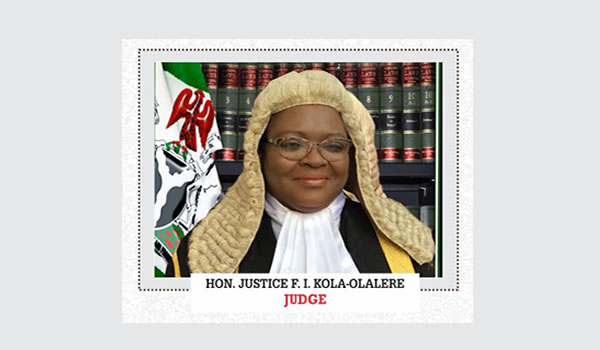
Ibadan—His Lordship, Hon. Justice F. I. Kola-Olalere of the National Industrial Court of Nigeria, sitting in Ibadan has declared the dismissal of Mr. Ganiyu Salami employment by Aiyepe Microfinance Bank Ltd. as wrongful, ordered defendant to pay 3 months’ salary in lieu within 30 days and dismissed other claims for lacking merit.


The court held that Aiyepe Terms and Conditions of Service tendered by the Mr. Ganiyu has no citation, unsigned and undated that has no evidential value in law.


From facts, the Claimant – Mr. Ganiyu instituted the action against defendant – Aiyepe Microfinance Bank, prayed for a declaration that the suspension and summary dismissal of the claimant from the employment of the defendant is unfair, unlawful and illegal.

Likewise, An order directing the defendant to reinstate the claimant into the employment of the defendant and place him on the level which he would have been, had the defendant not unlawfully and unjustly summarily dismissed him, and the sum of Ten Million Naira being compensation/damages for the unlawful and unjust summary dismissal among others.

The case of the claimant is that he was a former employee of the defendant for over 20 years before his alleged unlawful summary dismissal. He pleaded further that the defendant unlawfully and wrongfully terminated his employment by a letter on January 27, 2016 and was not given any query or asked to appear before any disciplinary committee, neither was he given a warning or suspension by the defendant prior to his dismissal as required by the terms and conditions of his contract.

The Defendant pleaded that, the Claimant was not too truthful that there was an avenue open to the Claimant but he failed to take the opportunity by giving satisfactory explanation; however, he could not give any convincing explanation. And so, the claimant was suspended upon the allegations against him and that it was his suspension that led to his termination.

In his final written address, Defendant’s counsel contended that the alleged terms and conditions of service that the claimant front-loaded was yet to be in force, has no citation, no commencement date, no formal copy and was only presented in draft form urged the Court to hold that the suit has no cause of action, lacking in merit and competence.

Counsel concluded that, facts admitted need no further proof and urged the court to dismiss the claim of the claimant for lacking in merit, being frivolous and gold digging.

Delivering the Judgment, the presiding Judge, Hon. Justice Kola-Olalere expressed thus “It is trite that an unsigned and undated document is a worthless piece of paper that has no evidential value in law.

“With all my findings on Document C.3, which the claimant presented to this Court as the terms and conditions of his employment with the defendant; I hold that Document C.3 is a worthless piece of paper, without any legal value and that this Court cannot ascribe any weight to it at all. Therefore, this Court cannot rely on it in determining the merit of this case; and so, Document C.3 is accordingly discountenanced in this judgment.

“By paragraph 4 of Document C4, the letter of termination of the claimant’s employment at page 16 of the record, the termination of the claimant’s employment was with immediate effect. In the circumstance, the defendant has not complied with the term of the contract stated in paragraph 6 of the Letter of Appointment since the Bank did not give the claimant three months’ notice neither did it pay him three months’ salary in lieu of the notice prior to the said termination. On this score, I find and hold that the termination of claimant’s employment is wrongful.”

On the whole, the court ordered defendant to pay the claimant three months’ salary in lieu of notice for the termination of his employment with immediate effect within 30 days and dismissed other claims.

Davido, Kiddominant collaborate with Chris Brown on new album

0

Nigerian music heavyweights David ‘Davido’ Adeleke and Ayoola Agboola aka Kiddominant have been featured on American artist, Chris Brown’s new album.

News Agency of Nigeria reports that the solid 32-song album, titled ‘Indigo Extended’, was released midnight on Friday as a follow up to the original ‘Indigo’ album.

Brown is an award-winning singer and actor who has sold more than 100 million records worldwide, making him one of the world’s best-selling music artists.

Throughout his career, Brown has won several awards, including a Grammy Award, 15 BET Awards, four Billboard Music Awards, and six Soul Train Music Awards.

The latest collaboration with Davido titled ‘Lower Body’ comes a few months after their first collaboration. In July, the music duo released ‘Blow My Mind’ which has garnered over 13 million streams on Spotify.

NAN reports that producer and writer, Kiddominant wrote ‘Under the Influence’, a song on the album. The excited maestro took to Instagram to share the news via his page @kiddominant.

He wrote, “Track 3 written and produced by me. Track 1 produced by me. Thank you, Chris Brown, for trusting me with the sauce. Thank you Davido for gingering all.”

Kiddominant is best known for producing Orezi’s hit single ‘Rihanna’ in 2013.

He also produced Davido’s international hit single ‘Fall’ which peaked on USR&B/Hip-Hop Airplay chart at number 13 and US Hot R&B Songs chart at number 25 on Billboard.

NAN also reports that other artists featured on the album include Tory Lanez, Rich the Kid, Sage the Gemini and Dani Leigh.


BREAKING: Court grants Sowore N100m bail, requests N50m security deposit

0

The Federal High Court in Abuja, on Friday, granted bail to the convener of #RevolutionNow protest, Mr. Omoyele Sowore.

Justice Ijeoma Ojukwu also barred them from addressing any rally pending the conclusion of their trial on charges of treasonable felony among others.

She also barred Sowore from traveling out of Abuja and the second defendant out of Osogbo, during the trial.

She granted bail to Sowore in the sum of N100m with two sureties in like sum.

The sureties who must be resident in Abuja must also have landed assets worth the bail sum in Abuja, and they are to deposit the original title documents of the assets with the court.

The judge also ordered him to deposit the sum of N50m in the account of the court as security.
She granted bail to the second defendant in the sum of N50m with one surety.

The defendants’ lawyer, Mr. Femi Falana (SAN), has described the bail conditions as stringent.

The judge ordered that the defendants be remanded in the custody of the Department of State Service pending when the would meet the bail conditions.

More details later…


Command queries Lagos DPO over escaped rapist brothers

0

The Lagos State Police Command has queried the Noforija Divisional Police Officer after two brothers accused of raping a teenager in the Igbooye community, Epe area of the state, escaped from custody.

The Police Public Relations Officer, Bala Elkana, said it was discovered that the DPO lied that the suspects were in custody, adding that he had been queried.

Our correspondent had reported that two brothers, Alaba and Abiodun Musa, allegedly took turns to rape the victim, a 16-year-old girl.

They were alleged to have hypnotised and raped her.

Despite threats from the suspects, the teenager was said to have opened up to some residents as community youths mobilised, apprehended the brothers and handed them over to men of the Lagos State Neighbourhood Safety Corps.

The security men then handed the brothers over to the police.

When contacted then, the police spokesperson, Elkana, told PUNCH Metro that the Commissioner of Police had instructed that the suspects be transferred to the gender unit of the command headquarters, Ikeja.

However, in controversial circumstances, the suspects escaped.

When our correspondent contacted the DPO, he denied the claim, just as another policeman at the station insisted that the brothers were still in custody.

Elkana had issued another order on behalf of the CP that the suspects and the parties should be brought to the command headquarters.

On Wednesday, he told PUNCH Metro that the DPO had been queried.

“We have discovered that the suspects are not in custody. We have sanctioned the DPO and asked him to produce them. The division has been queried,” he said.

Meanwhile, our correspondent gathered that members of the community were being pressurised to give up on the case.


Osinbajo alleged cabals behind corruption allegations – Wale Oke

0

The founder and Presiding Bishop of the Sword of the Spirit Ministries, Ibadan, Bishop Wale Oke, has said Vice-President Yemi Osinbajo is not corrupt.

While receiving the Nigeria Association of Women Journalists, led by Jadesola Ajibola, at the Covenant Arena, his church in the Agodi area of Ibadan, Oke noted that when the news of the  N90bn illegal funding went viral, some christian elders visited Osinbajo.

He said, “The VP did not only deny involving himself in any sleaze, but used the opportunity to  inform us that some cabals were behind the allegations.”

The renowned cleric noted that Nigerians must learn to reward committed, loyal and patriotic citizens in a positive way and at the same time, expose people who were corrupt.

“The VP is always reaching out to Christian leaders on the need to support Buhari. Osinbajo is loyal to a fault.

“So, those plotting his downfall through orchestrated campaigns should fear God. This man is not corrupt. He has been a friend for many years,” he added.


Nigeria’s fresh appeal won’t stop assets’ seizure – P&ID

0

The Process and Industrial Development Limited has said Nigeria’s fresh appeal moves will not stop it from commencing the seizure of the country’s assets.

It said the Federal Government must  meet the deadlines for the payment of $200m security deposit and £250,000 cost awarded by a London court on September 26.

The Minister of Information and Culture, Lai Mohammed, had said on Wednesday that the Federal Government had directed its lawyers to seek the leave of the court to appeal against last week’s ruling of Justice Christopher Butcher of the Commercial Court in London imposing the payments as conditions for granting a stay of execution of a $9.6bn award in favour of P&ID.

The court’s ruling ordered Nigeria to pay $200m security fund into the court’s account within 60 days as the condition for granting the nation’s request to stay execution in the $9.6bn award in favour of the P&ID, and £250,000 cost to the P&ID.

But responding to The PUNCH’s request for its reaction to the fresh development, P&ID, through a London-based public relations firm, iNHouse Communications, which it engaged in the aftermath of the controversial $9.6bn judgment, said it was confident Nigeria’s fresh appeal would not succeed.

A statement attributed to a P&ID’s spokesperson in the iNHouse’s reply, read, “The English Court ordered Nigeria to pay US $200 million as security, plus GBP 250,000 to P&ID for its legal costs, as a condition for any stay of execution while Nigeria appeals the August judgment.

“The English Court rejected Nigeria’s application for permission to appeal the payment requirement. We are confident that Nigeria will fare no better with the Court of Appeal. If Nigeria refuses to pay, P&ID will be allowed to start seizing its assets.”

Nigeria’s Information minister had said on Wednesday that the Federal Government retained international legal firm of Curtis, Mallet-Prevost, Colt & Mosle LLP, for the case.

Mohammed argued that contrary to claims by the P&ID and “its cohorts”, the government delegation’s trip to London (for the September 26 proceedings) was a successful one.

Apart from the $200m, the minister had said the government would be able to seek refund of the £250,000 it was asked to pay to P&ID if the appeal succeeded.

Describing the delegation’s mission as a huge success, the minister had said the firm had every reason to be worried that the $9.6bn arbitration awarded to it had a good chance of being overturned.

He said, “The Federal Government has a good chance of being successful in its impending appeal, otherwise the Commercial Court would not have allowed the appeal.

“Please note that Nigeria will be able to demand a refund of the 250,000 GBP payment to P&ID where the government wins on the appeal. This fact is being hidden by those who have been spinning the London judgment in their own favour.

“On the $200m payment as a condition for the granting of the stay of execution, Nigeria has instructed its lawyers to seek the leave of the Court of Appeal to appeal against that payment.

Justice Butcher of the London Commercial Court had ruled on August 16, 2019 that P&ID had the right to seize $9.6bn in Nigeria’s assets.


Communication Services tax underway

0


Vice President Yemi Osinbajo is currently meeting behind closed doors with the former Senate Leader, Senator Ali Ndume.

The meeting started a few minutes past 1 pm at the vice president’s office.

The meeting may not be unconnected with the Senate’s decision to introduce an action to impose tax on communication services in the country.

The bill for an act to establish the Communication Service Tax was formally introduced on the floor of the Senate on Wednesday is being sponsored by Ndume.

The lawmaker from Borno State, had told newsmen after the first reading of the bill that the imposition of tax on communication service is a better way of distributing wealth in such a way that would not affect the ordinary people.

Ndume had explained that increasing VAT would have very deadly effect on the economy as it could affect the prices of goods and services and take them beyond the reach of ordinary people.

The Communication Service Tax Bill will be pegged at 9% of the charge for the use of communication services.

Ndume had informed reporters that he was going to meet with Osinbajo as head of the economic team to buy into the Communication Service Tax Bill.

The bill reads in part: “There shall be imposed, charged payable and collected a monthly Communication Service Tax to be levied on charges payable by a user of an electronic communication service other than private electronic communication services.”

The bill further stated that “the tax shall be levied on Electronic Communication Services supplied by Service Providers.”

“For the purpose of this clause, the supply of any form of recharges shall be considered as a charge for usage of Electronic Communication Service.”

Specifically, the bill provided that the “tax shall be levied on such Electronic Communication Services like voice calls, SMS, MMS, data usage both from Telecommunication Services Providers and Internet Service as well as pay-per-view TV stations.”

If the bill is passed, “The tax shall be paid together with the Electronic Communication Service charge payable to the service provider by the consumer of the service.

“The tax is due and payable on any supply of Electronic Communication Service within the time period specified under sub-clause (5) of whether or not the person making the supply is permitted or authorised to provide Electronic Communication Services.”