


By Stephen Adepoju
The Arinjinya Festival is one of the most important traditional festivals in Ikare-Akoko, a historic Yoruba town in southwestern Nigeria. It is a deeply cultural and spiritual celebration centered on purity, fertility, and communal blessings.
The festival, rooted in Yoruba spirituality and linked to a water deity believed to bless the land with fertility and prosperity, marks a symbolic transition from girlhood to womanhood.
It is celebrated with elaborate processions, masquerade displays, and communal gatherings that draw indigenes from far and near.
Central to the ritual are young unmarried virgins who are expected to present themselves as pure, untouched, and worthy of communal honour.
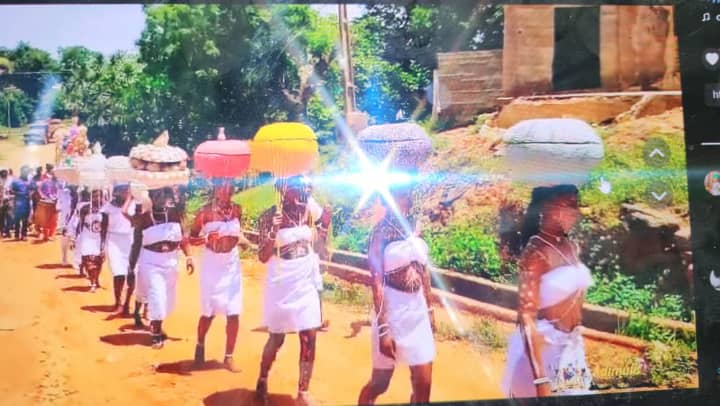
These young girls are paraded half naked through the town in coordinated procession—adorned with beads, their bodies covered in short white wrappers tied across the chest and waist leaving the rest of the body bare, while carrying earthen pots on their heads. Accounts by elders suggested that earlier in the practice, the attire was even more minimal, with less covering, exposing their bodies as symbols of natural purity.
This practice is not limited to Ikare-Akoko alone; it also extends to surrounding communities. The tradition within these communities makes it mandatory and compulsory for every girl transitioning into womanhood to undergo this ritual as a test of virginity and proof of chastity. It is considered a taboo for any girl or young woman to have lost her virginity before passing through the Arinjiya festival, as such an occurrence is believed to invite evil and the wrath of the gods upon the land.
As a result, the community imposes strict penalties on any family that either fails to present their daughters for the ritual or whose daughters do not pass it. The consequences include total banishment, ostracism and excommunication, where such families are stigmatized and excluded from participating in community activities or benefiting from communal opportunities. For such families, life within the community often becomes extremely difficult.
Consequently, it has become compulsory for all families who are natives of the community—both those residing at home and those in the diaspora—to return during the festival period to participate.
For families, this moment is everything.
A daughter’s participation and more importantly, her “success” is seen as a public certificate of good upbringing. It brings pride, respect, and social elevation. But failure carries consequences far heavier than disappointment. It brings shame
Link to FGM – A harmful practice
As a result of the dire consequences, family heads ensure that their daughters not only take part in the ritual but also pass the virginity test in order to bring honour and prestige to the family. In pursuit of this, some families resort to circumcising their female children at a very early age—a harmful practice known as female genital mutilation (FGM). According to this belief, circumcision is seen as a way to suppress sexual desire, thereby helping the girls preserve their virginity until adulthood.
A Growing Pattern of Displacement
However, as a result of growing civilization and religious convictions, some parents have begun to resist this practice. There have been increasing accounts of families leaving their ancestral homes to avoid forced participation in circumcision or ritual obligations tied to the festival. In some cases, they attempt to shield their daughters from the humiliation and trauma by relocating outside Nigeria. This is largely due to the widely held belief that any family that defies the tradition may face spiritual consequences as long as they remain within the country. Many of these families now live in forced exile or quiet displacement, torn between cultural identity and personal safety. For them, the cost of non-compliance is not only social—it is existential.
But resistance is not without consequence. In extreme cases, families who defy tradition reportedly face ostracism, banishment, or severe communal sanctions. Stories circulate quietly but persistently, of families forced to leave their ancestral homes, becoming displaced in search of safety and dignity. For these families, the cost of choice is exile.

Health Risks Concerns
Medical experts have consistently warned against the dangers of FGM. The procedure can lead to severe pain and trauma, excessive bleeding, infections and complications during childbirth as well as long-term psychological distress.
Beyond health, the practice raises critical legal and ethical questions. It directly conflicts with protections under the Child Rights Act Nigeria, which guarantees the dignity, safety, and bodily integrity of every child. At its core, it challenges a fundamental principle: Should culture ever come at the cost of a child’s rights?
Legal and Human Rights Concerns
Nigeria’s legal framework, particularly the provisions of the Child Rights Act Nigeria, guarantees the protection of children from harmful traditional practices and affirms their right to dignity, health, and bodily integrity.
Yet enforcement gaps at community level continue to leave many girls vulnerable to practices that conflict with these protections.
Human rights advocates argue that no cultural or religious justification should override the rights of the child.
Also, there are growing concerns around gender rights, child protection, and public health have placed the festival under renewed scrutiny. The central question is no longer whether the festival should exist—but how it can evolve without causing harm.
A Call for Action
There is an urgent need for government intervention to enforce laws against harmful traditional practices. There is also a need for community engagement to encourage safer, more inclusive cultural expressions. Public education must be mounted to challenge myths surrounding purity, honour, and worth. More importantly, support from international organizations to protect vulnerable girls should be encouraged as protecting cultural heritage should not mean sacrificing human dignity.


