Wednesday, April 22, 2026
Home Blog Page 937

Nigerian workers, government brace for nationwide strike

0

Who blinks first? This is the question on the lips of many observers as the Nigeria Labour Congress and the Nigerian government brace for a nationwide industrial strike on October 16. The face-off is over the unresolved consequential adjustments in salary arising from the new National Minimum Wage.

The Nigeria Labour Congress (NLC) in a letter to its state councils had said it was not ready to shift ground on its demand for the consequential adjustment in salaries.

The congress has since ordered its state councils to prepare their minds on industrial action starting from October 16, 2019.

But in what looked like a fierce response to Labour’s plan, the Chairman of the Nigeria Governors Forum, Dr Kayode Fayemi, said any attempt by labour to embark on strike would be an exercise in futility.

Ripples Nigeria had reported that the Federal Government negotiating team and the Joint National Public Service Negotiating Council (JNPSNC) will meet again on Tuesday after which the first phase of the negotiation collapse.

Labour is demanding 29 per cent salary increase for officers on salary grade level 07 to 14 and 24 per cent adjustment for officers on salary grade level 15 to 17. However, the government had presented a proposal of 11 per cent salary increase for officers on grade level 07 to 14 and 6.5 per cent adjustment for workers on grade level 15 to 17.

Labour had recently warned that would not guarantee industrial peace if the Federal Government failed to hold a meeting with it and accept its demand on the consequential salary adjustment before the close of work October 16.

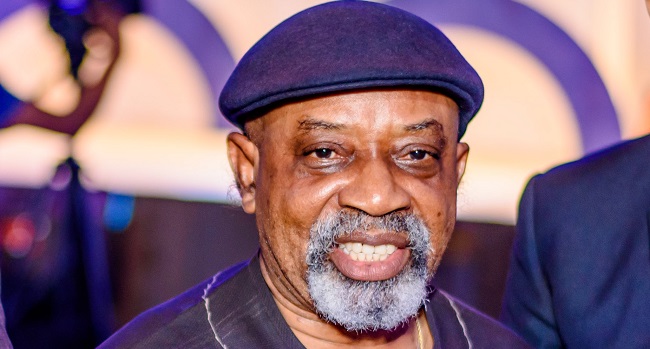
The warning prompted the Federal Government to call a meeting of all stakeholders last Wednesday with the Minister of Labour and Employment, Dr Chris Ngige, presiding. At the meeting, all the parties agreed to meet again on October 15 in Abuja.

However, speaking with newsmen in Lagos on Sunday, the Ekiti State governor, who is also the NGF’s Chairman, said the strike proposed by labour would be in futility.

Fayemi implored the workers to consider the country’s economy before embarking on the industrial action.

He said, “We don’t workers to down tools, but we made it clear during the tripartite negotiation that an increase in the National Minimum Wage is not tantamount to a general wage review.

“The fact that we moved people, who were below N30,000 to N30,000 and wherever they should be on the scale, should not automatically mean that we must increase the salaries of people on Level 17, who are on N400,000. It is a minimum wage law; it is not a general wage law.

“Yes, if you promote levels 05 or 06, they may go over what the current level 07 is earning. So, that calls for a consequential adjustment, but that adjustment should not go over levels 08 and 09. The Federal Government has even agreed to do nine per cent for levels 07 to 12 and five per cent for levels 13 and above, but they said no and insisted on 45 per cent.

“Where is Nigeria going to find the money? I mean the economy is in doldrums. Whether we openly admit or not, everyone knows. If you have an economy that earmarks N2.4tn for debt servicing; then what are we talking about? So, I hope good sense will prevail and that people will be able to convince labour that it is a futile effort if they do so because Nigeria cannot pay what it doesn’t have.”

Edo: APC confirms attack on Oshiomhole’s life, reveals masterminds

0

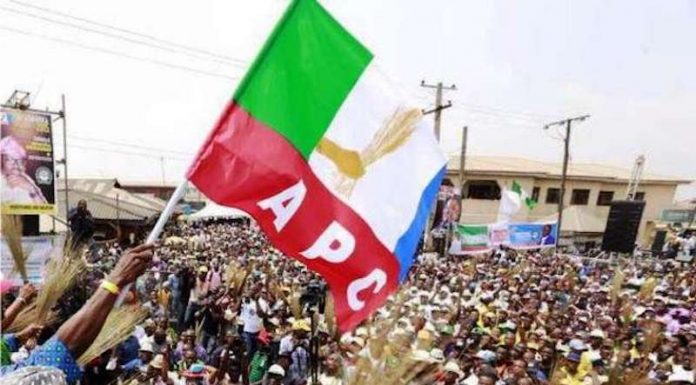
The All Progressives Congress (APC) on Sunday condemned the attack on the Benin residence of the party’s National Chairman, Adams Oshiomhole by political thugs.

It said those behind the incident were ‘desperate persons who have political ambition’.

Lanre Issa-Onilu, APC National Publicity Secretary, in a statement, however, commended Oshiomhole for “calling for calm after the apparent attempt on his life”.

APC called on the Inspector General of Police (IGP) Mohammad Adamu and other relevant security outfits to investigate the ugly incident and prosecute the sponsors and attackers.

“In Edo State, just as in any other state, everyone must be free to go about their normal and legitimate activities without harassment, intimidation, threat to life and property.

“It is clear that the sponsors of the attack are bent on causing crisis in the state in pursuit of their desperate and unpopular political interests. Human life is greater that anyone’s political ambition”, he added.

Why I left Nigeria for two months – Aisha Buhari

0

Aisha Buhari, the wife of Nigerian president has denied there was any rancour between her and President Muhammadu Buhari, which forced allegedly her to stay away from the country for an unusually extended period.

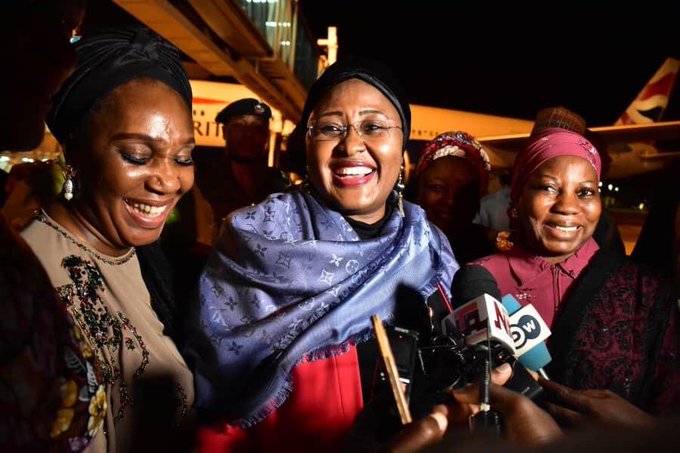
Mrs Buhari arrived at the Nnamdi Azikiwe International Airport, Abuja via a British Airways flight.

Mrs Buhari told the government-owned Nigerian Television Authority shortly after she returned to Abuja around 5 am on Sunday morning that she was in the United Kingdom to be with her children.

She said she also saw her doctors while she was there, adding that she has always travelled out for vacation for six weeks every year. This, she said, was nothing unusual.

”It has been a tradition for us. For like 20 to 27 years now, if our children are on holiday, we used to spend holiday with them,” Mrs Buhari said.

”I never abandon my children and last year, I went to Spain and spent two months with Zahra when she gave birth.

“So, the same this year’s holiday in U.K, I fell sick. So, I stayed back to see a doctor and the doctor advised me to stay back to attend to my health.

”From the U.K., I travelled to Saudi Arabia for Hajj and returned to England on doctor’s advice and they also advised that I should slow down my activities.’’

Mrs Buhari said she was able to focus on her health and “family” because President Muhammadu Buhari approved the appointment special assistants to her office to assist her achieve her mission of improving the lives and wellbeing of women and children in Nigeria.

Her silence while she was away generated a few rumours. It was insinuated that she irked the oft-mentioned powerful cabal in the presidency and was pushed to the background.

The rumours got to a head during the week when it was rumoured that Buhari was going to take another wife as a punishment for the First Lady.

Mrs Buhari chalked the rumours down to fake news, negative impacts of which she said her family has endured in the past.

“The genesis of this fake news started when my husband fell sick and perpetrators of this act were showing fake Ambulance, Hospital and dead body suggesting that my husband is dead,” she said.

“That time, I received so many calls from other first ladies and Presidents of other countries to confirm; so I called the attention of NCC, NBC and the National Orientation Agency.

”Fake news will lead this country to something else if actions are not taken with immediate effect.”


Nigeria: Jonathan, Buhari Spent N1.164 Trillion On Power in 8 Years

0

The Nigerian government, between 1999 and 2010, reportedly spent over N4.7 trillion on power, but the country remained in darkness. Eight years later, Jonathan and Buhari administrations invested another N1.164 trillion into the sinkhole through capital releases, but homes and factories in Nigeria are yet to be provided with constant electricity supply.

Beatrice Ogbor, a six-year-old girl, and her two-year-old sibling, were born into darkness and have never shared in the joy of the popular exclamation “Up NEPA” that follows power restoration in Nigeria.

“We gave birth to her here in 2014,” her father, John Ogbor (45) says. “You will be surprised that she and her sibling have never seen electricity since birth.”

Ogbor is originally from Igede in Obi Local Government of Benue State. For the past 14 years, he has been living in Moro, a community along Shagamu – Ikorodu Expressway in Ogun State, after he left his original birthplace. But for almost seven years, his adopted community has been without electricity.

“We tried the little we can. As individual landlords, we contributed N40, 000 to try to make this electricity thing a reality. They said we should pay the money to process this and that to give us transformer, and we paid to Itesiwaju Area Community Council but at the end, nothing positive came out of it,” he said.

For Ogbor, it has become almost hopeless waiting to access electricity in Moro, a community situated near the Nigerian Pipelines and Storage Company, a subsidiary of the Nigerian National Petroleum Corporation (NNPC) in, Mosimi. Aside its energy need, the community lacks access to healthcare, potable water, road, and schools.

“God can still send help though, we believe,” says John. He paused for a moment, took a deep breath while gazing at his two young children. “During campaign periods, we told them we don’t need rice, we don’t need money but electricity. That has been our only request.”

Similarly, Alasia, Iraye, Oremuti, Oponua, Likorodu, Imede and five other communities in Ogun State visited by The ICIR, shared the same fate or worse. For eight years, the Oremuti community struggled to access power. Oponua has never been connected to the national grid. These conditions are not peculiar to Ogun State, but also other states across the country.

In Iraye community, Sagamu Local Government Area, the first set of electricity poles, according to Rasheed Alimi, the community head, was erected in 1994. To date, residents still live in darkness. A huge concrete platform constructed for the electrification project still lies adjacent to the residence of Alimi. It has neither transformer nor electricity cables except for about three electricity concrete poles sighted in the area.

Nearby is a multimillion Naira 10-bed health care facility built by the NNPC, but it is off-the-grid. Neglected and taken over by bush, eight months after commissioning. The oil firm had installed a giant generator to service the clinic whenever it becomes operational but when this reporter visited, he observed that weeds also have covered the generator.

Findings, however, revealed that the Ogun State Assembly under the administration of Sen. Ibikunle Amosun, approved in the 2013 budget, the electrification of 32 communities, including Iraye. A closer look shows that the state Ministry of Rural Development and Rural Electrification in Annexure-II (B) listed the proposed benefitting communities but no such project exists today in Iraye.

Over N1 trillion invested in power in eight years

Nigeria generates its power via four main sources – hydro, gas, coal and natural gas. But for almost 20 years, huge unverified amount of money has been expended on the sector. Specifically, The ICIR, can authoritatively report that N1.164 trillion has been released to the power sector as capital budgets from 2011 to 2018, yet the power sector has not measured up – darkness still prevails. This figure was obtained from the Office of the Accountant General of the Federation.

Electrical power often generated is literally not commensurate with the huge investments. And returns on investments have largely been discouraging as the Federal Government continues to pump in more resources in terms of budgetary allocations, loans among other interventions to ensure the nation meets its energy need.

The Energy Business report (April 2016 vol. 15 no 160), shows that N6.52 trillion has been spent on Nigeria’s power sector in 16 years with no significant improvement.

For example, ex-President Olusegun Obasanjo, the report says, allegedly spent N3.52 trillion ($16 billion) during his tenure, though this figure has been contested. Also, late President Umar Yar’adua was said to have spent N1.183 trillion, while the former President Goodluck Jonathan during his administration reportedly expended N1.817 trillion and President Muhammadu Buhari reportedly spent N1.5 trillion in two years, as at September.

Meanwhile, findings by The ICIR revealed that between 2011 and 2018, the Office of the Accountant General of the Federation released capital sum of N1, 164,278,006,846 for power projects in the country.

This sum, however, excludes capital releases to six agencies between 2016 and 2018 namely, Office of the Surveyor-General of the Federation, Federal School of Survey, Oyo, Federal Road Maintenance Agency (FERMA), Council for the Regulation of Engineering in Nigeria (COREN), Surveyor Council of Nigeria and Regional Centre for Training in Aerospace Survey, when the Buhari-led administration merged the power ministry with works and housing.

Epileptic power crippling rural economies, small businesses

The importance of stable power as driver of any country’s economy cannot be overemphasised as it is capable of transiting Nigeria from an under-developed to the much desired developed status, especially when industries, Small and Medium Business Enterprises (SMEs) are supported. But as at today, 90 million Nigerians still lack access to power, a situation that has crippled SMEs and industries.

Mrs. Apansile Ade, for instance, is an entrepreneur who operates water and paint factories. She had run the business for over five years but at a loss. She is currently operating only the water factory because the paint business has gone under.

“We just stopped producing because the generator developed a fault,” she told The ICIR. “Last week I spent almost N75, 000 repairing generator. I had to stop my son from resuming school on Monday because the little money I would have given to buy books and beverages was no longer there”.

Unfortunately, the community she resides since 2010 has never been connected to the grid. As a result, she bought six generators to power her house and the water factory. The last power generating set just collapsed when The ICIR visited.

Government hoards information

In order to ascertain the exact amount invested in the power sector, the FOI request was sent to the Federal Ministry of Power. The ministry acknowledged receipt of the request and promised to respond. Weeks after, the ministry is yet to send a reply.

Efforts through FOI requests from The ICIR to access a copy of the power sector shared agreement, which the federal government signed with the unbundled companies, failed. The power ministry acknowledged the same letter but referred to the National Electricity Regulatory Agency (NERC) and the Bureau of Public Enterprise (BPE). But, till date, the document has not been provided. BPE claimed one of the power agreements is being investigated by the EFCC. However, the EFCC has remained numb on the claim after several attempts to verify.

During the investigation, The ICIR visited the Omoku Generation Company Limited 264.7MW and 225MW power project awarded to Rockson Engineering Company Limited, which is located in Omoku community, Ogba/Egbema/Ndoni Local Government Area of River State.


The military and private security officials guard the uncompleted facility, which was awarded 14 years ago. In November 2017, the NDPHC promised Omoku and three other plants – 750MW Alaoji, 338MW Egbema and 225MW in Bayelsa would be completed before the third quarter of 2018, but that’s not entirely the case.

The ICIR’s visit to the Omoku project site which also accommodates a state-owned power project revealed that the facility has since 2018 been taken over by the Assets Management Company of Nigeria (AMCON).

Experts proffer solutions

In the face of these challenges, various experts have argued the need for the government to embrace renewable energy. Some also called for the rehabilitation of obsolete power equipment. “To address the problems, stakeholders including the Federal Government must try and invest in key infrastructure such as gas pipelines, equipment used in the distribution, generation and transmission of electricity, and other facilities,” says Marcel Hochet, President, Green Elect in an interview with The Nation newspaper.

The ICIR visited NDPHC headquarters to verify why some of the NIPP projects were not fully operational and others uncompleted, but Yakubu Lawal, the firm’s General Manager Communication and Public Relations, was absent. When the reporter called his phone number, it rang, but was later put on voice mail. Text messages sent to him also were not responded to.

This report is part of a collaborative investigative series by Daily Trust, the International Centre for Investigative Reporting (ICIR), Premium Times and TheCable, facilitated by the Wole Soyinka Centre for Investigative Journalism (WSCIJ) under its Regulators Monitoring Programme (REMOP) for the Electricity Sector, with support from the John D. and Catherine T. MacArthur Foundation

The Illusion And Reality Of FG’s 2020 Budget

0

The 2020 appropriation and finance bills of the Federal Government (FG) were presented to the National Assembly by President Muhammadu Buhari last week, CHIMA NWOKOJI in this report dissects the policy document through lens of economic and finance experts.


Nigerians are happy with the quick submission of the bill to the legislators because it should give ample time for deliberations and hasten final approval, especially as the current leadership of the National Assembly is supportive.

Also, many people are slightly comforted by the finance bill which proposes the increase in Value Added Tax (VAT) rate from 5.0per cent to 7.5 per cent as well as business friendly tax reforms. Although, the president called it job creation budget, most analysts see it as budget of taxation because the bulk of the budgeted revenue is expected to come from the VAT.

However, most economic and finance experts have criticised the estimates based on a lot of unrealistic assumptions.

The budget is underpinned by four pillars including fiscal consolidation, infrastructure & human capital development, incentivising the private sector and enhancing social investment programmes. These goals seem laudable at first glance, but experts are worried by the small sizes of budget allocations which they said suggest a shaky foundation that could affect progress. Their conclusion is that the budget needs re-visiting but not padding.”

To put this in context, the Chief Economist at a global investment consultancy and advisory services firm, PriceWaterHouseCoopers (PWC), Dr. Andrew S. Nevin while discussing the Budget presentation on Channels TV said that Nigeria which was growing at an average of 6 per cent in the 1990s and early 2000, needs to grow at 6-8 per cent, and that this requires private & public sector investment of N40 trillion a year. The 2020 budget estimates is N10.33 trillion.

In this context, the economist says, “We continue to get poorer and poorer as our growth is lower than population growth; with population growth of 2.7 per cent per annum, even if we grow GDP at 2.5 per cent at 2019, we are getting poorer and poorer. And even if we grew at 3.5 per cent per year, it would take about 100 years to double GDP per capita.”

The International Monetary Fund (IMF) did not differ from this idea when recently, it warned that Nigeria could face up to eight years of getting poorer and poorer – 2015-2022 – unless something different is done.


Test of countercyclical Economic theory

There is a school of economic thought founded by the United Kingdom economist John Maynard Keynes (1883-1946) and developed by his followers. Keynesian economics prescribes countercyclical spending as an orthodox stimulant for slowing economies as Nigeria’s. A ‘countercyclical’ fiscal policy is the idea that government should reduce spending and increase taxes during a boom period (Nigeria is not in boom period); increase spending and cut taxes during a recession or a period of high inflation and slow GDP growth (inflation is still in double digits and GDP growth is very slow).

The 2020 budget is theoretically in deficit but could be a balanced budget, if the Excess Crude Account (ECA) accruals are backed out. The budget deficit is projected at N2.2 trillion.

Keynesian economists would recommend that Nigeria should embark on deficit spending (allocate more money) on labour-intensive infrastructure projects in order to stimulate employment and stabilise wages in this period of economic downturn.

Managing Director, Financial Derivatives Company Limited Mr. Bismarck Rewane observed in the company’s monthly economic bulletin that in the last 3years, Federal Government of Nigeria (FGN) budgetary expenditure has been growing at an average of 12.7 per cent compared to the average inflation rate of 13.57 per cent.

“This means that after adjusting for inflation, Nigerian budgets have actually declined. If you go further to adjust for exchange rate depreciation, the decline gets more troubling. In effect, the budget expenditure in 2020 is approximately 5.78 per cent lower than the actual budget in 2016,” he said, agreeing with Dr. Nevin that Nigeria is not spending enough during this economic downturn.

It means that the N2.5 trillion or 24.3 per cent allocations to capital spending cannot provide the boost needed in infrastructure.

This explains why for example, pursuant to a motion moved by Babajimi Benson (APC, Lagos), the House of Representatives  called for more funding for the education sector in the 2020 budget, a prayer the House adopted.

The House also urged the federal government to increase the annual budgetary allocation to the health sector from 5 per cent to 15 per cent as had been pledged by successive governments in order to curb unnecessary deaths caused by the failing health system.

The call followed a motion entitled: Deplorable State of Government Owned Healthcare Facilities in Nigeria, sponsored by Mr. Ntufam Mbora (PDP, Cross River) during plenary on Wednesday.

Mr. Mbora noted that the health sector is in shambles as hospitals have been reduced to mere consulting clinics without drugs, water and health equipment does not function optimally. According to him, the decay in the nation’s health sector calls for a re-evaluation of the annual budgetary allocation to the sector, which is barely sufficient for adequate provision of medical facilities and maintenance. This call can be replicated in other sectors.


Doubtful Revenue Expectations

A herd of experts have also raised their eyebrows over some of the expectations about revenue.

They are worried that 2020 budget ignores lessons from the recent difficulties the FG encountered as regards budget performance.

For context, the Chief Executive Officer, Afrinvest (West) Africa Limited Mr. Ike Chioke said FG’s revenue projections underperformed actual collection by 47.8 per cent in 2017 and was little changed at 44.7 per cent in 2018 and 41.6 per cent as at first half (H1) :2019.

Available records show that the FG projected revenues of N8.2 trillion in 2020, is 17.1 per cent higher than N7.0 tillion in 2019 and more than twice the actual collection of N4.0 trillion in 2018.

Oil revenue projection was lowered 29.7 per cent to N2.6 trillion (vs. 2019: N3.7 trillion), reflecting prudent adjustments in the wake of lower for longer oil prices and weak oil production due to the slow pace of oil and gas reforms.

Specifically, crude oil price and production assumptions were revised downward to $57.0/bbl. and 2.18mbpd (vs. 2019: $60.0/bbl. and 2.3mbpd) respectively.

According to Chioke and his team of experts at Afrinvest, Oil revenue would be higher if the exchange rate assumption of N305.00/$1.00 is adjusted to the market rate of $365.00/$1.00.

On the other hand, non-oil revenue projections (customs & excise duties, VAT and CIT) increased by 28.6 per cent to N1.8 trillion (vs. 2019: N1.4 trillion) showing a marked 94.7 per cent surge in independent and other revenues budgeted at N3.7 trillion (vs. 2019: N1.9 trillion).

“Although the recent trend in core non-oil revenue has been positive, the projected increase is steep and unlikely to be achieved. The projections for non-core, non-oil revenues such as independent revenue, asset sales, recovery and fines, which have historically underperformed, are ambitious,” the according to the team from Afrinvest.

In its weekly review, the firm observed that looking at 2017, 2018 and H1:2019 budget performance, total collection from the non-core, non-oil revenue lines was zero “if we exclude independent revenue. We believe these unrealistic assumptions set up the budget for poor implementation.”

On Tax, Chioke and his team said the expected improvement from VAT revenue would be poorer than initially anticipated given the much overdue VAT reforms now proposed.

The FG is planning to raise the VAT registration threshold to N25.0million in annual revenue while the exemption list has been expanded to cover more food items.

Although the FG has once again revealed its plans to collect more revenues, this is likely to take time given that growth remains weak.

“We reiterate that the removal of petrol subsidies is key to boosting government revenues in the immediate term,” Afrinvest insists.

Agreeing with the position of Chioke and his team of economic and finance experts, BudgIT says it is doubtful of the federal government’s (FG) ability to realise its projected total revenue of N8.15 trillion. BudgIT is a civic organisation that holds government to public accountability and applies technology to intersect citizen engagement with institutional improvement, to facilitate societal change. In the 2020 Budget, oil revenue is projected at N2.64 trillion, non-oil tax revenue at N1.81 trillion and other revenues at N3.7 trillion.

“This revenue performance is only 58 percent of the 2019 Budget’s target due to the underperformance of both oil and non-oil revenue sources. Specifically, oil revenues were below target by 49 percent as at June 2019. “This reflects the lower-than-projected oil production, deductions for cost under-recovery on supply of premium motor spirit (PMS), as well as higher expenditures on pipeline security/maintenance and Frontier exploration,” the president stated in his budget speech.

The organisation observed that since total revenue earned by the FG as at June 2019, was N2.04 trillion, the  total revenue projection for 2020 should have reasonably be put at N4.08 trillion because there is nothing extra ordinary that the government can possibly do to geometrically multiply revenue to the tune of N8.15 trillion. Not even the VAT increments. Other analysts are equally concerned that fiscal revenues are likely to be impeded by declining oil prices. Revenue shortfalls have plagued the efficiency of Nigerian budgets as an efficient tool of economic management.

With increasing volatility in the oil markets, oil prices are projected to decline further. Three top oil traders Vitol, Trafigura and Grunvor are projecting a further decline in oil prices below the $57per barrel. Therefore, there is general opinion that Nigeria could fall short of the projected revenue of N8.16 trillion. This creates a quandary as the government seeks to stimulate the economy while hoping to maintain a low debt service payout ratio.


Dissecting planned Expenditure

The planned spending of the FG at N10.3 trillion for 2020 represents a 13.2 per cent increase from the previous year’s N9.1 tillion (without adjusting for inflation).

The team from Afrinvest, a Lagos-based research and investment consultancy firm sees the N10 trillion as too high when considering FG’s recent revenue woes (reliance on borrowing) which is likely to persist.

But in the broader context, and in line with Nevin’s argument of increased spending, the proposed expenditure is neither large enough nor supportive of the country’s growth aspirations at 6.7 per cent of GDP.

Nigeria’s gross expenditure to GDP which is estimated at 12.2 per cent compares poorly with peer economies such as South Africa (33.6 per cent), Egypt (29.9 per cent), Kenya (25.4 per cent) and Ghana (23.6 per cent).

Similarly, instead of capital and labour intensive projects, the non-debt recurrent expenditure according to experts is high at N3.6 trillion or 35.0 per cent of the budget, considering FG’s fiscal consolidation plans. The rise in fiscal spending in Nigeria should be channeled to productive investment projects instead of recurrent expenditure, if the government hopes to realise its aim of a 2.93 per cent GDP, says a team of Economic analysts from Financial Derivatives Company.

The budgetary allocation for capital expenditure (CAPEX) in the 2020 budget is 31.76 per cent lower than the N3.18 trillion CAPEX allocations in the previous budget.

Meanwhile recurrent expenditure recorded a 10.25 per cent boost to N4.84 trillion from N4.39 trillion. About 21 per cent of the budget (N2.14 trillion) was allocated to capital projects, while 46.85 per cent was allotted for recurrent expenditure.

Some experts attribute the increase in recurrent expenditure, partly to the non-discretionary minimum wage increase.

Another worrisome aspect of Nigeria’s financial management is the size of debt servicing cost at N2.45 trillion or 23.8 per cent of the budget. Stakeholders say this would continue to be a drag to human capital and infrastructure spending.

Also, the N2.5trillion capital allocation falls short of the 30.0 per cent target stipulated in the Economic Recovery and Growth Plan (ERGP).

“We also expect debt service to revenues to be elevated at 53.3 per cent compared with the budgeted 29.9 per cent. In addition to borrowing to cover the shortfall in revenues, we expect increased financing of FG’s operations by the CBN,” the experts noted.

Corroborating the above observations, a development Economist Mr Odilim Enwegbara is not happy with the figures thrown up in the budget. According to him, the figures are not what Nigeria should have at this level of economic journey.

He asks, “How can you allow debt to accumulate to N30 trillion and you don’t have ways to reduce or settle it?”

Nigeria’s debt service to revenue ratio is about 80 per cent, and in some countries, when it is 30 per cent, they declare economic crisis. To those who argue that debt to GDP ratio is still low compared to other countries, he not only want them to compare Nigeria’s  revenue to GDP with such countries, but also to check whether such countries borrow to invest or borrow for consumption like Nigeria.

“Why should we be drowning and at the same time celebrating? I think there is something wrong with this country called Nigeria, “Enwegbara lamented.


Solution

To achieve the desired growth, the development economist suggested that government should carefully create an enabling environment for foreign direct investment. That way Enwegbara stated, Nigeria will become an investment destination for infrastructure to investors from all over the world.

He said this is the only way at this moment, to solve the infrastructure deficit which according to him, is so wide that it can’t be bridged by throwing N2 trillion into it every year.

Enwegbara gave example with road infrastructure. According to him, through Tax Credit, Public Private Partnership (PPP), or build-operate-and-transfer model for 30 years roads can be constructed. When every 100 kilometers on such roads are tolled, sufficient revenue will be generated.

 

APC Lauds EFCC for Recovering N111m from Treasury Looters

0

The Kwara State chapter of the All Progressives Congress (APC) at the weekend lauded the Economic and Financial Crimes Commission (EFCC) on its recent recovery and handing-over of N111million allegedly recovered from treasury looters in the state to the state Governor, Alhaji Abdulrahman Abdulrasaq.

The Zonal Head of the EFCC, Mr. Isyaku Shari, at a news conference in Ilorin last Friday said the Commission which started its work in February this year at the zonal office has achieved a lot in terms of recovery and conviction of corrupt individuals.

He added that the Commission also saved the state from financial recklessness in May this year at the eve of handing and taking over of government.

“We have 29 convictions and over N500million recovery of both in assets and cash, part of this is the N111, 428, 891.00 cash recovered for the Kwara State Government.

“This recovery is from suspected Kwara State treasury looters. The suspects alleged to have criminally misappropriated landed properties of Harmony holdings while others diverted funds meant for micro small and medium credit scheme. The suspects area cut across political office holders, traditional rulers and top civil servants,” he said.

However, the APC in the state, in a statement issued in Ilorin to commend the anti-graft agency on the breakthrough, which was signed by  its state Chairman, Hon. Bashir  Bolarinwa, observed that “the monies recovered so far is a far cry from the alleged  wanton financial abuse of some officials of the immediate-past administration.”

Bolarinwa, therefore, advised the EFCC to redouble its efforts in holding more officials accountable and recovering all ill0-gotten funds in their custody.

In the same vein, he lauded the state Governor, Abdukrazaq’s resolve to channel the recovered funds to his administrations social investment programme, adding that such move would return the wealth of Kwara State back to Kwarans

part 2 justice kanyip and development of labour jurisprudence

1

—continuation—

At a time when some predecessor would be nursing fear about who they are handling the mantle of leadership to, Justice Adejumo Rtd never envisaged any fear about his successor capacity and capability on the deep knowledge of law, integrity and prudence in the management of resources.

He made it clear for the president Buhari when he came for commissioning of the annexe headquarters edifice the same day valedictory court session was made in his honour, he said “I started everything with Justice Kanyip, I met him in this court, we both applied for no 1 job, to the glory of God, I was chosen. To my surprise, he was the first person to call me to say congratulation and he promised unalloyed loyalty which he never derailed for once. My president, I had no doubt that he will do well.”

In marketing, this singular statement coming from the predecessor would give successor soft landing in the mind of the presidency, literally, the aims of having acting is to know if the person would be able to deliver on the given mandate.

From the Judiciary, both the bar and the bench know that Justice Kanyip elevation to the presidency of the court would further strengthen the court and the labour jurisprudence in Nigeria.

If you are looking for someone who is gifted, try to meet with Justice kanyip, both in law and others, his a versatile Jurist of high repute and you can take this to the bank that, his tenure and administration would certainly be on knowledge-based.

It is without a doubt that the Industrial Court is marching on greatness, the plethora and the aura of new administration signify the betterment and progressiveness of labour jurisprudence in Nigeria.

“The court as a specialized court, if we don’t give them justice forget it, all the achievements will be zero, the day any of them rises up to say NIC is a useless court, that is the end, we will start hitting the dead head of the court. We are lucky, the court has been accepted, there are other courts you give, they will say NO! it is what NIC says then we will listen to you, they’ve accepted the court as a place where they can get justice and they are happy with the court.” Justice Kanyip stated this during a media chat on the commemoration of the retirement of Justice Adejumo, OFR

As an incorruptible Judge, many positive reactions trailed his appointment, some opined and described him as one of the stars of Judiciary who is a genius about anything labour. He knew of hand why the section of each act was documented and some described him as the best man for the job not only because of his hierarchy in the judicial system, but also his efficacy in justice and fairness, and the enormous achievements recorded in the course of his career.

Without any gainsaying, the National Industrial Court of Nigeria under his lordship has been positioned and trademarked for greatness and would continue to be a template for the effective administration of justice system with negative tolerance for corruption.

Professor Kanyip is the author of numerous journal articles in the areas of consumer law, tax law, labour law and commercial law. He is the author of the book, Consumer Protection in Nigeria: Law, Theory and Policy (2005) and a joint author of the text, Elements of Commercial Law (1994).


Furthermore, In a bid to reward competency and to globally reward his contribution to the body of Knowledge, The Nigerian Institute of Advanced Legal Studies bestowed on him, the prestigious fellowship.

Professor Kanyip in the past concluded a study for the design of a Draft Labour Policy and Strategic Plan of Action for the Economic Community of West African States (ECOWAS) and also carried out a review of all the labour laws in Nigeria at the behest of the International Labour Organisation (ILO); and was subsequently nominated by the Federal Government of Nigeria as one of its two nominees in the Technical Committee for the reform of all the labour laws in the country.

Professor Kanyip is member, Nigerian Bar Association; Fellow, Nigerian Institute of Advanced Legal studies; Fellow, Chartered Institute of Taxation of Nigeria; Life Member and Deputy President II, Nigerian Society of International Law. He is a contributing editor of several academic law journals.


#NewSheriff

Fatai Abiodun writes from Abuja.

An ICT Expert, Public Affairs Analyst,

Studied Journalism as International Institute of Journalism,

Member, NUJ

Justice kanyip and the road to the development of Labour Jurisprudence in Nigeria

0

Undoubtedly, labour and industrial related disputes are serious issues in any nation. Labour dispute has Staggering effects on both the social and economic sectors of a country resulting in low productivity, unemployment, wastage of human resources and many other problems.

To avert this, countries have advocated for expeditious resolution of labour dispute before it goes out of hand. Rising to the occasion, the Nigeria Government, in the year 2006, after several years of confusion and problems associated with the jurisdictions of the National Industrial Court of Nigeria came out with statutory regulation on the matter and the third alteration of the 1999 constitution cured all lacunas associated with the status of the court.

The administration of Justice Adejumo Rtd put the court into the limelight, as we know that development is a continuous process, this analysis aims to give a synopsis of the road to the development of Labour Jurisprudence in Nigeria under the new leadership.

The acting president of the National Industrial Court of Nigeria, His Lordship, Hon. Justice Benedict Kanyip hails from Southern Kaduna, attended the prestigious Northern premier Ahmadu Bello University named after the first and only premier of the Northern Nigeria region, Sir Ahmadu Bello and obtained his Bachelor of Laws (LL.B) in 1985.

Ahmadu Bello University is a federal government research university in Zaria, Kaduna State, North West, Nigeria founded on 4th October 1962.

Justice Kanyip was a member of the Nigerian Bar class of 86’ and subsequently enrolled as a Solicitor and Advocate of the Supreme Court of Nigeria. Hon. Justice Benedict Kanyip started his career as a lecturer in 1987 in the department of commercial law at his alma Mata (ABU) and rose to the position of Lecturer II before leaving in 1992 for the National Commission for Colleges of Education as Legal Adviser in the rank of Principal Legal Officer.

In 1995, he was appointed Senior Research Fellow by the Nigerian Institute of Advanced Legal Studies and rose through this appointment to the rank of Associate Research Professor of Law in 2000.

Justice Kanyip was appointed a Judge of the National Industrial Court in 2000 for an initial period of four years although with eligibility for a renewal of a further term of four years and fortunately, In June 2004, having completed the first term, his re-appointment for another term of four years was renewed and with the passing of the National Industrial Court Act, 2006, he became a tenured Judge of the Court and by hierarchy the 2ic.

As second in command to the then retired president of the court Justice Babatunde Adejumo, he worked closely and his contributions to issues bordering on the strengthening of labour jurisprudence and judiciary were always interesting, original, and illuminating.

As a team worker and distinguish jurist, he works along with other colleagues relentlessly and contributed a lot to the achievement of the third alteration act of the 1999 constitution as amended that gives the court constitutional power as a superior court of records.

Justice Kanyip earns the trust of his former boss, Justice adejumo by showcasing total support and allegiance to the past administration and his idea as an erudite jurist makes it comfortable for his boss to have trust in his loyalty.

When asked about if he would like to work with his former boss again, he replied in affirmative that “if I can work with someone for 16years and no quarrel, I will work with him again” this act of loyalty marks him out as a quintessential unifying figure.

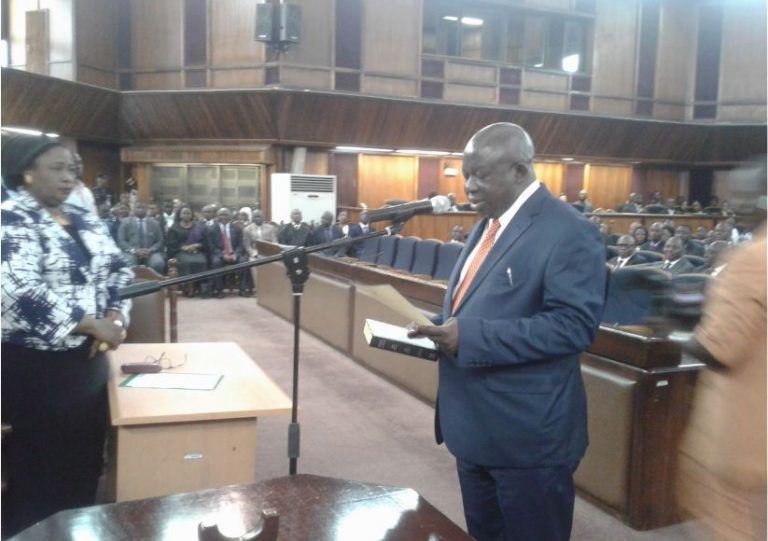
Quintessentially, It was indeed, new breadth of fresh air as he was sworn in as acting president of the National Industrial Court of Nigeria by the Chief Justice of Nigeria, Justice Tanko Muhammed on 2nd October 2019 following the retirement of Hon. Justice Babatunde Adejumo, OFR and upon his appointment by the Commander-in-Chief, Federal Republic of Nigeria, President Muhammad Buhari.

Success doesn’t just find someone, we have to go out and get it by Dream bigger and Do bigger as thinking and feelings do not produce action.

Without wasting time, on a path to reposition the court for greatness in tandem with equitable, fair and impactful justices system, My Lord, Hon. Justice Benedict Kanyip swung into action, rejigs his passion, rolled up his sleeves and had several meetings with the management and staff of the court, and in the clearest term spread his plans for the court, labour jurisprudence, judiciary and to march-on on the achievements of his predecessor.

They say show me your friend and I would tell you your CGPA same goes that, show me your assistant and I will tell you how far you can go in achieving your mandate. It is not a mistake to say Justice Kanyip was the brain-box of the last administration; he contributed meaningfully and always ready to show support where necessary.

The Man who has confidence in himself gains the confidence of others and the only limit to our realization of tomorrow will be our doubts of today, Justice kanyip gave a marching order to the management and staff, what he won’t accept and what is expected from their ends. He also read a riot act that any form of mediocrity and laziness would not be accepted and everyone is expected to perform their tasks in a professional manner devoid of hatred and ineptitude as greater things never come from comfort zones.

He made it clear that National Industrial court under him will not deviate but rather improved on the achievements of the past, and to better reposition the court in line with best global practices.


Please click here for the continuation


Listen: Asa Releases Highly Anticipated Album “Lucid”

0

The queen of soul Asa has released her highly-anticipated 13=track album, Lucid.

This is coming five years after her last album, Bed of Stones.

Before now, fans were given tracks to relive her glorious moments with singles, “The Beginning” and “Good Thing“.

Now, they can enjoy all the special offerings of the award-winning singer with Lucid.

Check on it here


Tokarczuk, Handke win 2018, 2019 Nobel Prize for Literature

0

Polish author, Olga Tokarczuk, and Austria’s Peter Handke have been awarded the Nobel Prize for Literature for 2019 and 2018 as the prize was not awarded last year.

Olga Tokarczuk, who was 10/1 and Peter Handke, 20/1, upset bookmakers’ prediction that Anne Carson 4/1, Maryse Condé 5/1, Can Xue 8/1, Haruki Murakami 8/1 and Lyudmila Ulitskaya 8/1 would emerge winners.

Tokarczuk, who also won the Man Booker International Prize last year, was awarded the 2018 Nobel Prize, with this year’s Nobel going to Handke.

The announcement was postponed last year after a sexual abuse and financial misconduct scandal, which led to a series of resignations at the Swedish Academy, which runs the award.

Jean-Claude Arnault, whose wife Katarina Frostenson was a member of the Academy until she quit in January over breaches of secrecy, was convicted of rape in October 2018 and jailed for two years.

According to agency reports, this year’s prize had set sight on diversity after the year of scandal. Chair of the Nobel Committee in the Swedish Academy, Anders Olsson, was confident that the prize would make a comeback by avoiding the ‘male-oriented’ and ‘Eurocentric’ perspective that dominated it in the past.

He suggested the Academy would not be as Europe-and male-focused as it had been previously.

Given that the last two winners-Kazuo Ishiguro and Bob Dylan-both write in English and just 14 of the 114 literature laureates were women, Olsson acknowledged the need for the jury to ‘widen’ its ‘perspective’.

Okarczuk, 57, the 15th female winner, considered the leading Polish novelist of her generation, was rewarded “for a narrative imagination that with encyclopaedic passion represents the crossing of boundaries as a form of life.”

The Nobel committee was also “very impressed” with her epic historical novel, The Books of Jacob, set in the 18th Century, which “presents a rich panorama of a little-known chapter in European history.”

Handke, the 76-year-old Austrian playwright, novelist, and poet, was recognised for “an influential work that with linguistic ingenuity explored the periphery and the specificity of human experience,” the academy said in a statement.

Meanwhile, PEN America has decried Handke’s choice for the recognition.

In a statement by its President, Jennifer Egan, it said: “Today’s announcement of the 2019 Nobel Prize in Literature to Peter Handke must be an exception.

“We are dumbfounded by the selection of a writer who has used his voice to undercut historical truth and offer public succor to perpetrators of genocide, like former Serbian President Slobodan Milosevic and Bosnian Serb leader Radovan Karadzic.”