Sunday, May 10, 2026
Home Blog Page 164

MTN Nigeria’s quarterly FX loss swells to N656bn, biggest in six years

0

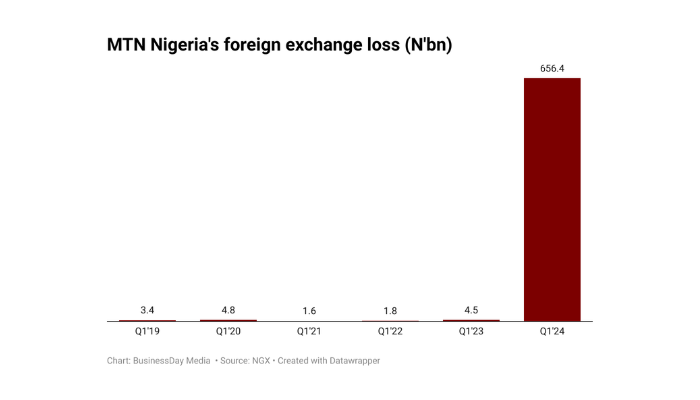
The foreign exchange loss of MTN Nigeria Communications Plc, the country’s biggest mobile network operator, rose to the highest in at least six years in the first three months of 2024, data compiled by BusinessDay shows.

According to the firm’s latest financial statements, its net FX loss widened to N656.4 billion in Q1 from N4.5 billion in the same period of last year as a result of the further devaluation of the naira.

“The operating environment in the first quarter remained very challenging, with rising inflation and continued naira depreciation off an already low base,” Karl Toriola, CEO of MTN Nigeria, said in a statement.

He said the naira depreciated to an all-time low of N1,627/$ at the Nigerian Autonomous Foreign Exchange Market in March, from N907/$ at the end of December 2023, before moderating to N1,309/$ by the end of the quarter.

“Additionally, the inflation rate maintained an upward trajectory, rising to 33.2 percent in March, with an average rate of 31.6 percent in the quarter. To curb inflation, the Central Bank of Nigeria increased the Monetary Policy Rate by four percentage points to 22.75 percent, which has driven up funding costs.”

Toriola noted that these factors have caused significant difficulties for businesses operating in Nigeria, including MTN Nigeria, putting additional pressure on consumers, the cost of doing business, and further foreign exchange losses.

Further analysis of the statement shows that the telco’s finance income dropped to N5.34 billion from N6.63 billion while finance cost surged to N98.7 billion from N45.8 billion.

Net cash generated from operating activities rose to N383.1 billion from N256.3 billion. Net cash flows used in investing activities stood at a negative N173.1 billion from a negative N76.01 billion.

Net cash flow generated from financing activities stood at a negative of N368.6 billion from a positive N36.1 billion. Cash and cash equivalents at the end of the period declined to N191.4 billion from N565.2 billion.

MTN Nigeria’s revenue increased to N752.9 billion in the first three months of 2024 from N568.1 billion in the same period of 2023.

“Our solid commercial operations enabled us to deliver service revenue growth of 32.0 percent which slightly exceeded the average inflation rate in the quarter,” Toriola said. “This growth was led by double-digit growth in voice, data, and digital services; as well as favorable base effects in Q1 2023 arising from the challenge in that period (including the redesign of the naira, which resulted in cash shortages).”

He said EBITDA, however, came under pressure, declining by 1.9 percent. “This was primarily because of a further depreciation of the naira in the quarter, exacerbated by higher general inflation and energy costs.”

Toriola said: “As a result, the EBITDA margin declined by 13.9 basis points to 39.4 percent. The EBITDA margin would have been 51.0 percent adjusted for the naira depreciation effects.

“We continue to pursue our efficiency measures and accelerate efforts to reduce forex exposure to minimise the impact on our business. The further depreciation of the naira in Q1 resulted in a materially higher net forex loss of N656.4 billion (Q1 2023 restated: N4.5 billion), arising from the revaluation of foreign currency denominated obligations.”

The after-tax loss amounted to N392.7 billion from an after-tax profit of N108.4 billion during the period reviewed.

Read also: GTCO reports N509.3bn Q1 pre-tax profit

Capital expenditure

MTN Nigeria’s capital expenditure increased by 49.1 percent to N179.7 billion, while core capex, excluding leases, rose by 84.4 percent to N78.1 billion, with a capex intensity of 10.4 percent.

“The increase in capex reflects the impact of the significant devaluation of the naira amidst forex supply challenges. As a result, free cash flow declined by 35.6 percent to N117.2 billion. In terms of our debt metrics, approximately 47 percent of our debts have fixed interest rates, while 53 percent are floating,” Toriola said.

“We have taken steps to significantly reduce our outstanding short-term trade loans for letters of credit establishment by 41.6 percent to $243.4 million (December 2023: $416.6 million).


“This enabled us to manage our debt mix, of which 56 percent is local currency denominated and 44 percent is foreign currency. Our net debt-to-EBITDA ratio of 1.1 times remains within all our financial covenant levels, supported by a cash balance of N191.3 billion.

“Notwithstanding the near-term pressure, the fundamentals of our business and our cash flow generation remain strong, and we continue to pursue our plans to restore our capital position, supported by our value-based capital allocation strategy,” he said.

MTN Nigeria’s outlook

The CEO said continued elevated inflation and unpredictable foreign exchange rates remain significant challenges for businesses.

“However, we remain focused on sustaining our commercial momentum, accelerating our service revenue growth, unlocking operational efficiencies, and strengthening our balance sheet to improve the profitability of our business,” Toriola stated. “We do, however, also require regulated tariff increases to restore the profitability of the Company.”

“As we navigate the prevailing headwinds to our business, we remain committed to delivering on our growth strategy through superior commercial execution and continued investment, guided by a value-based approach to capital allocation.


“We will drive the operating leverage in our business to restore earnings growth and sustain strong cash flow generation and returns over the medium to long term. We will continue to monitor developments in our operating environment as the year progresses.

“The current state of elevated inflation and unpredictable trends in foreign exchange rates continue to pose significant challenges for businesses,” Toriola said.

“The Federal Government is also implementing several reforms to attract and retain long-term domestic and foreign direct investment in the economy while managing the transitory inflationary effects on households and enterprises through social and economic interventions.”

FG May Need Supplementary Budget To Pay Minimum Wage – IMF

0

The Federal Government may need to raise a supplementary budget to accommodate the proposed minimum wage increase for workers.

This is because the negotiated amount may surpass the budgeted amount in the original 2024 budget.

The International Monetary Fund gave this recommendation in its latest staff country report for Nigeria.

“The authorities noted that a supplementary budget may be needed to accommodate the outcome of the ongoing wage structure negotiations which may exceed what they had included in the 2024 budget,” the report stated.

It also noted that the government might need to raise the domestic and external borrowing ceilings to prevent fresh borrowings from the apex bank’s Ways and Means.

The new minimum wage has been an ongoing matter between Organised Labour and the government since the beginning of this year to cushion the impacts of the harsh economy.

Recent reforms in Nigeria including the removal of fuel subsidy and the unification of the foreign exchange market have pushed the cost of living to newer levels.

While labour leaders demand N615,000 from N30,000 as salaries for lowest ranked workers, there are indications the tripartite committee may recommend N70,000 as the new minimum wage.

In the 2024 budget, the government allocated N6.48tn for personnel costs but the international lender posits that the amount may be insufficient.

The IMF further noted that the country’s budget deficit for 2024 is expected to surpass projections, owing to implicit subsidies for fuel and electricity, alongside rising interest expenses on debt.

The Minister of Finance, Wale Edun, had stated the government planned to reduce the budget deficit from 6.1 per cent in the 2023 budget to 3.8 per cent in the current appropriation.

The report read in part, “Staff projects a higher fiscal deficit than anticipated in the 2024 budget, but broadly unchanged from 2023. The drivers are lower oil/gas revenue projections, reflecting IMF oil price forecasts but incorporating recent production gains; higher implicit fuel and electricity subsidies; continued suspension of excise measures included in the MTEF; and higher interest costs.

Staff factors in an under-execution of capital expenditure in line with past outcomes and estimates an FGN deficit of 4.5 per cent of GDP relative to the 2024 budget target of 3.4 per cent of GDP. For the consolidated government, this implies a projected deficit of 4.7 per cent of GDP in 2024—compared to 4.8 per cent of GDP in 2023 measured from the financing side—which is appropriate given the large social needs and factoring in a realistic pace of revenue mobilisation.

“Over the medium-term, staff projects consolidation in the non-oil primary deficit. With rising interest costs, government debt stabilises towards the end of the projection period.”

Meanwhile, the report also urged the government to consider meeting its financing needs from the market and external borrowing.

It said, “Based on staff’s projections, the authorities must raise the domestic and external borrowing ceilings to prevent renewed recourse to CBN financing. With higher interest rates, banks and nonbanks should have sufficient appetite—as indicated by market sources—conditional on careful management of system liquidity, including a likely reduction in the currently high cash reserve requirement.

“Staff projects that the government’s 2024 net financing needs can be met from the market and external borrowing. Domestic market financing needs to increase by 1.5 per cent of GDP over 2023. In addition, the government wants to retire outstanding ways and means borrowing from the CBN of 2.5 per cent of GDP through the issuance of further domestic securities.

It added, “While staff agrees that ways and means financing should be brought to zero by end-2024 in line with the law, the authorities may need to consider other options to avoid crowding out private sector credit, including drawing down the government’s deposits at the CBN built up in 2023 or a second securitisation operation to tackle this legacy problem.

“While external financing is costlier than when Nigeria last accessed Eurobond markets, staff supports an opportunistic issuance, also given upcoming maturities in 2025. A Eurobond issuance and some official financing are factored into staff’s projections as an integral part of the 2024 financing mix.”

Naira Slumps, Exchanges At Over ₦‎1,500 Against Dollar

0

The naira continued its depreciation against the US dollar in the foreign exchange market.

Data from the parallel market section and FMDQ showed further depreciation against the dollar on Monday.

At the parallel market, a Bureau De Change operator in Wuse Zone 4, Mistila Dayyabu, told DAILY POST that the naira was sold as high as N1,517 per dollar on Monday before settling at N1,500 per dollar.

“On Monday morning, the dollar was sold at N1,517 per dollar. However, on hearing the information about the coming of the Economic and Financial Crimes Commission operatives, we started selling at N1,500 this evening, ” he said.

The figure increased from the N1, 450 per dollar it traded at the weekend.

Similarly, at the official market, FMDQ data showed that they dipped to N1478.11 per dollar on Monday from N1466.31 last Friday.

This represents an N11.8 drop from the N1466.31 recorded last Friday.

Earlier, the Central Bank of Nigeria Governor, Olayemi Cardoso, said the apex bank’s Monetary Policy Committee will do everything to bring down soaring Nigeria’s inflation, which stood at 33.22 per cent in March 2024.

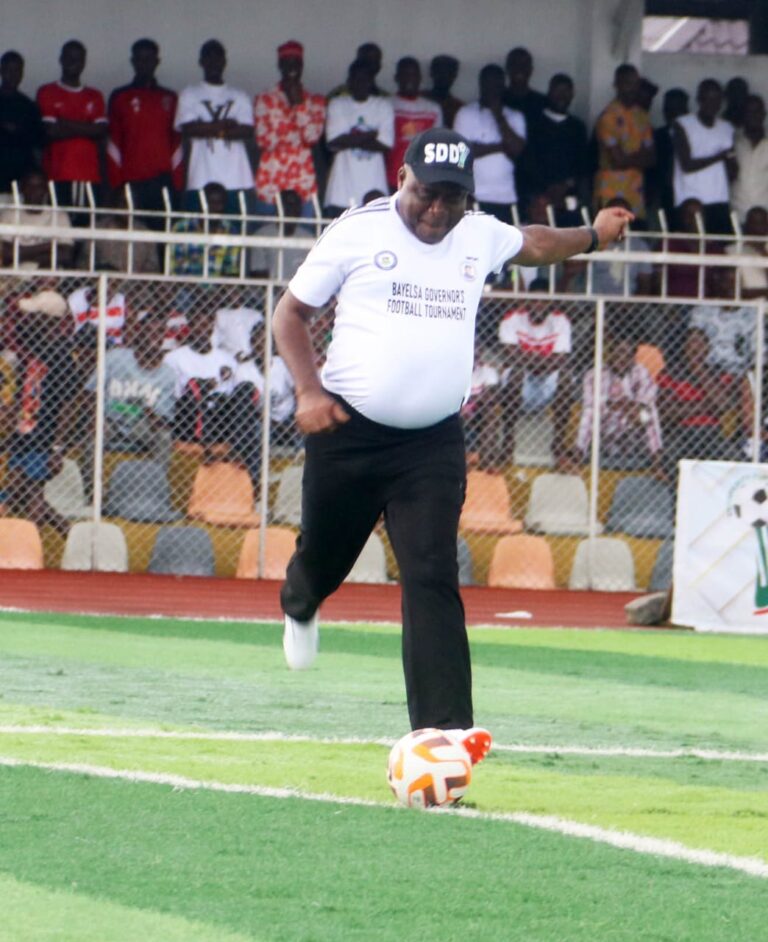
Governor Diri to Light-up Prosperity Cup Season 6 with Kick-off on Friday

0

…As 2023 Champions Krusaders Feeders FC Challenge the Fire Power of Police Machine FC

All is now set for the kick-off of Nigeria’s most prestigious and largest grassroots football spectacle, the Bayelsa State Governor’s Football Tournament christened the Prosperity Cup on Friday, 17th May, 2024.

This was contained in a statement signed by the Director-General of the tournament Mr. Ono Akpe on behalf of the Central Organizing Committee COC ahead of Friday’s kick-off date.

The statement notes that the Bayelsa State Governor Senator Douye Diri would be the Special Guest of Honour. According to him the Deputy Governor Senator Lawrence Ewhrudjakpo who is the Guest of Honour will lead other distinguished personalities to the ceremony, including the Speaker of the Bayelsa State of House Assembly Rt. Hon Abraham Ngobere and the Chief Judge Honourable Justice Matilda Abrakasa Ayemieye as Special Guests to be supported by the Chairman of the House Committee on Sports, Hon Tare Porri.

Others include, Secretary to the State Government, Prof Nimibofa Ayawei, members of the Bayelsa State House of Assembly, Head of Service Barr. Mrs. Biobelemoye Charles-Onyema, State Executive Council members, President of the Super Eagles Supporters Club, Chairman Bayelsa Football Association, Service Commanders, All Local Government Chairmen and their vice and political appointees.

Commissioner for Sports Development Hon (Dr) Daniel Baralatei Igali is the Host while the Royal Father of the day is the Chairman Bayelsa State Traditional Rulers Council, King Bubaraye Dakolo AGADA IV, Ibenanaowei of Ekpetiama Kingdom.

The statement maintained that the opening fixture to herald the tournament will see Defending Champions Krusaders Feeders FC of Peretrogbene battle Police Machine FC by 3pm at the Samson Siasia Stadium, Yenagoa.

Mr Akpe notes that heads of federal and state agencies, Sports Writers Association of Nigeria, (SWAN) Bayelsa referees, coaches, stakeholders and all participating teams and captains of Industry are expected to be in attendance.

The Central Organizing Committee equally invites all sponsors, Nigerian Content Development and Monitoring Board (NCDMB), Premium Trust Bank, Century Group, Aqualina Waters, Amadeus University and Grooming Centre.

Other supporters are , Linkage Assurance PLC, Ayalla Group, Phone Headquarters, Hamilton Garden, Red Tech Ltd and DSTV and is powered by Red Sapphire Nig Ltd.

The Bayelsa Governor’s Football Tournament, which hosted the NFF President Alhaji Ibrahim Gusau and top officials of the football body, at its finals last year, was recently endorsed by the Federal Ministry of Sports, Abuja and has become one of the most prominent events in grassroots soccer in the country today.


0

Hon. Justice Sanda Yelwa of the Lagos Judicial Division of the National Industrial Court has dismissed the application filed by United Bank for Africa challenging the jurisdiction of the Court to entertain the suit filed by one Ndidiamaka Umeh for lacking merit.

The Court held that labour jurisprudence is fast developing that the suit as it is constituted is not statute-barred by virtue of the time and circumstances of its filing and the court is competent to hear same.

From facts, the applicant- United Bank for Africa had sought an order of the court striking out the suit on the ground that the suit is statute-barred and Ndidiamaka lacks the Right of action to institute the suit.

Learned Counsel submitted that Ndidiamaka’s action was filed out of time against the stipulated period allowed by the Limitation Law of Lagos State and has consequently robbed the Honorable Court of the jurisdiction to entertain same.

In defence, the respondent- Ndidiamaka Umeh averred that the court has made a radical departure from this age-long law that the UBA relied upon when it held that contracts of service were no longer subject to Limitation Laws, and urged the court to dismiss the application in the interest of justice.

In a well-considered ruling, the presiding Judge, Justice Sanda Yelwa held that section 8 of the Lagos State Limitation Law just like section 2 of the Public Officers Protection Act shall not apply to defeat the case at hand.

The Court ruled that suits that are within the context of contract of employment/service are not subject to limitation laws in terms of instituting an action in court.

From my analysis above I have no hesitation to hold that this suit as it is constituted is not statute-barred by virtue of the time and circumstances of its filing. It is not statute barred and this court is competent to hear same. Accordingly, the preliminary objection lacks merit and same is hereby dismissed.” Justice Yelwa ruled.


Visit the Judgement Portal for full details www.nicnadr.gov.ng/judgement

Weak naira, rising inflation signal further rate hike

0

Nigeria’s Monetary Policy Committee (MPC) is likely to raise interest rates when it meets next week, following the renewed pressure on the naira and rising inflation.

The naira has gone from the world’s best performing currency in March to the worst in April as dollar inflows thin. The currency exchanges between a rate of N1,400 and N1,440 per US dollar at the official and unofficial FX markets, after reversing gains made in March that saw it hit a high of N1,000.

Inflation, meanwhile, accelerated to 33.2 percent in March 2024 compared to 31.7 percent in February 2024, according to the latest data from the National Bureau of Statistics (NBS).

Most of the analysts polled by BusinessDay expect another increase in the interest rate, also known as the Monetary Policy Rate (MPR), as the MPC meets on May 20 and 21, 2024.

“Another rate hike perhaps to help encourage a stronger naira, which is the best way to get inflation down,” Charlie Robertson, head of Macro Strategy FIM Partners UK Ltd, said.

Economists polled by BusinessDay all predict inflation to rise further in April, putting pressure on the CBN to respond with another rate hike. However with the inflation rate close to its peak, the CBN may adopt a wait-and-see approach before raising rates.

“We think headline CPI edged up to 33.7 percent year/year in April from 33.2 percent in March,” Razia Khan, managing director, Chief Economist, Africa and Middle East Global Research, said.

“In month/month terms, this likely reflected slower price gains, 2.3 percent m/m, from an average of 2.9 percent Year-To-Date,” Khan said.

CBN’s recent tightening measures, including adjustments to the Standing Deposit Facility rate, implemented at the end of March, have contributed to a stabilising effect on prices.

However, Khan warns that the full impact of these measures may not be fully realised for several months, but says the measures may provide enough comfort for the CBN to hold off another rate hike.

“While the full effect of the CBN’s tightening may not feed through for some months, we think headline inflation may now be close to its peak, suggesting little need for the CBN to raise its policy rate further,” Khan said.

Despite indications that headline inflation may be nearing its peak, Khan emphasises the lingering uncertainty in Nigeria’s inflation outlook.

Factors such as a recent fuel shortage, prompting speculation of potential fuel price adjustments, and fluctuations in the USD-NGN exchange rate due to profit-taking by foreign portfolio investors, add complexity to the economic landscape.

Market concerns are further amplified by the impending maturity of approximately USD 1.3 billion equivalent Nigerian Naira (NGN) futures on May 29th. Nevertheless, Khan suggests a glimmer of relief in the form of the state-owned oil company’s forward sale of oil, totaling USD 1.1 billion in May. Additionally, a new CBN circular indicates a potential shift in International Oil Companies’ selling mechanisms, which may alleviate pressure on the foreign exchange market.

With these dynamics at play, analysts are deliberating the necessity for further policy rate adjustments by the CBN. While Khan underscores the possibility of inflation nearing its zenith, the broader economic landscape remains fraught with uncertainties, warranting a cautious approach by monetary authorities.


For Chinazom Izuora, Senior Associate, Parthian Securities, “The month-on-month slowdown in inflation observed between February versus March inflation figures was a glimmer of hope that the monetary policy initiatives to curb inflation were heading in the right direction however the actions of other regulatory agencies, such as the electricity tariff hike, increased the burden on businesses and households so we expect the May inflation numbers to be critical to the MPC decision.

She said, higher interest rates translates to higher cost of funds and finance costs so in light of rising cost of living due to electricity and fuel costs, another hike at this point is likely to spur inflation rather than dampen it so my expectation is for the MPC to hold at this point and revisit hiking rates at subsequent meetings.

Uwaleke, who said he expected a hike, also said he would vote for a hold if he were an MPC member.

“Nevertheless, if I were a member of the MPC, I would vote for a hold position as the aggressive policy rate hike is taking a toll on output. Production is stifled because of the very high cost of funds. Moreover, the seeming over reliance on the MPR as a tool to tame inflation does not appear to be making any meaningful impact due to the significant non-monetary factors driving inflation in Nigeria such as high cost of energy, transport as well as insecurity in the food-belt regions of the country,” Uwaleke said.

PAP Boss Harps On Partnership To Bridge Medical Professionals Gap In Niger Delta

0

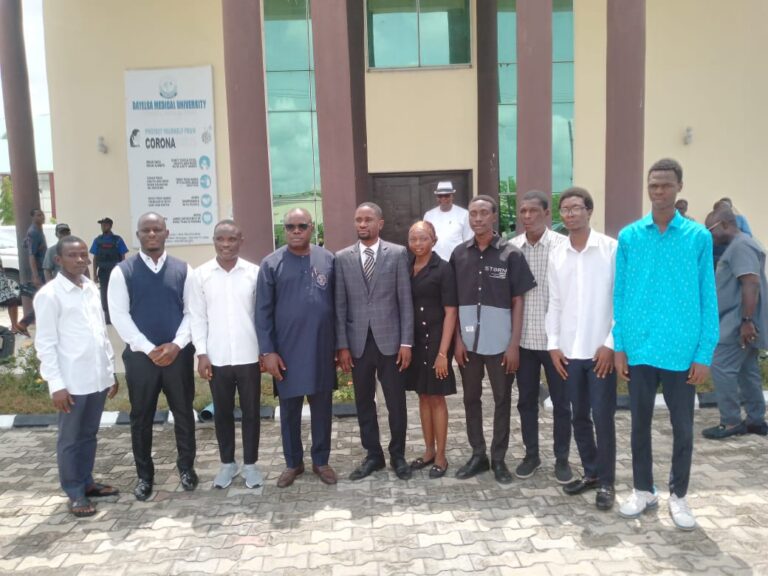
Dr. Dennis Otuaro, the Administrator of the Presidential Amnesty Programme (PAP), has assured the management of the Bayelsa Medical University (BMU), Yenagoa, Bayelsa State, of the Programme’s readiness for collaboration to remedy the shortage of medical professionals in the Niger Delta.

He observed that there was a gap in medical personnel in the region, stressing that one of the major objectives of the Programme is human capital development in the region.

Otuaro, who gave the assurance when he led PAP management team on a visit to the BMU, on Friday, stated that the Amnesty Programme Office and the BMU could strengthen their partnership to train more students in critical areas in the health sector.

This was contained in a statement signed by, Mr Igoniko Oduma, Special Assistant on Media to the Administrator, Presidential Amnesty Programme.

According to the statement, before BMU, he and his team had visited Igbinedion University and Benson Idahosa University in Edo State; the Western Delta University, Oghara; the Edwin Clark University, Kiagbodo; and the Michael and Cecelia Ibru University, Ughelli, all in Delta, as a part of his tour of tertiary educational institutions partnering with the PAP.

During the visits, Otuaro interacted with the PAP scholarship students and the management of the institutions with a view to getting first-hand information towards improving service delivery.

The Amnesty Programme, which was established in 2009 to disarm, demobilize and reintegrate ex-agitators into the mainstream of society and expand educational opportunities for indigenes of impacted communities, is currently in the reintegration phase.

A statement issued by his Special Assistant on Media, Mr. Igoniko Oduma, quoted the PAP Administrator as having noted that the Niger Delta was faced with two major challenges namely, limited infrastructure and human capital development.

He applauded the BMU for being a success story of the PAP scholarship scheme, and playing the role for which it was established by the Bayelsa State Government.

Otuaro said, “The Amnesty Programme under my watch will focus on developing the human capital in the Niger Delta.

“The Bayelsa Medical University is very vital at this time when we need more trained medical professionals to cater to the healthcare needs of our people and drive development in the Niger Delta region.”

In his remarks, the Vice-Chancellor of BMU, Prof Ebitimitula Etebu, congratulated the PAP Administrator on his well-deserved appointment by President Bola Tinubu.

He also commended Otuaro for the deliberate decision to visit the institutions where scholarship students are studying, noting, “this demonstrates the vigour and dynamism you have brought to the Programme.’’

Etebu sought further collaborations between the university and the Amnesty Programme, especially in professional courses, and appealed to the PAP to consider creating a special scholarship scheme for the health sector because of the great need in that area.

“I believe we should be able to take advantage of the Presidential Amnesty Programme to leave a lasting legacy for our people and impact them positively”, the VC said.

Otuaro later interacted with the PAP scholarship beneficiaries in the institution led by their leader, Fawei Disebira, a 300-level Medicine and Surgery student, promising to respond promptly to their complaints which bordered on late payments of in-training allowance and lack of gadgets for learning.


Why Governor Fubara Executive order on State Assembly cannot stand by Fatai Abiodun

By Fatai Abiodun

It was Baron de La Brède et de Montesquieu, generally referred to as simply Montesquieu, a French judge, man of letters, historian, and political philosopher, and the principal source of the theory of separation of powers, which is implemented in many constitutions throughout the world stated that to have political liberty, it is important and requisite that the government be so constituted as one man need not to be afraid of another.

What is happening in Rivers State under the governance of Governor Sim Fubara is one of the reasons why Montesquieu expressed that every man invested with power is apt to abuse it, and to carry his authority as far as it will go. Montesquieu suggested that to prevent abuse, power must be a check to power.

Nigeria as a country turned into a democratic nation in 1999 following many years of military struggle. The current happening in Rivers State is a clear signal that those in power do not really understand the tripod stand that holds the democratic setting.

The ground norm which is the constitution acknowledges three arms of government which include legislative, executive and judiciary. The powers of the legislative to make laws for peace and good governance in the country are not in doubt. The power of the executive to perform executive functions were also not in doubt while the powers given to the judiciary for the interpretation of laws were also in affirmative.

The political crises in Rivers State have been there for some months now. The common man did not know the root cause of the crisis and no one among the political warriors was ready to explain why the problem is yet to abate.

The crisis got to the climax this week following the first executive order signed by Governor Sim Fubara who ordered immediate temporary relocation of the sitting of the State House of Assembly to the Government House in Port Harcourt.

It is sad and pathetic to state that some federal lawmakers had publicly encouraged Governor Fubara can rule the state through an executive order and jettison the state assembly. [Error!]

I wonder if this set of people who were employed to make laws really understand the workings of democracy. This is the bad advice that encouraged Gov Fubara to issue an order that is clearly against the tenets and spirits of the constitution. While the power of the Governor to issue an executive order is not in doubt, such an order must not encroach on the powers of other arms of government.

Could you imagine a Governor issuing an executive order against the State judiciary? It will not stand. In the same way, an executive order that affects the State Assembly cannot stand.

A clear understanding of the constitution will show that the executive is not to serve as police for the legislative or judiciary, the same reason Montesquieu averred that when the executive and the legislative powers are united in the same person, there can be no liberty because apprehension may arise; and there would be an end to everything, were the same man or the same body to exercise the powers of legislature, executive and judiciary.

What we are witnessing today in Rivers State is a situation where one man wants to be the executive and the legislative, which is clearly against the democratic setting.

The intention of the drafter of the Constitution is not to place other arms of government under the whim and caprices of the executive, both must be a check for one another. The attitude of the executive governor to move the state assembly sitting to the government house ultra vire the power of Governor Fubara.

Some political schools of thought have suggested that the action of the governor on the executive order was due to fear of impeachment, I disagree with this assertion because section 188 of the 1999 (As Amended) has provided ways acceptable to the removal of a governor.

The Courts have not failed to reverse any purported impeachment of the governor that failed to meet the constitutional provisions, and a clear example of such is the case of Ladoja and the Oyo State House of Assembly in 2007.

The Courts have held in plethora of cases that the position of law is that where a statute or rules of the Court have provided for the method of doing a thing, it must be done in accordance with the express provisions of the statute or rules.

I strongly advised Governor Sim Fubara not to panic. The impeachment process by the State House of Assembly is not automatic because the drafters of the constitution never envisaged that the state assembly and the governor must come from the same party. The development of the state should be the unifying factor between the Executive Governor and the legislative.

It will be in the interest of the Rivers State and Nigeria at large for Governor Sim Fubara to rule in accordance with the rule of law and the Constitution. If the governor feels that the House of Assembly members who ‘decamped’ to another party are no longer entitled to their offices, it’s not the power of the governor to declare their seats vacant, such action is usurping the power of the judiciary in interpreting the law.


Fatai Abiodun read Law at Baze University

fatai10367@bazeuniversity.edu.ng

29 Nigerian Army Generals Retire

0

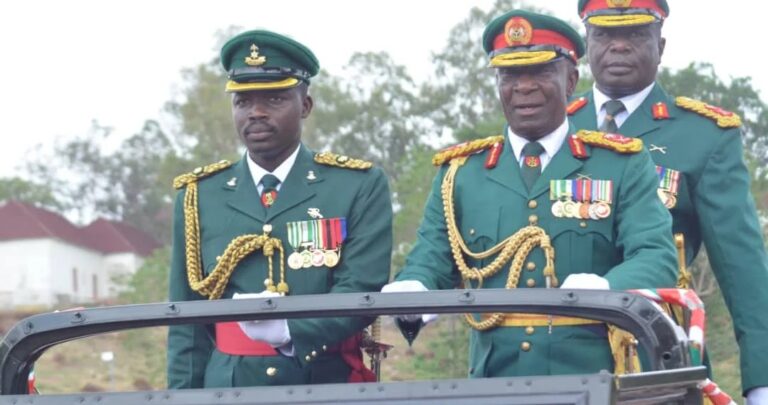
The Nigerian Army on Friday pulled out 29 generals of the Infantry Corps who retired from active military service.

The News Agency of Nigeria (NAN) reports that out of the 29 retired infantry officers pulled out of active service at the Jaji Military Cantonment in Kaduna State, 19 were major generals and 10 brigadiers general.

Leading the pack was Victor Ezugwu, a major general, who spoke on behalf of the retirees.

Mr Ezugwu encouraged their successors to not only sustain the modest strategic, operational and tactical achievements made, but also to surpass them.

”The frontline is expanding and the Nigerian Army is becoming increasingly committed with the eyes of the nation and the world on it.

”Our Infantry Corps must therefore not relent or rest on her oars as the entire Nigerian Army depends largely on the Infantry Corps to achieve its core mandate and mission.

”I admonish the Infantry that as the threats to Nigeria sovereignty is becoming asymmetric in time and space, you must be proactively way ahead of our adversaries in all aspects of the unfolding combat scenarios,” he added.

Mr Ezugwu also called on the Infantry Corps to review some of its tactical and operational strategies in the areas of night fighting capabilities, and frontline intelligence gathering on enemy activities.

He further advised the corps to strengthen basic field crafts training in the areas of aggressive fighting patrols to dominate at least 5 km radius of their locations, ambushes, listening and observation posts as well as all levels of battle drills.

Mr Ezugwu advocated for employment of modern technology and ICT enablers, and deliberate efforts to develop the leadership skills of junior commanders.

“Be rest assured that my colleagues and I will be glad and willing to avail the Infantry Corps our time, energy and resources until our last breath on earth.”

He announced the donation of 200 books and encyclopedia to the Infantry Corps Centre and Nigerian Army School of Infantry libraries to promote training, reading culture, mentorship and capacity development of officers and soldiers.

“We are also availing the infantry Corps the sum of N1 million to purchase more Corps related books.

“This is our modest way to encourage the edification of younger Infantry officers and soldiers so as to inspire and motivate them to reach their full potentials as they grow in service,” Mr Ezugwu said.

He described military career as the most priceless, honourable and sacrificial call to duty globally, and thanked God for allowing them to end their careers alive after serving the nation for between 30 -38 years.

The general described the day as full of emotional feelings, nostalgic memories, wholesome gratitude, unending joy and unwavering fulfilment.

“For every service personnel, retirement from active service remains a natural and inevitable end which begins to count from the day we passed out from NDA as officers in the Armed Forces of Nigeria.

”Our joy and that of our families, colleagues and friends gathered here today knows no bounds as we take a final bow from the Infantry Corps.

“On behalf of my retired colleague generals, I most respectfully and dutifully appreciate the incumbent Chief of Army Staff, Lt-Gen Taoreed Lagbaja for organising this benefitting and memorable pulling out parade in our honour,” he added.

He also appreciated the Commander Infantry Corps, Olufemi Oluyede, a major general, for mobilising the entire Infantry family including veterans and other luminaries in the Infantry Corps to honour them.

”As I stand on this podium and looking around this Parade Ground, I am moved with hysterical feeling of excitement considering the mammoth turn out of the infantry family, host and neighbouring communities of Jaji, Labar, Wusono, Railway, Birnin Yero, Angwan Loya and other parts of Zazzau Emirate, led by our revered Emir, to celebrate our retirement.”

Olubunmi Tunji-Ojo: FG To Review Visa Policy To Attract Foreign Investments

0

The Federal Government is set to review the nation’s visa policy to attract foreign investments and boost visits to the country.

The Minister of Interior, Olubunmi Tunji-Ojo, disclosed this at the Transcorp Hotel, Abuja during a stakeholders consultative meeting on Nigeria visa on Saturday.

Tunji-Ojo stated that last year’s visitor numbers was inadequate compared to the country’s population and resources, noting that policy on visas has to be reviewed to meet the standards of the Renewed Hope Agenda of President Bola Tinubu.

He said, “We are determined to make sure that in the next couple of weeks, by the grace of God, the new implementation framework will be on the ground.

And people all over the world will start having easy access to the country. We want to welcome investment and people. Just last year, the number of foreign passengers that came to Nigeria whether Nigerians or non, was just less than two million people.

“That is unacceptable for a country of over 200 million people. It means that we are limiting investment and import of forex among other things. So, once we get the visa policy right and we get the implementation framework perfect, then definitely the economic prosperity will come.”

He stressed that a visa policy that attracts investments and encourages visitors to visit Nigeria from across the world without putting the country’s security in jeopardy

Speaking further, the minister stated that though it was difficult to reach a balance between easy access to visa and national security considering its delicate nature “if gotten right, it would no doubt lead to a healthy investment promotion for Nigeria”.

He said, “You see, seamless access to any country is key for investment promotion, job creation, foreign direct investment. In short, it is key to whatever a particular country wants to do or achieve to enable it to progress

The logic is that everything is built on effective visa administration. So, we are here to really talk about it and to be able to streamline the process for the better. Especially, in areas of short stay visa and even our other categories of visa to see how we can optimise them and make it more efficient in such a way that will be able to attract more investment”.

Tunji-Ojo further said if the country is right on its track, the development will open up the nation’s space for tourism, and infrastructural development.

This, he said will equally create a balance in terms of our national security architecture.

He noted that the Tinubu-led administration’s resolve is to make Nigeria’s visa policy the best in the world and that it would not rest on its oasis until it is achieved.

The renewed hope is about business unusual, it is about prioritising Nigeria by making sure that it is the best in the world and that is exactly what we are trying to achieve. It is one thing to have a policy, but it is another thing to be able to implement it

So, we are gathered here today, to deliberate on the need to use technology to reduce the waiting time to get a short-stay visa, business visa, tourism as well as entertainment. And how easy is it going to be for them to have access to their application mechanism? Why must somebody need to travel from British Columbia in Canada all the way to Ottawa, just because you want a Nigerian visa?”

He added that “What are the reasons today people go to Qatar, UK and Singapore even more than the way people go to Europe; it is because there is easier access. So, creating the right framework and having that benchmark that will be competitive, and comparable with the best in the world is exactly what we aim to achieve.

“We want to assure Nigerians that this is not just a workshop, neither are we just here to talk but to actualise it,” the Minister asserted.

On his part, the Permanent Secretary of the Ministry of Interior, Aishetu Ndayako, noted that the review has become necessary given the importance of visas to the overall development of any country.

Ndayako stated, “We are here today to discuss the significance of our collective efforts in shaping the future of visa regulations and procedures that have a profound impact on individuals, businesses and the nation as a whole.”