Saturday, November 28, 2026
Home Blog Page 956

Fela Kuti’s 81st Posthumous Birthday Is Today

0

Fela Anikulapo Kuti (15 October 1938 – 2 August 1997), also professionally known as Fela Kuti, or simply Fela, was a Nigerian multi-instrumentalist, musician, composer, pioneer of the Afrobeat music genre and human rights activist.

At the height of his popularity, he was referred to as one of Africa’s most “challenging and charismatic music performers”.


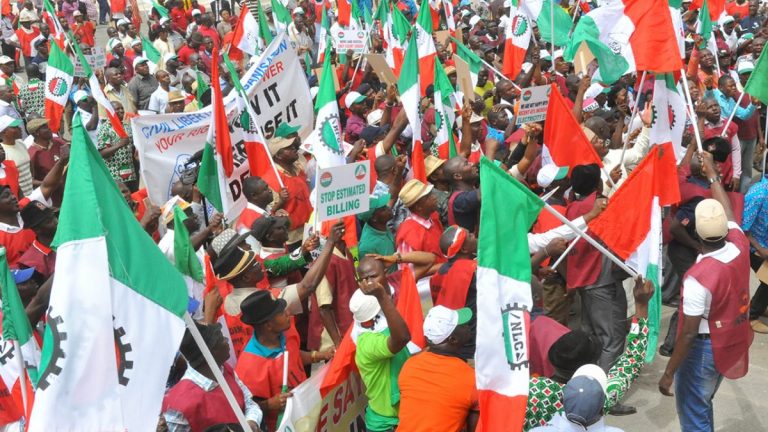
New minimum wage: Workers set to join NLC proposed strike

0

Workers in Osun State have announced plans to join the proposed nationwide strike by the Nigeria Labour Congress (NLC).

Mr Jacob Adekomi, the Chairman of the state chapter of the NLC made this disclosure on Monday.

Adekomi said he had received the directive on the proposed strike by the national headquarters of the congress and that the directive would be followed to the letter, NAN reports.

The NLC General Secretary, Mr Emmanuel Ugboaja, had in a circular, directed the state councils of the congress to mobilise members for the strike in case the negotiations between government and the union slated for Tuesday, breaks down.

Adekomi, however, said it was unfortunate that labour had to resort to strike before workers’ demand for welfare would be looked into.

“It is quite unfortunate in this country that you do not get your right easily.

“The language employers of labour understand is agitation, which is quite unfortunate.

“It is about precedent now, if you want to get your right here, you have to do the unthinkable.

“It is the unthinkable language that they do understand,” he said.

Adekomi, however, expressed the hope that the issue of consequential adjustment on the minimum wage implementation would be resolved between now and Tuesday.

“It is not about the issue of strike. It is about getting our demands. Nobody is interested in strike but what we are saying is give us what is due to us’’.


News New Minimum Wage: What Ngige said after meeting with labour

0

Representatives of the Federal Government on Monday met with the leadership of organised labour over the implementation of the new N30,000 minimum wage.

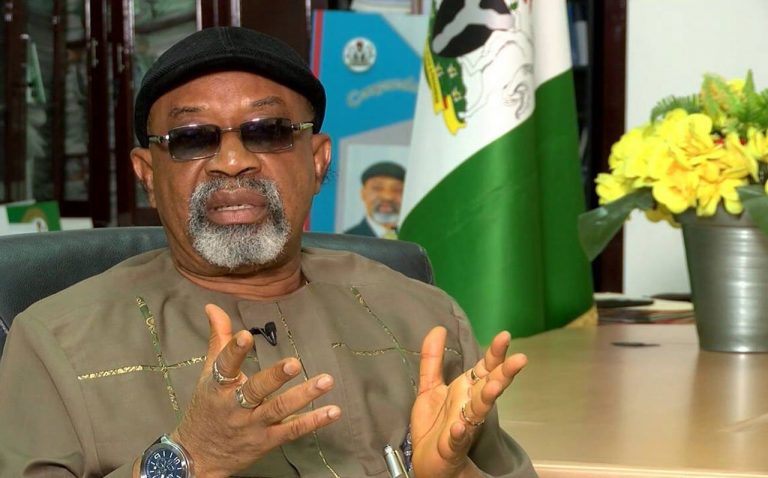
The Minister of Labour and Employment, Dr Chris Ngige presided over the meeting.

Speaking after the meeting, Ngige announced that there would be another meeting on Tuesday with heads of government agencies and parastatals, where their books would be opened for scrutiny to see what amount can actually be paid to workers, Channels Tv reports.

“We met with the leadership of the organised labour movement on the implementation of the new N30,000 minimum wage and the consequential adjustment of salaries for civil servants.

“The meeting was an information-sharing from the previous meeting between the government and the labour leaders.

“We assured the union leaders that we would remain neutral in the whole negotiation and appealed to members of the union to show some understanding.”

if negotiation breaks down again with Federal Government.

In a circular sent to state councils, signed by its General Secretary, Mr Emmanuel Ugboaja, NLC said it was a notice in case the proposed negotiations slated for Oct. 15 with the Federal Government broke down.


$665b lost in three years to disasters

0

About $665billion has been lost in the last three years globally to disasters, it was learnt.

According to statistics, large percentage of the loss was recorded by high-income countries.

This was revealed in Abuja on Monday by the Director General of National Emergency Management Agency (NEMA), Engr. Mustapha Maihaja during the celebration of ‘International Day for Disaster Risk Reduction’ with the theme; ‘Build to last’.

Maihaja, who was represented by the Director of Finance and Account, Mr. Sunday Hamman, explained that the most effective way to reduce risk was by incorporating disaster risk reduction into investment decisions.

He said: “According to the United Nations International strategy for Disaster Reduction, there are about $665billion direct economic losses during the past three years .A considerable proportion of those losses comes from infrastructures failures in high-income countries.

“The theme has captured the essence why we must work towards integrating disaster risk reduction into investment decisions which is the most cost-effective way to reduce risk.”

On the essence of reducing risk, Maihaja said: “Weak implementation and enforcement mechanisms are common problems in countries where most urban development is informal, as such when critical infrastructure fails, businesses experience indirect losses, as production, distribution and supply chains are interrupted.

“The recurring disasters and their impacts on our people and environment must serve as a wake up call to all stakeholders, governments at all levels, individuals and the organized private sector must rise up to their responsibilities on disaster risk reduction.

“Disaster risk reduction is everybody’s business; therefore the need to re-strategize and foster stronger collaboration on principled and effective disaster management remains paramount. Despite the competing demands for resources, we must work together to improve the lives of the vulnerable citizens as well as enhance their resilience.

Minister of Works and Housing, Babatunde Fashola said risks could be avoided if people have respect for nature and other environmental issues.

Fashola, who was represented by the Director of Construction of the ministry, Arc. Mosunmade Odusanya, said with adequate commitments, dedications, and constant awareness, disasters can be prevented and minimized if they occur.

He also noted that the speed at which help and services are rendered when disaster occurs should be of paramount importance.

Speaking on areas that require attention in order to mitigate risks associated with disasters, Fashola said: “Priority should be given for the consideration of planning, environmental issues, structural design, construction and other building components that can stand the test of time occasioned by unforeseen disaster.

“At the pre-design, design, construction and post-construction stages, the provisions in the National Building Code, Fire Code and other environmental prescriptions should be adequately considered.

“Spaces for human habitation, workspaces, setbacks, access roads, fire prevention and firefighting equipment; ecological, geophysical thermal consideration should take the prime of place.

“Also hazardous spaces such as filling stations, chemical factories, bunkers and shelters should also be given attention at the design stage of the development. Consideration should also be given to evacuation of people and goods.”


Minimum wage: NLC directs members, state councils to be ready for strike

0

The Organised Labour has intensified mobilization for a nationwide strike over the Federal Government failure to commence full implementation of the new minimum wage, as the Nigeria Labour Congress (NLC), has directed its members and state councils across the country to mobilize and be ready for the strike after Wednesday deadline.

The congress, in a circular sent to all it’s state councils, the NLC directed the state chairmen and secretaries to coordinate preparations with the Trade Union Congress (TUC) and the Joint National Public Service Negotiating Union (JNPSNU) in their respective state for industrial action if the time expires without an agreement reached with the government.

The circular, signed by the General Secretary of the NLC, Comrade Emmanuel Ugboaja read: “You will recall that a joint Communique… said industrial harmony could not be guaranteed in the country should an agreement not be reached with the Federal Government on the Consequential Adjustment of Salaries as a result of the New National Minimum Wage of N30,000.

”You are hereby directed to coordinate preparations with TUC and JPSNC in your State for necessary industrial action should the time expire without an agreement as contained in the communique.”

However, in a swift reaction last night, the Minister of Labour, Sen. Chris Ngige reminded the Labour of the provisions of the extant Labour law and the International Labour Organisation (ILO) convention, as they affected strike and negotiation.


Attack on Oshiomhole: APC has disintegrated

0

The Peoples Democratic Party (PDP), on Monday, said that the violent attack by members of the All Progressives Congress (APC) on its embattled National Chairman, Adams Oshiomhole, has further confirmed that the dysfunctional APC has finally disintegrated.

In a statement made available to newsmen in Abuja by its National Publicity Secretary, Kola Ologbondiyan, the party pointed out that the fact that APC members openly took up arms against its leadership was a huge demonstration of their eternal rejection of the APC and the Buhari Presidency, particularly for the ruins they have caused our nation.

According to the statement, “for APC members to publicly call their National Chairman a “thief,” as reported in the open media, amply captures the mood of the majority of Nigerians, including APC members, that the APC and its government are havens for thieves, criminal gangs and corrupt persons.

“The indisputable fact among Nigerians is that the APC has become torn apart within its core. The manifest greed and ravenousness of its leaders, particularly, in the Presidential Villa, in addition to endless infighting over positions and looted resources has further exposed the party as a soulless mob.

“The APC has never been a genuine platform for governance. It has neither the predisposition nor the design for operable people-oriented policy and programmes. If anything, it has remained a special purpose vehicle, for power-grabbing, hijacked by an oppressive and exploitative cabal, who has no iota of interest in the welfare of Nigerians.


Ship owners want international collaboration to curtail poaching

0

Onyema-Orakwusi said this in an interview with the News Agency of Nigeria (NAN) on Monday in Abuja. According to her, the international community has the market and capability to effectively monitor all activities that take place in the waterways. She said:

I have always said this, any crime that takes place out there in the sea, the planning is done ashore; they go there, execute and come ashore with their bounty. “So, with good intelligence, right from ashore, you can arrest what goes on there.

You can also trace the movement of the fund through financial institutions. “We are underplaying the activities of the financial institutions especially the international banks because that is where the poachers find markets for their products, which shouldn’t be. “

The poachers have easy market in Asia, in Europe and in America and they pass their money through their financial institutions. “Some of us who export, we know that for your payment to be received through the bank, you need to furnish documentation to show how you earned that money.

So seriously speaking, if we really want to arrest the issue of poaching in Africa, we need the cooperation of Europe, Asia and America. Also read: Ekweremadu charges environmental MDAs on early defence, passage of budget

This is because it is easy for them to monitor these things. Also, sanctions should be placed on the financial institutions and on the big buyers.” Onyema-Orakwusi however, urged the federal government to deploy relevant personnel to adequately monitor the territorial waters to ensure the security of the waterways.

She also urged the government to be at the fore of all the partnerships going into the sector to ensure that its full benefits were maximised. “We need to secure our domain; we need to tap on the resources; we need to let it provide employment and earn foreign exchange, it is our own.

We have also recognised how difficult it is to fight international organised crime and that is why it is important that all hands must be on deck,” she said. The SOAN boss expressed optimism that the recently concluded Global Maritime Security conference would ensure a more secure environment in the country’s maritime sector. She reiterated the importance of safety to enable the country to harness all available resources, to engender growth and development of Nigeria and the continent at large.

On indigenous criminal activities in the country’s maritime domain, Onyema-Orakwusi said resolving it was beyond the amnesty programme. According to her, rather than give fish to the people, it is important to teach them how to fish so they can be useful to themselves, their family and the nation.

I believe that hunger can drive an innocent man to steal in order to eat. “If you look at the Niger Delta area, you will find out that a lot has happened, a lot is still happening and people’s livelihood has been taken from them.

The environment has been abused; there is a lot of pollution which means you have taken from them what they are traditionally good at doing and that is farming and fishing.

And what have we replaced with that. I have never been to the amnesty programme. We need to train these young boys and girls, find some other means for them to earn an income. “So we really need to equip them more and create an environment for them to be able to earn income and improve on themselves,’’ she added.


Foreign Airlines Lobby Governors, Others For More Flight Services

0

In a time Nigerian carriers are shouting themselves hoarse to cut down on multiple designations to foreign airlines, the carriers are clandestinely lobbying the Ministry of Aviation for more flights into the country, New Telegraph has learnt.

Besides, the carriers are lobbying influential people in government and some state governors for help to extend flight operations to many states in Nigeria, a situation that has far more implications for the growth of domestic airlines.
Not a few have lamented that foreign airlines are now designated to multiple routes within Nigeria, but this development threatens the survival of local airlines.

This newspaper gathered from a source close to some European carriers that they, in conjunction with their home countries, are mounting so much pressure to expand their operations in the country; a situation that defeats the Bilateral Air Services Agreement (BASA) Nigeria has with many of the countries.

BASAs are treaties signed between Countries to allow international commercial air transport services between territories.

BASAs promote international air link between countries, which supports and enables movement of persons, cargo, trade and tourism. These agreements provide the framework under which identified airlines from the two countries fly into designated ports in each other’s country.

Nigeria loses over N500 billion in capital flight yearly due to the lopsided air pact the country has with many countries. Nigeria’s carriers do not have the capacity to compete with their foreign counterpart. They are equally not protected by government policy, leaving predator foreign carriers that are having a field day in the country.

There are indications that the ticket sales of foreign airlines out of Nigeria could rise to N600 billion in no distant time, as more foreign airlines have been granted permission to operate to Nigeria, while many are taking away the domestic market from local airlines.

Nigerian airlines have been muscled, as they only make less than two per cent from the huge sales in the country.

For example, Ethiopia Airlines operates in five cities namely Enugu, Kano, Kaduna, Abuja and Lagos. Turkish Airlines operates in four cities: Abuja, Kano, Lagos and Port Harcourt, while Emirates Airlines operates two frequencies daily into Lagos and one to Abuja.

For instance, Turkish Airlines has just started Istanbul to Abuja, Abuja to Port Harcourt, Port Harcourt to Abuja, then Abuja to Istanbul. Lufthansa and Air France are also doing the same, thereby running indigenous airlines out of business.

While Emirates has two frequencies into Lagos and one to Abuja, it has announced plans to introduce a third flight in and out of Lagos to commence very soon, making it three flights daily to Lagos.

Indigenous airlines have the capacity to cover all the domestic routes being operated now by these foreign airlines. The practice in international aviation is for foreign airlines to partner with local airlines to help them distribute their passengers within the domestic routes.

Besides multiple designations, foreign airlines are being encouraged to do multiple frequencies into the country and within the country, a practice not allowed in other countries.

A few days ago, Rivers State Government and Ethiopian Airlines were said to have reached an agreement for the operation of permanent international flights from the Port Harcourt International airport subject to the approval of the relevant federal authorities.

The two parties reached the pact at the headquarters of Ethiopian Airlines in Addis Ababa after a meeting attended by the Group Chief Executive Officer of the airline, Dr Tewolde Gebremariam and other top managers.

Aviation safety consultant, Group Capt. John Ojikutu (Rtd), said Wike’s position is at variance with the position of the National Assembly on the matter.

He stated that while the National Assembly is planning to curtail foreign airlines’ incursion into “our domestic routes and reduce their multiple destinations in Nigeria, the state governors are thinking differently.

119 Nigerians On Death Row In Malaysia, Says Amnesty International

0

Amnesty International (AI) has identified 119 Nigerians among a total of 1,281 persons sentenced to death in Malaysia. AI gave the figure in its report titled, “Fatally flawed: Why Malaysia must abolish the death penalty.”

It said the 1,281 death row inmates were being kept in 26 detention facilities across Malaysia. In Malaysia, 33 offences are punished with a death sentence.

The AI report said the 119 Nigerians were convicted of hard drug-related offences. “As of 22 February 2019, 1,281 people were under sentence of death in Malaysia, held in 26 detention facilities across the country.

A startling 44 per cent (568) of all those under sentence of death were foreign nationals, from 43 countries.

“Nationals from Nigeria made up 21 per cent of this group, with those from Indonesia (16 per cent), Iran (15 per cent), India (10 per cent), Philippines (eight per cent) and Thailand (six per cent) following suit.

“A significant 73 per cent of all those under sentence of death have been convicted of drug trafficking under Section 39(b) of the Dangerous of Drugs Act, 1952 — an extremely high figure for an offence that does not even meet the threshold of the ‘most serious crimes’ under international law and standards and for which the death penalty must not be imposed,” AI said in the report.

In its report, Amnesty documented many violations of international human rights law and standards associated with the use of the death penalty in Malaysia.

“Our research found a pattern of unfair trials and secretive hangings that itself spoke volumes. From allegations of torture and other ill-treatment to an opaque pardons process, it’s clear the death penalty is a stain on Malaysia’s criminal justice system,” said Shamini Darshni Kaliemuthu, Executive Director of Amnesty International Malaysia.

In July 2018, the Malaysian government established a moratorium on executions, a temporary prohibition that means the convicts won’t have their sentences carried out.

Even though the government previously committed to full abolition of the death penalty, it is expected to soon table legislation in the Malaysian Parliament that’ll remove the mandatory death penalty for only 11 offences.

Amnesty called on the government to completely abolish the death penalty for all crimes and review all cases where people have been sentenced to death, with a view to commuting the sentences.

Maina Has Started Speaking Up On How He Spent The N24bn

0

The embattled former chairman of the Pension Reforms Task Team, Faisal Abdulrasheed Maina “has started speaking up on how he spent the N24 billion”, Vanguard can confirm.

A top EFCC official conversant with the matter told Vanguard that Maina had started speaking up on how he spent the N24 billion, which the federal government handed over to him in ten commercial banks to use and pay off millions of its retirees across the world.

But in a twist that rattles the government and those who brought Maina to the top job, the team under him merely embarked on globe-trotting, sharing the cash with top government officials, under the guise of going round the world to verify the biometric of Nigerian workers.

According to documents at the disposal of the EFCC, which Maina signed off as approved expenditures and receipts for overseas and local trips by the Pension Reforms Task Team, no fewer than 200 top federal government officials were captured as ‘beneficiaries’ of travelling allowances for trips they did not embark on.

According to the documents, which the embattled official wants to rely on as his evidence of utilizing the huge cash of N24 billion released in 2011 to his team, a former Inspector General of Police, Director-General of the National Intelligence Agency, NIA, a Permanent Secretary in the Presidency, a controversial Head of Service of the Federation, Director of Budget of the Federation, two ex-chairmen of the EFCC and ICPC and hordes of officials have been listed along with their bank details and the amount collected by each for phantom biometric trips.

It was learned that Maina was ready to defend the expenditure by calling some or most of the beneficiaries as his witnesses although he has reportedly denied many of the payments and ownership of most of the houses traced to him.

It was learnt that many of the top government officials who are listed as beneficiaries were aware that Maina’s team had been making payments into their accounts even though they did not make the purported trips. It did not also summon the courage to reject and return the millions paid into their accounts by the PRTT.

It was gathered that most of them had since left public service might still be summoned to account for the public funds.

In a similar development, Maina’s son has been reportedly handed over to the Nigeria Police Force to prosecute over illegal possession of firearms and ammunition, Vanguard learnt.

The DSS in its report while transferring father and son to the EFCC last week, accused Faisal of pulling a gun against its operatives and threatening to shoot them.

The service listed items it arrested the father and son with to include: a pistol with live ammunition, bulletproof Range Rover Sports Utility Vehicle, foreign currencies and seven drones.

Vanguard gathered that the police would press charges against junior Maina, who was actually caught with the pistol firearms unless he produces appropriate licenses to operate same in Nigeria.

A source confirmed to Vanguard the 20-year-old student in the American University of Dubai had been transferred to the police, leaving his embattled father alone with EFCC operatives.