


By Biliyaminu Suraj
Nigerian Federal Government authorities do not publish any reliable data about the export of lithium nor gold despite the continuous hype from Minister Alake about the alleged billions of dollars of foreign investment in Lithium production.
In Part 1 of THE MISSING EXPORTS AND HIDDEN ROYALTIES, we examined Nigeria’s Lithium exports and the royalties that should be generated by these exports. In Part 2 we examine gold exports and the royalties due to Nigeria.
In Part 1 we saw the lack of transparency and accountability of the Ministry of Solid Minerals Development (MSMD) and the Mining Cadastre Office (MCO) in failing to publish operator-level royalty and production data disaggregated by mineral type. Hence, as explained in Part 1, we must rely on mirror data for trade statistics as recorded by the importing country rather than by Nigeria’s own authorities. The two primary destinations for Nigeria’s lithium and gold exports are China and UAE respectively. Both publish data for minerals imported from Nigeria. In regard to gold, the UAE is the most significant destination for gold mined in Nigeria. Fortunately, the UAE records and publishes statistics on the amount of gold imported from Nigeria.
Gold Exports and Royalties
The mirror data for Nigeria’s gold trade is found in the UN Comtrade dataset which is a comprehensive global record of international trade statistics maintained by the United Nations Statistics Division since 1962, covering over 200 countries and more than 99% of world merchandise trade including minerals.
The UN Comtrade dataset shows gold imported by UAE from Nigeria in 2024: US$2.71 billion
This figure is explicitly listed under “gold, unwrought or semi manufactured forms” within the UAE’s imports from Nigeria.
This is the only year for which a disaggregated, Nigeria specific gold value is published (see Table 1).
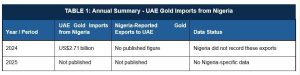
Year/Period UAE Gold Imports from Nigeria Nigeria Reported Gold Exports to UAE Data Status
2024 US$2.71 billion No published figure Nigeria did not record these exports
2025 Not published Not published No Nigeria specific data
Nigeria’s gold export data does not match the UAE’s gold import figures because most gold leaving Nigeria is not formally declared, moving instead through illegal mining sites, informal aggregators and smuggling networks that bypass customs and official reporting. Nigeria’s institutions—Customs, NEPC and the Ministry of Solid Minerals—record only licensed, documented exports, which represent a tiny fraction of actual production.
Meanwhile, the UAE’s refinery and import system captures all incoming gold, including shipments that originated in Nigeria but were mislabelled, under invoiced, or routed through third countries. The result is a persistent statistical gap: Nigeria reports almost no gold exports, while the UAE records billions of dollars’ worth of Nigerian-origin gold, revealing the scale of the informal corridor that operates outside Nigeria’s regulatory reach.
This mismatch has become structural: most Nigerian gold moves through informal buyers, middlemen, and smuggling networks that bypass Customs and the Nigerian Export Promotion Council. These illegal informal channels through Dubai and Sharjah are well known. Regardless of the channel, the UAE’s gold refinery system logs all incoming metal, including gold that was misdeclared, under invoiced, or routed through third countries.
But the gap is not only about undeclared exports—it is also about missing royalties.
Two pathways explain how gold royalties could have been paid yet never appeared in Nigeria’s federal accounts:
Legal miners may have paid royalties in Nigeria, but the payments were not remitted upward into the Central Bank—lost through administrative leakage, diversion, or corruption within the chain of custody.
Illegal miners and aggregators may have paid “royalties” informally—not to the Nigerian Government, but to local officials, security actors, or gatekeepers who pocketed the money while allowing gold to move through illicit channels.
In both scenarios, the state loses three times:
first, the gold is not recorded as an export;
second, the royalty revenue never reaches the Central Bank;
third, the company exporting the gold does not pay corporate tax in Nigeria.
Royalty Calculation: What Nigeria Should Have Earned from Gold in 2024
Nigeria’s statutory royalty rate for gold under the Nigerian Minerals and Mining Act is 3% of the value of the mineral exported.
The royalty due for 2024, if the UAE reported gold had been declared, would be:
“Royalty Due”=US$2.71″ billion “×0.03=$US81.3″ million ”
Nigeria’s lost gold royalty revenue for 2024: ≈ US$81.3 million (N110.9 billion)
This is the amount the Nigerian Government should have collected if the gold recorded by the UAE had been formally declared and taxed in Nigeria.
Instead, the combination of undeclared exports, informal payments and royalties diverted or pocketed, means the federal treasury may have received none of this revenue.
Where is the missing US$81.3 million gold royalty for 2024?
The Combined Narrative
The Ministry of Solid Minerals Development says that the Federal Government of Nigeria made more than N70 billion from mining in 2025.
According to Segun Tomori, the Solid Minerals Minister’s media assistant, income went up from N16 billion in 2023 to N38 billion in 2024 and then to N68 billion in 2025.
Calculated only on gold imported from Nigeria into the UAE, the gold royalty payable for 2024 was N110 billion and yet the Solid Minerals Minister’s media assistant says the aggregated income from mining all minerals in 2024 was only N38 billion; N72 billion short when only counting the contribution of gold.
Compounding the shortfall in declared income from mining is the fact that the windfall described by the Solid Minerals Minister’s Office was primarily from an astronomical increase in the cost of tenement fees imposed on Nigeria’s small-scale miners (Nigeria’s mining lease application fees are 29 times higher than Canada’s fees).
If gold mining companies are not officially paying royalties, then they are likely not paying taxes, further compounding the loss to Nigeria.
The gap in unrealised royalties from gold and lithium mining is huge and demands answers. The payment of royalties and taxes by mining companies demands a serious and independent review.
Approximately US200 million in royalties payable on lithium and gold is unaccounted for under the current Ministry of Solid Minerals Development.
Where is the Extractive Industry Transparency Initiative? Where is the World Bank? Like the Ministry of Solid Minerals Development, they have both failed Nigerians.
Where are the missing royalties?


