Wednesday, April 22, 2026
Home Blog Page 37

Prosperity Cup 2025: Afini Ladies Shock Favourites, Crystal Stars, as Golden Sun Sports Club Secure Semi Final Place

0

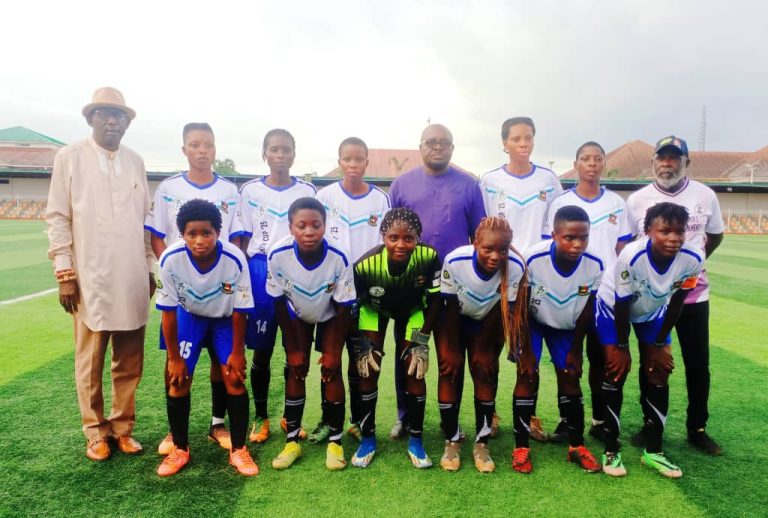
Afini Ladies and Golden Sun Sports Club have joined Bayelsa Stars Queens and Ezuogha Soccer Academy in the semi finals of the women’s version of Nigeria’s biggest grassroots football fiesta, the Bayelsa Governor’s Football Tournament tagged the Prosperity Cup.

Afini Ladies beat Crystal Stars, one of the tournament’s favourites 3-1 on penalties after a one all draw in regulation time in an encounter decided at the Samson Siasia Studium, Yenagoa.

Last year’s highest goal scorer, Blessing Anderson broke the deadlock on 46 minutes after a beautiful team work.

The celebration did not last long as Agba Praise was brought down in the danger area and centre referee, Elisha Clifford wasted no time in pointing to the spot, and Praise, who scored a hat trick in her first game, stepped forward to send Afini Ladies goalkeeper the wrong way on 50 minutes.

Still basking in the euphoria of their thirteen nil drubbing of the Global Stars of Yenagoa in their opening tie of the tournament, Crystal Stars came into the game full of confidence having clinically taken their last opponents to the cleaners, but met their Waterloo against a technically disciplined Afini ladies FC.

The last quarter final game was more of a ‘one-way traffic, as Golden Sun Sports Club made light work of Bayelsa State College of Nursing Sciences, BYSCON Queens with a comfortable five nil triumph

Afuruku Anibarafa’s hat trick on 23, 28 and 58 minutes as well as Jessica Mark’s effort on 24 minutes, and captain Rebecca Iwowari’s header in the 31st minute ensured Golden Sun Sports Club completely overwhelmed BYSCON Queens.

With the quarter finals concluded, attention will now shift to the semi-finals, with Bayelsa Stars Queens facing Ezuogha Academy, while Afini Ladies will confront Golden Sun Sports Club as the women are now being separated from the girls.

Afini Ladies coach, Anthony Fouye who was filled with excitement, commended his girls for their doggedness and resilient spirit throughout the encounter, admitting that he was sceptical at the beginning following Crystal Stars intimidating scoreline in their previous match.

Crystal Stars Coach, Sese Ebimobowei said he was proud of his girls despite the disappointing result, blaming over confidence as the greatest undoing of his girls. He, however, gave an assurance that, they would return to the competition as a much improved team next year.

Also, Afini Ladies forward, Blessing Anderson, hailed her teammates for their determination, stating that her team would progress to the final of the tournament, which would be an improvement to their third place finish in last’s year edition.

Ghana’s FM Call To Prioritize Africa’s Socio-economic Needs Over Building “Killing Machines”, A Wake Up Call?

0

By Alex Enemanna

Several African countries have been reported to face prolonged conflict and armed struggle as non-state actors have literally taken control of large swathes of land, displacing thousands of people amid the helplessness of state and sometimes regional forces.

According to the Geneva Academy of International Law and Human Rights, Africa has at least 35 non-international armed conflicts (NIACs) taking place in different countries, including Burkina Faso, Cameroon, the Central African Republic (CAR), the Democratic Republic of Congo, Ethiopia, Mali, Mozambique, Nigeria, Senegal, Somalia, South Sudan, and Sudan.

It comes second in the number of armed conflicts per continent, behind the Middle East, which has 45. Asia comes third with 21, Europe has 7, while Latin America has 6.

But, worried by how global leaders have prioritised investment in war over development and human welfare, Ghana’s Foreign Minister, Samuel Okudzeto Ablakwa, while speaking on the sidelines of the Raisina Dialogue conference in New Delhi, India, recently stressed that while billions of dollars are being poured into conflicts, millions of people continue to suffer from hunger, inadequate healthcare, and lack of access to essential services.

“Too much money is going into war when people are starving, people are dying. Babies are dying, pregnant women are dying when they shouldn’t be dying,” Ablakwa said, pointing out that over $380 billion has already been funnelled into the conflicts in Ukraine and the Middle East.

He continued, “We can use that to solve problems, to solve the lack of clean water, to solve the lack of hospitals, the lack of childhood vaccines. Global leaders must get our priorities right, we must stop shifting resources away from human development and using it to build killing machines.” The minister questioned the global obsession with military expansion, arguing that funds could instead be used to combat homelessness, provide electricity and other facilities that contribute to human and community development.

Undeniably, most of the social welfare needs highlighted by Ablakwa are well domesticated in Africa, but despite that, even seemingly poor countries, including Sudan and South Sudan, have invested a large chunk of their resources to import “killing machines” while neglecting human development that is the core of governance. With an average GDP of $109.33 billion, according to official data from the World Bank, Sudan, according to a finance ministry source, spent about $1.6 billion in just about three months in 2004 to equip fighters in camps inside and outside the country in its war against the rival Rapid Support Forces (RSF), a conflict that has lingered since April 2023.

DR Congo and M23 Conflict

Despite its endowment with exceptional natural resources and rich mineral deposits such as cobalt and copper, hydropower potential, expansive arable land, immense biodiversity, and the world’s second-largest rainforest, the Democratic Republic of Congo (DRC) is still considered a very poor country. According to a World Bank source, DRC is among the five poorest nations in the world, as the nation’s wealth has not trickled down to the majority of its citizens.

An estimated 73.5% of Congolese people lived on less than $2.15 a day in 2024, while about one out of six people living in extreme poverty in Sub-Saharan Africa (SSA) lives in DRC, data from the World Bank Group show. The East African country has had a prolonged history of conflict and political instability that has taken a toll on the treasury and indirectly impacted the quality of social investment available to the populace.

While there is no accurate data on how much DRC has spent in its war against the Rwanda-backed rebel group M23 in recent years, it is estimated that billions of dollars have gone into building a stockpile of arms shipped from foreign lands for the country’s security forces countering the rebels’ hostilities. The financial cost is in addition to the socio-economic disruptions that have come with the conflict.

In regions controlled by the M23 rebels, banking operations have been brought to a standstill, as most commercial banks have been shut down for fear of attacks, leading to a liquidity crisis. The closure of Bralima Brewery in eastern DRC has also had severe economic implications, affecting local businesses, including bars and retail outlets, as commercial activities have been crippled.

The conflict has also impacted the easy flow of goods from neighbouring countries like Uganda, Kenya, and Rwanda, as key supply routes have been blocked, leading to a high cost of essential goods. As Foreign Minister Ablakwa pointed out, the shifting of resources from real issues comes with grave consequences.

The war-battered DRC ranks 164 out of 174 countries on the 2020 Human Capital Index, reflecting decades of conflict and fragility, and constraining development. Five years on, the situation remains unchanged. DRC’s Human Capital Index is 0.37, which is below the Sub-Saharan African average of 0.4. This means that a Congolese child born today can expect to achieve only 37% of their potential, compared to what would have been possible if they had benefited from a full, quality schooling experience and optimal health conditions, thanks to the ongoing conflicts.

South Sudan — Arms In Face Of Acute Food Shortage
Created in 2011 following independence from Sudan, South Sudan is the youngest country in the world. It suffered a deadly civil war that lasted for five years, ending in a 2018 peace pact between President Salva Kiir and his rival and First Vice President Riek Machar, who enjoys the loyalty of an ethnic militia, the White Army.

While the war between Kiir’s government forces and Machar’s ethnic militia group continued, a large chunk of the country’s resources, 95% of which comes from oil production, was invested in military spending despite widespread hunger. A 2017 data report showed that of the gross oil income of $3.38 billion, the sum of $884 million was paid to Sudan for the use of its pipeline and other fees, while another deduction of $781 million was made in loan to donors and international financiers, leaving the country with only $1.715 billion, which was again spent on the acquisition of arms. There is no record of significant investment in agriculture, infrastructure, healthcare, education, or shelter.

“The bulk of evidence suggests that famine is a result of protracted conflict and, in particular, the cumulative toll of military operations undertaken by the Sudan People’s Liberation Movement and Army (SPLM/A) in Government in southern Unity State, denial of access to humanitarian aid, and population displacement resulting from the war,” a UN report stated.

According to the Stockholm International Peace Research Institute, African countries in 2023 spent a total of US$51.6 billion, accounting for 2.1% of the world total and marking a 22% increase from the previous year. Incidentally, two African countries, the Democratic Republic of Congo (DRC) and South Sudan, registered the highest year-on-year increases in military spending worldwide.

The institute states that DRC’s military spending saw the highest increase globally in 2023. Its US$794 million expenditure was 105% higher than in 2022, while South Sudan had the second-highest increase. Following a 108% rise in 2022, the country’s military spending increased by another 78% in 2023, reaching US$1.1 billion.

A South Sudan Poverty and Equity Assessment (PEA) Report released in December 2024 by the World Bank indicates that poverty is endemic, and vulnerability is almost universal following a decade of economic decline. The most recent South Sudan Household Budget Survey, conducted in 2022, found that 76% of citizens live below the national poverty line of 358,724 South Sudanese Pounds (SSP) per person per year.

“Food insecurity is a widespread issue in South Sudan and has worsened recently with the spike in inflation. High food prices limit access to food, even in rural areas where over half of households depend on market purchases to acquire food. Insecurity, population displacements, and low agricultural investment have reduced food production, contributing to the high rates of food insecurity. Investing in agriculture and road infrastructure would enhance market integration, connect rural areas with towns, and improve food delivery, thereby lowering staple food prices and reducing import dependence,” World Bank Senior Economist for South Sudan, Frank Adoho, stated. However, the war between Kiir and Machar has greatly channeled investment on arms procurement.

Nigeria’s Prolonged Insurgency

In Africa’s most populous country, Nigeria, the nearly two-decade conflict between government security forces and the Al-Qaeda-linked Boko Haram insurgency group has intensified the humanitarian crisis, especially in the country’s northern region, amid the government’s widening defence and security spending.

According to Dataphyte, which cited budget documents from the Ministry of Defence, Nigeria’s defence budget increased by 134.80% in five years. The total allocation to the defence sector in 2019 stood at N589.955 billion, but by 2023, the country budgeted N1.383 trillion for defence, marking a 134.8% increase.

During the 2025 budget presentation before the National Assembly, President Bola Tinubu proposed N4.91 trillion for the defence and security sector, out of his N49.7 trillion total proposal, making it the highest budget ever presented in Nigeria’s history.

Closely following defence and security, N4.06 trillion was allocated to infrastructure, while N2.48 trillion was set aside for health, and N3.52 trillion for education. A close observation shows that more investment has been directed towards arms acquisition than most of the social sectors Ablakwa highlighted.

Despite this enormous budgeting, communities in the country’s North West and North East regions have been displaced by the insurgency group, aided by other armed groups simply classified as “bandits” without any clear-cut ideology but linked to numerous abductions of schoolchildren, travellers, and community members. Stories have been told of how malnourished these non-state actors appear, often leading them to invade communities to loot food barns.

Alarmingly, poverty remains endemic in Nigeria, with about 70% of its population living in poverty, according to the National Bureau of Statistics (NBS). As far back as 2022, the National Multidimensional Poverty Index revealed that 63% of Nigerians, representing approximately 133 million people, live in poverty, with Northern Nigeria experiencing the highest rates. This is despite the country’s abundant agricultural and mineral deposits, particularly in the security-volatile northern regions.

Like Ablakwa warned, global and African leaders must get their priorities right by paying attention to real issues, building alliances, and forging new frontiers. “We should not be fighting each other. Let’s unite. Let’s come together. Let’s build a fair, just and prosperous wealth for our people,” he urged.

Ablakwa also appealed for the strengthening of continental initiatives, including the African Continental Free Trade Area (AfCFTA), to enable African nations to trade and cooperate more, thereby building wealth and reducing over-reliance on foreign powers.

How Crackdown On Opposition Denies Africa Full Democratic Benefits

0

By Alex Enemanna

The age-long definition of democracy as expounded by Abraham Lincoln has consistently faded in theoretical meaning and practice, moving from government of the people for the people to government of a few powerful individuals (who have access to power) for their cronies and allies.

The intolerance of the plurality of opinions and dissenting views in the African political space has largely whittled down the very essence of democracy, widely believed to represent the most acceptable form of governance of all times. While a significant number among the governed population ought to fully own the governance process, as democracy entails, developments in many African countries in recent times point otherwise.

From de-registration of lawfully licensed parties to disqualification of rival candidates and prosecution of opposition figures on trumped-up charges, the political atmosphere in several African countries has been unfairly tilted to favour the party in power, as against equal civic space for everyone to market their agenda before the electorate.

The desperation to exclude opposition from vying for political power stems from the ambition of ruling parties to seek a backdoor to remain in office, in some cases to avoid the resentment of the masses, mostly expressed in the ballots. This has given rise to the sit-tight syndrome where leaders deploy unconventional means to hold on to power, including compromise of the electoral system and changing the constitution to grant them extended tenure.

In Cameroon, President Paul Biya, who became President in 1982, has been accused of presiding over a ruthless crackdown on dissent in over 40 years of his iron-fist reign. Discussing succession even among his aides is seen as a taboo as he clings on, raising suspicion about his intention to hand over power. In Equatorial Guinea, where Teodoro Obiang Nguema Mbasogo has firmly held sway since 1979, his tenure has been characterised by allegations of human rights abuses and corruption, with limited political freedoms for the populace.

Same goes for the Republic of Congo (Congo Brazzaville), where President Denis Sassou Nguesso, who first ruled from 1979 to 1992, returned to power in 1997 following a civil war. He has since remained in office. In 2015, he caused a constitutional referendum removing presidential term limits to enable him to seek re-election. During the 2016 election, he secured another term amidst opposition allegations of electoral fraud.

In Rwanda, Paul Kagame, who became President of the East African country in 2000, amended the constitution in 2015 to extend his tenure beyond 2017. He was cleared to contest for another fresh term of seven years, which ended in 2024, after which he can only be eligible to run twice, each for a five-year term. This makes him eligible to remain in office until 2034. He raked in over 98% of the votes in July 2024 to seal his third term.

It’s Antithetical to Building Strong Institutions — Analyst

A political commentator and lecturer at Baze University Abuja, Dr. Joe Izuagbe, while lending his voice to what he called “criminal adulteration of democracy,” said stifling opposition voices weakens institutions of government, while individuals in power become more emboldened and authoritative. According to him, strong individuals in the midst of weak institutions lead to corruption, absence of checks and balances, and unhealthy civil space.

“When there are frequent clampdowns, censorship is unavoidable; arbitrary arrests, harassment, and violence are unavoidable. And you know this clearly violates basic rights such as freedom of expression, assembly, and association. Groups or individuals cannot freely meet when they are not certain that the state security forces will not swoop in and detain them indefinitely. In any environment where discussions that are not centred on supporting the government of the day are viewed with suspicion, the people’s choices in choosing who leads them become highly restricted.”

“Governments that suppress opposition will see nothing wrong in undermining judicial independence, arm-twisting the electoral body, and compromising the legislature, which is seen as the bastion of democracy. These institutions, instead of becoming instruments to build a robust democratic environment, become tools of the ruling party to suppress,” he stated.

Dr. Izuagbe further noted that citizens easily lose faith in democratic systems where opposition leaders are persecuted or elections are brazenly rigged to achieve a pre-determined aim. This, he remarked, can lead to voter apathy, civil unrest, or even support for undemocratic alternatives.

For him, without an active opposition to critique and offer alternatives to government policies, poor governance, corruption, and executive recklessness will go unchecked, a situation that can hinder economic and social progress. This, he said, is in addition to sanctions, reduced foreign aid, strained diplomatic relations, and the impact on the global standing and development of countries that consistently crack down on dissent.

Uganda

The East African country, like some of its neighbours, has become a danger and volatile zone for opposition politicians, journalists, and activists. In the last 39 years, while the United States, for instance, has produced at least six Presidents, including Ronald Reagan, George W. Bush, Bill Clinton, Barack Obama, Donald Trump, and Joe Biden, Uganda has only known one President — Yoweri Museveni, who has continued to recycle himself since 1986 as the nation’s leader.

After spearheading a guerrilla warfare that ousted the previous regime, Museveni has continued to extend his tenure beyond the initially stipulated period. In 2005 and 2017, he orchestrated constitutional amendments expunging presidential term and age limits, respectively, paving the way for him to become a life President if he wishes. He has also been criticised for presiding over democratic backsliding, suppression of political opposition, and large-scale human rights violations.

He has repeatedly arrested opposition leaders, including Kizza Besigye and Bobi Wine, whose real name is Robert Kyagulanyi, often without clear charges or under vague accusations that they are inciting violence. In 2019, Bobi Wine, a singer-turned-politician, was charged with “annoying” the country’s leader in a move some analysts say is part of a “worrying” increase in political repression. He appeared in court on a charge of treason for an incident in August 2018, in which he and other opposition figures allegedly threw stones at Museveni’s presidential convoy while he was campaigning during a by-election.

An Afrobeat icon who has long used his music to make a case for political change in Uganda, the introduction of Wine’s 2016 hit “Situka”, which means “Rise up” in the Luganda language, goes — “When leaders become misleaders, and mentors become tormentors, when freedom of expression becomes a target of suppression, opposition becomes our position,” made him popular among young Ugandans, many of whom have known only one President since birth.

His campaign in 2020 against Museveni was brutally suppressed by security forces, with his rallies and gatherings often dispersed with teargas and supporters arrested. Even when less active in politics in 2025, the country’s army head, General Muhoozi Kainerugaba, who is the son of President Yoweri Museveni, threatened to “behead” Bobi Wine.

In the case of Kizza Besigye, leader of the Forum for Democratic Change (FDC) party, a former personal physician who stood against Museveni in the 2001, 2006, 2011, and 2016 elections, he has been incarcerated on treason charges arising from allegations of illegal possession of weapons and treachery. Despite a Supreme Court ruling that civilians are not to be tried in military courts, Museveni has gone ahead to introduce a new law that could allow his government to take Besigye back to a military court martial as soon as it is passed by the legislature, an institution believed to be compromised under his prolonged presidency.

Tanzania

President Samia Suluhu Hassan, who succeeded John Magufuli following his death in office, had been lauded for lifting repressive bans on political activities involving the opposition and media censorship put in place by her predecessor. The praise was, however, short-lived, as she quickly launched a crackdown that later saw unexplained abductions, detention, and in some cases killings, of political opponents.

In September 2024, a senior member of the opposition CHADEMA party, Ally Kibao, was arrested and later found dead, with marks of violence all over his body. While President Hassan condemned his killing, opposition figures accused security forces of involvement, insisting on an independent investigation. A protest to draw attention to the clampdown on the opposition at the instance of CHADEMA party chairman, Freeman Mbowe, was met with stiff resistance by the police, leading to Mbowe’s arrest along with other opposition leaders.

Ahead of the country’s election in October, a top contender and leader of the CHADEMA party, Tundu Lissu, has been repeatedly arrested and charged with treason. This was in connection with what prosecutors said was a speech calling on the public to launch a rebellion and disrupt the upcoming election. Lissu has, however, denied the allegation, instead calling for reforms that will strengthen the independence of the electoral commission.

In a move which activists have described as a ploy to suppress political competition, the Independent National Election Commission this month announced the disqualification of the CHADEMA party in the upcoming election, accusing it of refusal to sign the mandatory code of conduct. The ban will remain in effect in every by-election till 2030. The detained Lissu is still undergoing prosecution over alleged treason and incitement.

Ivory coast

The government has come under severe criticism for using security forces and the judiciary to stifle opposing voices and limit political competition. At least four opposition candidates have been disqualified from running in the October election, in which the governing party of 83-year-old President Alassane Ouattara, the RHDP, is yet to announce its candidate. Laurent Gbagbo, the country’s President from 2000 until his arrest in 2011, his former right-hand man, Charles Blé Goudé, and exiled former Prime Minister and rebel leader, Guillaume Soro, have all been barred through court rulings.

The latest to join the list of disqualified candidates is a former Chief Executive Officer of Credit Suisse, Tidjane Thiam, who, according to an Abidjan court, is not eligible to run for the election. The court held that Thiam forfeited his Ivory Coast nationality when he acquired French citizenship in 1987, making him ineligible to run for the top job. Despite renouncing his French citizenship in February to qualify to run, he was unsuccessful. Thiam said the court’s decision was an “act of democratic vandalism, which will disenfranchise millions of voters”. His disqualification came just a week after he was confirmed as the presidential candidate of the centre-right Democratic Party — the PDCI.

Tunisia

In Tunisia, President Kais Saied has presided over a rapid reversal of the highly celebrated Arab Spring, in which democratic forces were dislodged through a series of anti-government protests in late 2010. In addition to placing a ban on political rallies and the incessant arrest of opposition figures he usually brands as “corrupt elite” and “enemies” of the state, Saied has been accused of taking control of the judiciary.

In 2022, he dissolved the Supreme Judicial Council and gave himself power over judicial appointments. He has outrightly removed judges he views as sympathetic to the opposition. Since his 2021 power grab, in which he suspended parliament and ruled by decree, Saied has governed in the total absence of checks and balances, which undermines democratic principles.

His decrees have weakened institutions that could resist him, making it easier to target opponents. He has also been criticised for militarising politics. Civilians, including political critics, have been increasingly tried in military courts, which human rights groups say violates their rights to a fair hearing.

Prosperity Cup 2025: Adaka Boys Beat Gov Diri’s Sampou FC to Lift Kolga LGA Champions

0

…as Kolga Stakeholders Splashes Cash on Teams…

Adaka FC of Kaiama have emerged Champions of the Kolokuma/Opokuma Local Government Area Season 7 Final in Nigeria’s biggest grassroots football fiesta, the Bayelsa Governor’s Football Tournament tagged the Prosperity Cup.

Adaka FC of Kaiama humbled Sampou FC of Sampou by three goals to one in an encounter watched by the crème de la crème of Kolokuma/Opokuma Local Government Area at the Odi field.

Timitimi Seidougha put the Kaiama-based side ahead in the 24th minute from a beautiful finish to send Adaka FC fans into wild jubilation.

Forward, Seidougha got his brace 59 minutes into the game, giving his side a goal cushion. Seidougha added another in the 72nd minute from a close range shot to complete his hat-trick while Osese scored Sampou FC’s consolation goal in the 90th minute of the game.

Victorious Adaka FC smiled home with the sum of one million naira while second-placed Sampou FC got five hundred thousand naira.

Chairman of Kolokuma/Opokuma Local Government Area, Hon. Tariye Isaac Lelei in a remark, commended both sides for their doggedness, urging both teams not to rest on their oars till they get to the final of the showpiece, describing both sides as victors.

He noted that Adaka FC’s triumph in the local government final was just the beginning of greater success to come, stating that the council would support both teams when the round of 32 commences.

According to him, the Prosperity Cup remains the surest way of positively engaging the youths in the state, maintaining that the testimonies from the tournament over the years are testaments to the credibility of the competition.

He equally appreciated the organizers of the tournament for ensuring that the competition receives international attention, stressing that the council would continue to collaborate with the tournament organizers to discover more talents.

Apart from the prize money from the organizers of the tournament and ALGON, donations equally came from Kolokuma/Opokuma stakeholders and guests who attended the final.

The member representing Kolokuma/Opokuma Constituency 1 in the Bayelsa State House of Assembly, Hon. Werinipre Pamoh rewarded the winners with One Hundred Thousand Naira 100,000.00 while Sampou FC received Seventy Thousand Naira 70,000.00.

Former Commissioner for Sports Development, Hon Ebikitin Diongoli also rewarded Adaka FC with the sum of One Hundred Thousand Naira (100,000.00) while the runners-up Sampou FC received Fifty Thousand Naira (50,000.00).

A guest, David Iruafemi donated the sum of seventy thousand naira (N75,00.00), covering the man of the match who went home with 20,000.00, while the runner-up smiled home with N10,000.00. The Centre Referee received 15,000.00 while the Assistant Referees and fourth official received 10,000.00 each.

The Councilor representing Sagbama Ward 8 initially declared Ten Thousand 10,000.00 for the first and second goal scorers then later rewarded every goal scorer with the same amount.

Hon Ebikitin Diongoli promised to rally all stakeholders in the LGA to raise the sum of one Million Naira each for both teams that will be participating in the round of 32 of the Prosperity Cup.

The hat-trick hero in addition to the cash reward also went home with the match ball.

Sterling Bank Officials Caught In $122 Million Scandal, Indicted For Forgery

0

Shocking revelations have emerged regarding the indictment of top officials of Nigerian Bank, Sterling Bank PLC, for alleged Money laundering, illegal deductions, forgery and fraudulent mismanagement of over $122 Million dollars belonging to a customer, MIDEN Systems Ltd following Police investigations.

Documents exclusively obtained from official sources reveal that the bank has been involved in fraudulent accounting, mismanagement of contract proceeds, money laundering, unauthorized fund transfers, opening of fake bank accounts in the name of MIDEN Systems without authorization, and forgery of bank documents in clear violation of banking regulations.

It may be recalled that in June 2012, MIDEN Systems Ltd, an indigenous oil service firm, entered into a Term Loan/Vessel Finance Facility Agreement with Sterling Bank to enable Miden finance the acquisition of six Light Marine Vessels to be used in operation of the firm’s contract with SPDC.

Under the agreement, the Company contributed $7.3 million (30%) of vessel cost, while the Bank provided the sum of $17 Million dollars ($17,079,000.00) amounting to 70% as loan (via Letters of Credit) for the purchase of the vessels in Malaysia and Singapore. The Repayment plan was structured such that 70% of all contract proceeds from Shell Petroleum Development Company would be transferred, as Loan Repayment, to a Debt Servicing Repayment Accounts (“DSRA”) domiciled with Sterling Bank, while 30% would be reserved for the Company’s operational needs. The tenor of the loan was a 60 months duration (with 6 months moratorium) and billed to terminate by September 2017.

A Police Investigative Report of the activities of Sterling Bank dated 14 January 2025, and which is now pending before a Joint committee of the National Assembly, uncovered a series of grave banking malpractices committed by Sterling Bank between 2016 and 2024 regarding this loan transaction.

According to the report, the bank has been misappropriating contract proceeds without rendering proper account statements to the customer. Several Unauthorized Payments have been made from customer account to unknown persons, including disclosed and undisclosed Sterling Bank solicitors.

Despite multiple formal requests by the customer, Sterling bank refused to provide account statements thereby concealing transaction records (credit and debit notifications) and falsifying book entries.

In addition, the bank failed to disclose the status of the loan liquidation process thereby creating financial opacity.

The police also discovered the Creation of multiple fake accounts by the bank, including an unusual 20-digit account in the name of the Company without authorization.

The Bank unlawfully consolidated the Customer Company’s account with the account of a different and distinct company, Chasewood Nigeria Limited, in order to fraudulently impose dubious and illegal debt obligations on the Company.

It was found that Sterling Bank deliberately denied the Customer access to its 30% share of proceeds, thereby crippling the Company’s operations.

Between 2016 and 2024, Sterling Bank received more than $57 million in contract payments from SPDC and yet falsely claims the Company owes an additional $30 million Dollars to the Bank

Further findings show that Sterling Bank has received a total credit of One Hundred Million and Twenty Two Thousand US dollars (USD122,768,041.69) in the domiciled account without rendering a proper account of the application and sources of funds to the customer contrary to CBN Rules & Regulations.

“The discoveries are shocking and sordid” An Insider source disclosed

It is instructive to note that Sterling Bank falsely claimed that a $30 million loan was applied for, approved and disbursed in one day- 13th January 2017. The loan application did not emanate from the company.

The Bank forged the company’s lodgment of loan application and some documents relating to the loan including Account officer/branch review of loan application, credit committee approvals, customer’s board meeting/resolution. Etc.

They purportedly fulfilled all terms and conditions for loan disbursement under one day and diverted the funds to private accounts operated by top officials of the bank.

Furthermore, the Police report indicates high level criminal conspiracy at the top management level of the bank to defraud the customer and conceal evidence. The bank unlawfully disbursed and failed to account for the sum of One Hundred and Twenty-Two Million dollars (USD122,768,041.69) admittedly credited to the Company’s account between 03/05/2016 and 19/07/2024.

The Bank also failed to apply the remittances in the sums of Fifty Seven Million US Dollars (USD57,301,865.56) and Six Billion, Nine Hundred and Seventy Million Naira (NGN6,972,548,982.39,) respectively, by SPDC between 2013 to 2020 towards reducing alleged debts but rather channeled the funds to unknown beneficiaries and accounts suspected to be operated by bank insiders and top officials

In addition, the bank falsified book entries on 13 January 2017 by pretending to credit the Company’s account with $30 Million US dollars when in fact there was no outstanding debt on the account

On 16th September 2017, the bank fraudulently transferred from the account the sum of USD28,302,140.59, under an unlawful scheme titled AA Loan Repayment – when there was no transaction linked to the account as well as other fraudulent transactions on 6th May 2016 and 27th August 2016,

This matter has now escalated to public hearings before the House of Representatives Committee on Public Petitions, where the Nigeria Police Force has submitted a report indicting Sterling Bank for alleged money laundering and mishandling of Miden Systems’ accounts.

To avoid further investigations and embarrassment by the House of Reps, the Bank hurriedly approached the Federal High Court, sitting in Lagos, on 5th of February 2025, to seek a restraining order on House of Representatives from further probe or investigation of Sterling Bank Limited and the Group Chief Executive Officer of Sterling Financial Holdings Company, Yemi Odubiyi pending the determination of the Motion on Notice.

At the resumed hearing of the case on April 30th 2025, the Court couldn’t hear the matter but went on a prolonged adjournment raising concerns on the process.

Section 37(3) of the Cybercrimes (Prohibition and Prevention) Act 2015 explicitly criminalizes unauthorized debits by financial institutions.

Evidently, Sterling Bank’s actions, as outlined in the Police report, clearly violate this provision and Sections 18; 20, 24(1); 25 of the BOFIA, which prohibit fraudulent banking practices.

Legal experts and Consumer Advocacy group, Citizens Network for Consumer Rights, have described the stunning revelations as a financial heist and called for the authorities to conduct a thorough and impartial investigation with a view to initiating possible criminal prosecution of those found culpable.

Why We Arrested Verydarkman- EFCC

0

The Economic and Financial Crimes Commission (EFCC) has explained why it arrested popular rights activist Martins Vincent Otse, also known as VeryDarkBlackMan (VDM).

Speaking to BBC News Pidgin, EFCC spokesperson Dele Oyewale said the arrest was made following several petitions from individuals who had complaints against the activist.

“We arrested him to respond to a series of allegations raised against him by some petitioners,” Oyewale said.

When asked if the petitions were connected to GT Bank, he explained that the complaints came from different people and that the EFCC has a duty to protect the identities and interests of those who reported the matter.

He added, “We will release him once he meets the bail conditions, and we will take the case to court as soon as possible. We are law-abiding.”

Oyewale also confirmed that the activist was arrested in Abuja.

The development comes shortly after VeryDarkMan went to a bank in Abuja with his mother to inquire about her account.

https://tribuneonlineng.com/why-we-arrested-verydarkman-efcc/

EFCC secures court order to remand VeryDarkMan, prepares charges

The Economic and Financial Crimes Commission (EFCC) has secured a court order to remand social media activist, Martins Otse, popularly known as VeryDarkMan (VDM), pending the conclusion of an investigation into alleged cybercrime offences.

VDM was arrested last Friday at a bank branch in the Wuse area of Abuja by a combined team of EFCC operatives, officers of the Department of State Services (DSS), and the Nigeria Police Force.

Eyewitnesses said he was accosted shortly after exiting the bank premises.
His arrest sparked widespread outrage on social media, with the hashtag #FreeVDM trending across platforms throughout the weekend.

Critics have accused authorities of using security agencies to silence dissenting voices.

Sources close to the investigation confirmed that the EFCC is preparing to file charges under Nigeria’s Cybercrimes Act, which empowers the commission to investigate and prosecute cybercrimes, particularly those involving financial and economic crimes.

“The remand order was granted to allow us to complete our investigation and finalize the charges,” a senior EFCC official said, adding that “he would be arraigned once we conclude that process, and the charges are expected to be substantial,” a source said.

As of Monday morning, VDM remains in the custody of the EFCC. His legal representative, Deji Adeyanju, issued a formal statement last week confirming that they are seeking access to him and reviewing possible legal actions.

The EFCC has not issued an official statement on the arrest or the charges.

Today Marks Exactly The 15th Year Of Yar’adua’s Demise

0

On this day in 2010, the country mourned. The intrepidly, cold and bold daring hands of Death snatch our beloved president away. Despite his fleeting stay in office, he was able to transform Nigeria even beyond expectation.

If he was still the president, or if he hadn’t died, we would have seen a different Nigeria today. Nigeria would have been Better than it is today because Yar’Adua was leading the country on the right path to achieving Her prosperous Destiny. He was about to set the pace and Blaze the trail of the country. He was on the brink of finding a new path. But sadly, He died.

Why Do good die so early?
May His Soul continue to Rest in Peace.

What are your Memories of President Umar Musa Yar’Adua?

JAMB Releases Breakdown Of 2025 UTME Results

0

The Joint Admission and Matriculation Board (JAMB) has officially released the 2025 UTME result analysis.

The analysis released on Monday morning by the exam body revealed the breakdown of candidates’ performance across various categories.

The number of candidates who scored 320 and above is 4,756, representing 0.24% of the total candidates.

A total of 7,658 candidates scored between 300 and 319, accounting for 0.39%.

When combining scores of 300 and above, the number rises to 12,414 candidates, which is 0.63% of the total.

In the 250 – 299 category, 73,441 candidates achieved this score range, making up 3.76% of the total candidates.

Those who scored between 200 and 249 numbered 334,560 candidates, representing 17.11%.

A significant 50.29% of candidates, 983,187 in total, scored between 160 and 199.

In the 140 – 159 range, 488,197 candidates (24.97%) scored, while 57,419 candidates (2.94%) scored between 120 and 139.

A smaller group of 3,820 candidates (0.20%) scored between 100 and 119, while 2,031 candidates (0.10%) scored below 100.

In total, 1,955,069 candidates sat for the 2025 UTME.

Additionally, 40,247 underage candidates were allowed to demonstrate their abilities, but only 467 of them (1.16%) achieved scores that met the threshold for exceptional ability, with their performance in the subsequent stages pending.

There were 97 candidates involved in examination infractions, and 2,157 others are undergoing investigations for suspected malpractices.

Also, 71,701 candidates were absent for the exam.

Those facing biometric challenges are still under investigation, with rescheduling for those cleared to take the exam at designated centers.

Some results, including those of blind candidates and others in the JEOG candidates group, are still being processed.

A press conference to announce individual results and facilitate result checking will be held later this week.

“Payment of salary in lieu cannot validate illegal termination”- Industrial Court faults Bayelsa College

0

The Presiding Judge, Yenagoa Judicial Division of the National Industrial Court, Hon. Justice Polycarp Hamman has declared that late Mr Weber Charles was a staff of the Bayelsa State College of Health Technology Otuogidi until his death., having not been retired, disengaged, dismissed or redeployed to any Department or Agency of the Bayelsa State Government.

The Court directed the Bayelsa State College of Health Technology Otuogidi, Its Provost and the Bayelsa State Government to pay the wife of the Late Mr Weber the sum of N3, 931, 218.60 (Three Million, Nine Hundred and Thirty-One Thousand, Two Hundred and Eighteen Naira, Sixty Kobo) being and representing the cumulative net salaries of the Late Mr. Weber owed him by the Bayelsa State College of Health Technology from May, 2018 to March 2nd, 2022 when he died within 30 days.

Justice Hamman awarded the sum of N1, 300,000,000 (One Million, Three Hundred Thousand Naira) as general damages in favour of Mrs Weber for the hardship and inconveniences suffered by Late Mr Weber and his family, and the sum of N700,000.00 (Seven Hundred Thousand Naira) cost of action.

From facts, the claimant- Mrs Weber had submitted that her late husband was dedicated to his duties until the 14th of May 2018 when the Bayelsa State College of Health Technology Otuogidi without any cogent reason put up an internal memorandum notifying him and other staff of the Institution that their names had been forwarded to the Bayelsa State Government for redeployment without stating the particular Department or Agency of the Bayelsa State Government to which they had been redeployed.

Mrs Weber averred that the Bayelsa State College of Health Technology, Otuogidi, withheld her late husband’s monthly salaries from May 2018 to March 2nd, 2022, when he died.

She argued that since her late husband was not suspended, disengaged, retired, dismissed, or redeployed to any department or agency of the 3rd defendant, and was still a staff of the 1st defendant until his death, he is entitled to his monthly salaries and entitlements until his death.

In defence, the defendants-Bayelsa State College of Health Technology Otuogidi, Its Provost and the Bayelsa State Government maintained that the late Mr. Weber’s appointment did not have the approval of the Governing Council of the Bayelsa State College of Health Technology, Otuogidi, and there was no advertisement for vacancies, and that his appointment was in breach of the College Regulations/Scheme of Service.

The defendants argued that the late Weber A. Charles refused to sign his letter of disengagement, and he cannot be heard to complain later that the contract of employment was not validly and properly determined, having accepted salary in lieu of notice of termination, urged the Court to dismiss the case in its entirety.

In opposition, Mrs Weber’s counsel posited that the contention of the Defendants that the appointment of late Weber did not have the approval of the 1st Defendant and that it was characterised by irregularities is sharply contradicted by the exhibits tendered.

Counsel averred that the payment of three months’ salaries in lieu of notice cannot validate the illegal termination of the employment of Mrs Weber’s late husband given the fact that Mr Weber’s employment with the Bayelsa State College of Health Technology Otuogidi is guarded by statutory flavour, and urged the Court to grant the reliefs sought.

Delivering judgment after careful evaluation of the submission of both parties, the Presiding Judge, Justice Polycarp Hamman, held that the employment of Mr. Weber had statutory protection, and the law expects the defendants to adhere strictly to the provisions of the statute or Regulations before any termination can be adjudged lawful.

The Court reasoned that from the state of the pleadings and the evidence on record, the defence put forward by the defendants flies in the face of the exhibits tendered.

Justice Hamman held that the late Weber was duly verified by the Bayelsa State Government as an employee of the State Government, as evidenced by exhibit CW004, that is not correct that late Weber’s employment did not follow due process, and that there were no budgetary provisions to cater for his employment.

The Court stated that the payment of the three months’ salaries in lieu of notice cannot validate illegal termination of the employment of the late Mr Weber, given the fact that late Weber’s employment with the Bayelsa State College of Health Technology was guarded by statutory flavour.


Beware Of Fraudulent Postgraduate Scholarship Facilitators – NDDC

0

The Niger Delta Development Commission, NDDC, said its attention has been drawn to a series of fraudulent emails and messages being sent to applicants of the Postgraduate Foreign Scholarship Programme.

The mailing address (nddcregistry@gmail.com), claiming to be the Commission’s ‘Board Registry,’ invites unsuspecting members of the public to a fake document verification and authentication exercise scheduled for May 19th–21st, 2025, at 30 Bishop Oluwole Street, Victoria Island, Lagos.

We want to clarify that the NDDC is not associated with this fraudulent selection process and exercise. All official communications concerning the scholarship programme will only be through the official NDDC portal (www.scholarship.nddc.gov.ng).

Applicants are strongly advised to disregard any unsolicited messages requesting money, an invitation, sensitive information, or offering scholarship placement outside of the official NDDC processes. Anyone who receives such messages is encouraged to report them immediately to the appropriate authorities, as your safety and privacy are our priority.

We urge those with legitimate inquiries about the scholarship programme to contact us through our official channels. We also encourage beneficiaries of our programmes to verify facts on the NDDC’s official website: [www.nddc.gov.ng].