

…As Okoroma United Battle Akinima/Biogbo in Epic Final
All is now set for the final of Season 8 of Nigeria’s biggest grassroots football spectacle, the Bayelsa Governor’s Football Tournament, tagged the Prosperity Cup and the and the historic signing of the MoU of the FC Barcelona-affiliated Bayelsa Starlets Academy.
The final will see Okoroma United of Okoroma from Nembe Local Government Area lock horns against Akinima/Biogbo of Ogboloma at 3.00pm in the men’s final as defending champions, Afini Ladies of Amarata battle Active Ladies of Agudama in the women’s final at 1.00pm at the Samson Siasia Stadium, Yenagoa
This was contained in a statement signed by Tournament Director, Mr Ebi Avi ahead of the grand finale of Season 8 of the showpiece.
The statement notes that the winner of this year’s tournament will smile to the bank with the sum of ₦30,000,000, the second placed team will receive ₦10,000,000, the third placed MLDM FC on Thursday, 7th of May, got ₦5,000,000 while Krosaders who finished 4th smiled home with the sum of ₦2,000,000.
According to him, the champions of the women’s category will go home with ₦10,000,000, second position ₦5,000,000, third place ₦2,000,000 while 4th place got ₦1,000,000 along with other consolation prizes.
The statement notes that the Bayelsa State Governor, Senator Douye Diri is the Chief Host, Dr Peter Akpe, the Deputy Governor of the State will serve as Guest of Honour while the Commissioner for Sports Development, Dr Daniel Igali is the Host, describing this year’s competition as historic.
It explains that the Managing Director/CEO, Premium Trust Bank, Dr. Emmanuel Efe Emefienim will be the Special Guest of Honour, former NFF President, Mr. Amaju Pinnick will chair the occasion with the chairman of the Nigeria National League, NNL, Mr. George Aluo also expected to grace the final.
The statement further explains that the Guests of Honour include Managing Director/CEO, Niger Delta Development Commission, Dr. Samuel Ogbuku; Director General, National Institute of Sports, Comr Philip Shaibu and Hon. Bukola Olopade, Director General, National Sports Commission, among other dignitaries.
Mr Avi added that there will be lots of side-attractions which include raffle draw, free branded jerseys for the first 50 spectators, and free health check for the first 200 spectators to arrive the stadium, courtesy of Bayelsa Health Insurance Scheme (BHIS).
Prosperity Cup 2026: Gov Diri to Close Tournament
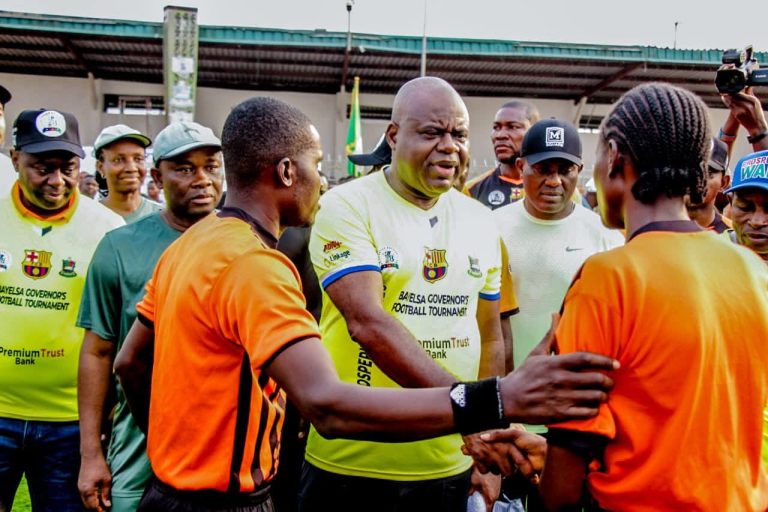
Bayelsa Governor’s Cup: Akpe Gives Thumbs Up To Organizers, Quality Of Grassroots Football
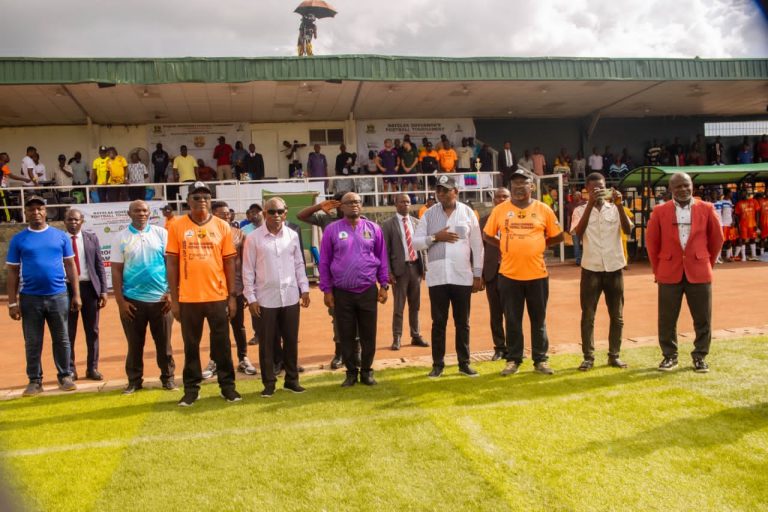
The Deputy Governor of Bayelsa State, Dr. Peter Akpe, has expressed satisfaction with the general standard of organization and quality of football on display in the 2026 edition of the Bayelsa Governor’s Cup.
Dr. Akpe gave the passmark while fielding questions from newsmen at the main bowl of the Samson Siasia Stadium in Yenagoa on Thursday, during the halftime break of the third-place match between Mountain of the Lord’s Deliverance Ministry, MLDM, Odi, and Crusaders FC of Peretorugbene.
The Deputy Governor, who performed the ceremonial kick-off for the match, described Bayelsa as the hub of grassroots football in the country, reiterating that the yearly competition is aimed at harnessing budding football talents as well as dissuade youths away from crimes and criminality.
According to Dr Akpe, the players featuring in this years edition of the largest grassroots soccer tournament in Nigeria were drawn from all the local government areas of the state.
The Bayelsa Number Two Man expressed confidence that some bright talents discovered from the competition would find their way into big football clubs in the domestic and foreign leagues.
Responding to concerns raised about the dwindling fortunes of Bayelsa United, Dr. Akpe assured that proactive steps were being taken to change the narrative of the Prosperity Boys in the Nigerian Football League.
His words: “I think the purpose for which this event is organized is being achieved by my assessment. Through this programme we have discovered great talents and we will continue to discover more and export them to the Nigerian League and the world.
”From what we have seen so far, I think there is very high level of improvement in the tournament. As a state and even at the level of the country, we should take grassroots sports development seriously.
”If you forget the grassroots, that means your investment will yield little or nothing. That is why I commend the organizers of this grassroots tournament for going to all the nooks and crannies of Bayelsa State. ‘
”On the issue of Bayelsa United, I will not divulge our plans and what we are doing about it. I agree with you that it is a challenge to us. But you know that when you have challenges you go back to the drawing board.
”This grassroots event is what we are really going to encourage to see how we are going to put ourselves back in where we have been before. I can assure you that our team will bounce back again.”
At the end of the game, Mountain of the Lord’s Deliverance Ministry, MLDM, FC of Odi beat Crusaders FC of Peretoru 4-3 on penalties after a three all draw in regulation time.
Present at the ceremony were; the Chairman , Bayelsa State House of Assembly Committee on Sports, Hon.Tare Porri; Commissioner for Sports Development Chief Daniel Igali, the Director General, Bayelsa Governor’s Football Tournament, Mr Ono Akpe, the Permanent Secretary, Ministry of Sports Development, Mr. Pere Efeke and the Director of Sports Bayelsa State Sports Council, Mr. Bibowei Lambert as well as FC Barcelona of Spain Scouts, Mr Alberto Lafuente and Bernat Villa Gorriz.
Prosperity Cup 2026: Okoroma United in Historic Win
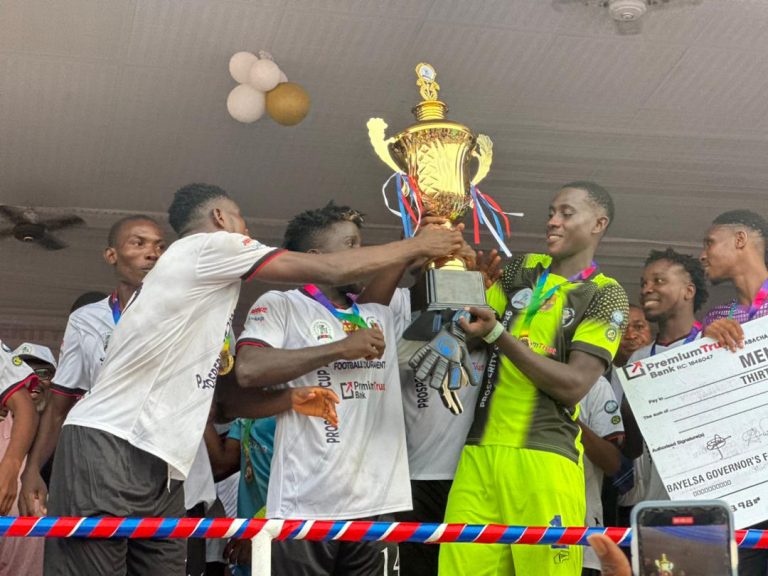
…As Bayelsa State Government Signs FC Barcelona MoU
Okoroma United of Okoroma from Nembe Local Government Area and debutants, Active Ladies of Agudama have emerged the men and women’s champions of Nigeria’s biggest grassroots football fiesta, the Bayelsa Governor’s Football Tournament, tagged the Prosperity Cup.
Okoroma United pipped hard-fighting Akinima/Biogbo one nil to win a historic tournament. Erasmus Noble on 18 minutes gave the Nembe side the deserved victory in an encounter decided at the Samson Siasia Stadium, Yenagoa.
Active Ladies in the women’s category beat defending champions, Afini Ladies of Amarata by a lone goal courtesy of Ughwumioma Charity’s 32nd minute strike to ensure that they go home with the trophy and prize money.
Champions, Okoroma United received ₦30,000,000 for their effort, second placed Akinima/Biogbo went home with ₦10,000,000, Mountain of the Lord Deliverance Ministry, MLDM FC who finished third got ₦5,000,000 while 4th placed Krosaders FC smiled home with the sum of ₦2,000,000.
Women’s champions, Active Ladies were rewarded with the sum of ₦10,000,000 for their effort, second position received ₦5,000,000, third placed team got ₦2,000,000 while the 4th placed got ₦1,000,000, along with other consolation prizes.
Para-Soccer champions, Shadrack Sports Academy got ₦1.5 million naira for their triumph, with the total prize money amounting to ₦80,000,000.
The final also witnessed an historic signing of the Memorandum of Understanding, MoU for the setting up of the FC Barcelona-affiliated Bayelsa Starlets Academy.
Declaring the tournament closed, an elated Governor of Bayelsa State, Senator Douye Diri, said he was pleased with the continuous growth of the tournament, maintaining that his administration has used the Prosperity Cup to empower the youths of the State.
The governor, who described sports as a global event, remarked that the competition was one of the programmes he inherited from his predecessor and invested hugely in it to empower the youths, pointing out that beyond politics, football has become a means of livelihood.
He acknowledged that the introduction of the women’s category improved the quality of football in the competition, stressing that the continuous increase in the number of clubs participating in the showpiece reflects the growth of the tournament.
The State helmsman noted that he wants to see the government disengaging completely from football and indeed all sports, pointing out that the essence why only football could thrive in the country was because of the private sector involvement.
While commending the organizers of the tournament for the smooth organization of the competition, the governor asserted that he was elated with the increase in sponsors yearly in the competition and that he hoped to see the tournament standing independently without government involvement.
Managing Director/CEO, Premium Trust Bank, Dr. Emmanuel Efe Emefienim represented by the Chief Operating Officer, South South, Dr. Aniebet Offiong, said beyond the delivery of premium services to customers, the institution is poised for the development of sports.
Also, former President of the Nigeria Football Federation, NFF, Mr. Amaju Pinnick commended the governor’s intentionality in the development of sports, pointing out that the total display of talents in the final was unprecedented.
Earlier in an address of welcome, a completely fulfilled Director General of the tournament, Mr. Ono Akpe, opined that this year’s edition was unique as a result of the competition’s international identity, stating that the signing of the MoU reflects the state government’s commitment to bettering the lot of the youths.
He lauded the sponsors, Premium Trust Bank, Linkage Assurance Nig Ltd, Niger Delta Development Commission (NDDC), Nigeria Content Development and Monitoring Board (NCDMB), Nigeria Customs Service, Binad Table Water, Agco Engineering and the Bayelsa State Board of Internal Revenue for the unwavering support to the tournament.
Shortly after signing the MoU, Technical Director, Bernat Villa Gorriz, said they are elated to be part of the historic event.
Okoroma United coach, Ebinimi Festus and Akinima/Biogbo gaffer, Ibomotimi Fyneface in separate post-match interviews, affirmed the huge improvement in this year’s tournament.
NDDC Speeds Up Construction Of Kaa-Ataba Bridge In Rivers
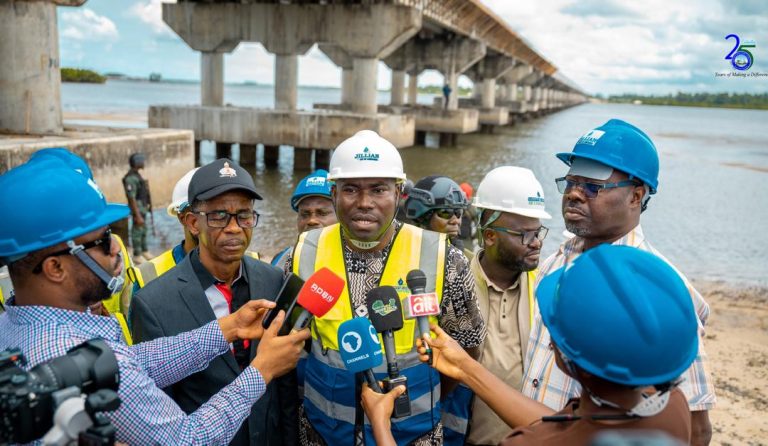
The construction work on the 1.2-kilometre Kaa-Ataba Bridge in Rivers State, being undertaken by the Niger Delta Development Commission, NDDC, has reached an advanced stage and is expected to be delivered soon.
Speaking at the Project site, the Managing Director of the construction firm, Engineer Christian Emeozor, described the multi-billion-naira project as ambitious and impactful, linking the Khana Local Government Area to the Andoni Local Government Area of Rivers State.
Emeozor assured that his company was making every effort to complete the job expeditiously. He noted that irregular tidal waves had hampered the delivery of construction materials to the site and affected the schedule for crossing the remaining beams on the bridge.
According to Emeozor, the construction firm had made efforts to address adverse weather conditions, which had contributed to delays in completing the project. He promised that more men and materials would be committed to the project to ensure that it was delivered on schedule.
He said that, despite the challenges, the bridge project would be tackled with sufficient manpower and equipment to compensate for the reduced working hours due to the unfavourable weather conditions.
Emeozor expressed satisfaction with the conduct of the host communities, applauding them for their support and cooperation in executing the project. He noted that the project would open up the communities in the area, reduce accidents associated with crossing the river, and boost socio-economic activities.
He observed: “The bridge project will improve the quality of life of the people of Kaa and Ataba, as well as help transport farm produce, goods and properties from the rich agricultural area.”
He assured his company would do everything necessary to ensure the project’s early completion, declaring, “We are committed to delivering on speed and quality.”
Recall that the NDDC Managing Director, Dr Samuel Ogbuku, recently briefed President Bola Tinubu on the progress made on the Kaa-Ataba Bridge and other legacy projects of the Commission.
Prosperity Cup: Okoroma United Face Akinima/Biogbo FC In Mouth-watering Final
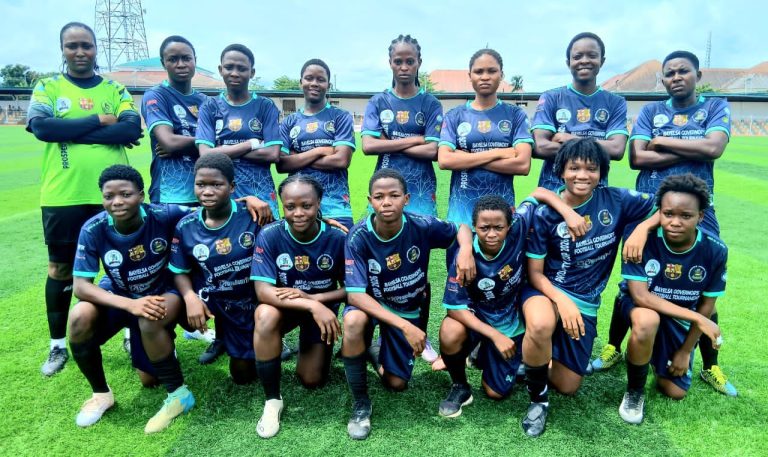
… As Afini Again, Reach The Final
Akinima/Biogbo FC of Ogboloma in Yenagoa Local Government Area and Okoroma United from Okoroma in Nembe LGA will battle for the ₦30,000,000 prize money in Nigeria’s biggest grassroots football fiesta, the Bayelsa Governor’s Football Tournament, tagged the Prosperity Cup.
Akinima/Biogbo beat former champions, Krosaders FC of Peretorugbene by two goals to one in an encounter decided at the Samson Siasia Stadium, Yenagoa, to qualify for the final of the tournament for the first time.
Defending champions, Afini Ladies of Amarata square up against Active Ladies in the women’s category. Goals from Augustine Chidinma, Favour Ufiaka, Ogolo Blessing at halftime on 17, 25 and 30 minutes respectively gave Afini Ladies the well-deserved victory.
Okoroma United in the first semi-final overpowered Mountain of the Lord Deliverance Ministry, MLDM FC by three goals to two to reach a historic tournament final.
A hat trick from Noble Erasmus on 5, 54, 73 minutes was all Okoroma needed to sail through. Goals by midfielder, Omoro Bright on 45 minutes and James Ofiefemote just before the final whistle were not enough to see MLDM FC through to the final of the competition.
The third place match will see Krosaders FC up against MLDM FC of Odi at 3.00pm while Ezougha Queens will entertain Bayelsa Stars in the women’s category at 1.00pm.
The FC Barcelona/Prosperity Cup scouting programme entered day two with beautiful display of football by players in the Under-15 and Under-19 categories.
The Prosperity Cup/Barcelona FC partnership, facilitated by Sylvester Okonkwo of Whiz-kid Ventures of the Netherlands, will culminate into the establishment of a world-class football academy in Yenagoa, where products of the Bayelsa Governor’s Football Tournament would be nurtured and mentored as the historical signing of the MoU gets underway this weekend.
The Member representing Yenagoa Constituency 1 in the Bayelsa State House of Assembly, Chief Ayibanegiyefa Egba, noted that the competition has given a new direction to the development of female football in the State.
According to her, football has moved from a recreational activity to a money-spinnng venture, urging the young ladies to combine their sporting career along side education, which will serve as a buffer after retirement from active sports.
A visibly satisfied coach of Akinima/Biogbo, Ibomotimi Fyneface in his post-match reaction, said the victory reflects the commitment and the determination of the team, pointing out that their aim was to lift the trophy and smile home with the N30 million prize money.
Also, Man of the match, Omasua Wisdom, said he was pleased with the show of determination by his team mates throughout the encounter, that their attention has now moved to the final of the tournament coming up on Friday, May 8, 2026.
FC Barcelona Officials Impressed With Facilities on Ground
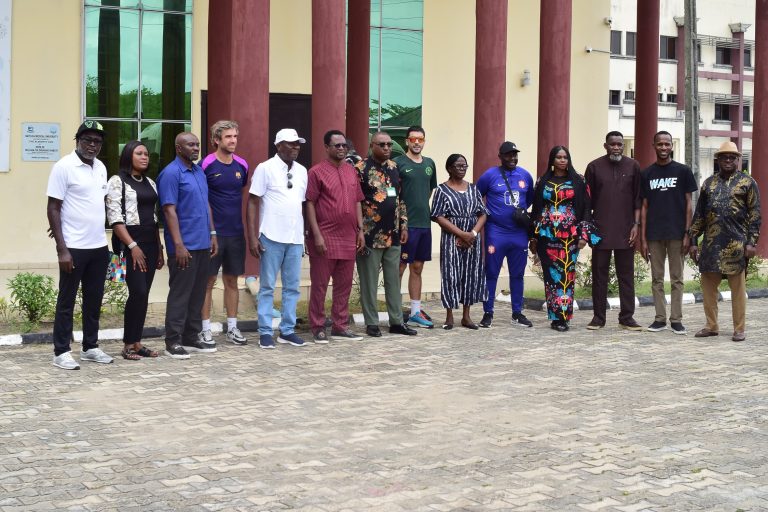
… As Grand Finale of Prosperity Cup Gets Underway.
Ahead of the official signing of the Memorandum of Understanding, MoU that will pave the way for the setting up of the FC Barcelona-affiliated Bayelsa Starlets Academy, officials of the Spanish football giants have expressed satisfaction with facilities on ground.
The FC Barcelona officials made the assertion while speaking shortly after a facilities tour to the Bayelsa Medical University, BMU Hostels, the Sampou campus of the institution, Belary Montessori International School, along Tombia/Imiringi Road and the ongoing 30,000-capacity stadium at Igbogene in Yenagoa, the State capital.
The tour, which was led by the Director General of the Prosperity Cup, Mr. Ono Akpe, alongside the Permanent Secretary of the Bayelsa State Ministry of Sports Development, Mr. Pere Efeke, was to ascertain the suitability and level of construction work done on the facilities, expected to facilitate the take-off of the Bayelsa Starlet Academy.
While speaking shortly after the tour, FC Barcelona Technical Adviser, Mr Alberto Lafuente, said
he was pleased with what he saw on ground during the visit.
Mr Lafuente, who noted that the state government was being intentional in its plan to set up the Bayelsa Starlets Academy, said the academy, when fully operational, would rewrite the story of grassroots footballers in the state in the nearest future.
Also, Permanent Secretary, Ministry of Sports Development, Mr. Pere Efeke remarked that the ministry was committed to the development of sports, stating that the academy would take the youths off the streets.
He stated that the ongoing construction work at the stadium would be completed at the stipulated time, maintaining that the Prosperity Cup has become the pride of grassroots football in the country.
Earlier, Vice Chancellor, Bayelsa Medical University, BMU, Prof. Dimie Ogoina represented by Deputy Vice Chancellor, Prof. Ligha Aloysius Ebi, noted that beyond the award of certificates, the institution accords priority to sports development.
Director General of the tournament, Mr Ono Akpe earlier in an address, said Sampou would be the permanent site for the academy, that the target would be for players to combine education and their football career.
Meanwhile, in the on-going Prosperity Cup, the third place matches for both men and women will come up on Thursday, 7th of May, 2026 at the Samson Siasia Stadium where the Mountain of the Lord Deliverance Ministry, MLDM FC will battle Krosaders FC at 3.00pm
Ezeougha Oueens will face Bayelsa Stars in the women’s category at 1.00pm, with the grand finale in both the men and women’s categories, slated for Friday, 8th of May, 2026.
Be Fair To All Contestants, Gov Diri Charges IYC Electoral Committee
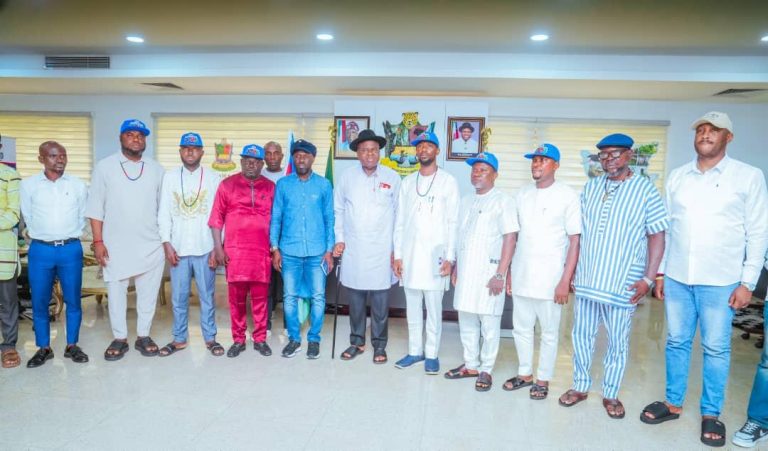
Governor of Bayelsa State, Senator Douye Diri, has advised the electoral committee for the forthcoming Ijaw Youth Council (IYC) election to be fair to all contestants and ensure a credible process.
Governor Diri gave the charge on Tuesday when the IYC President, Comrade Jonathan Lokpobiri, presented the Dr. Charles Ikimi-led electoral committee to him at Government House, Yenagoa.
A statement by Chief Press Secretary, Daniel Alabrah noted that the Bayelsa governor said a lot rests on the shoulders of Ikimi and members of his committee, urging them to avoid the recent election-related crisis in the Ijaw National Congress (INC).
He assured of his administration’s support for the Ijaw nation’s topmost youth organisation but warned against its involvement in partisan politics.
Governor Diri said he was closely monitoring the IYC activities, including its recent convention that produced a new constitution, which he noted would address issues challenging its existence.
He said: “As the electoral committee, a lot rests on your shoulders. I will not want a repeat of what played out during the recently held Ijaw National Congress election here in Yenagoa. Make sure you are fair to all contestants in the election.
“My administration will continue to give the needed support for the Ijaw Youth Council to grow. However, the body must not be politicised as we have witnessed in other quarters.
“I have followed the activities of the council closely, including the convention that produced its constitution. I am delighted that the IYC has successfully drafted a document to address the issues challenging its existence.”
Diri admonished the organisation’s leadership not to forget the history of the Ijaw struggle birthed by the late Major Isaac Adaka Boro, and that it should work with the INC to speak against issues of injustice and environmental genocide in the Niger Delta region.
He also commended the outgoing leadership for initiating the construction of a permanent secretariat for the council.
Earlier, Comrade Jonathan Lokpobiri, in his remarks, expressed gratitude to Governor Diri for his consistent support to the council.
Lokpobiri, while formally presenting the electoral committee for the 2026 IYC National Convention, noted that the committee will oversee the election scheduled for July 11, 2026.
He stated that the council had successfully produced the final copy of its constitution, saying it was an achievement that had eluded past leaderships.
The IYC leader explained that the constitution serves as the guiding framework for activities of the body.
Lokpobiri also informed the governor that this year’s Boro Day celebration would be the last under his leadership and that he intends to make it memorable.
He added that the council had undertaken the construction of a complex comprising a training centre, workshop and administrative block through the support of individuals and organisations committed to development of the Ijaw nation.
Okoroma United, Krosaders FC, Others, Advance to the Semi-finals
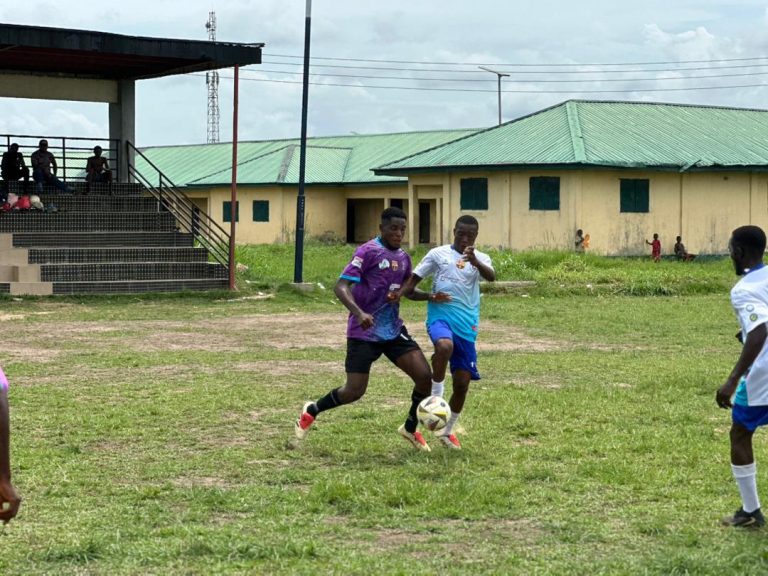
… What the Stats Say
After two months of scintillating football across thirty different centres. in the Bayelsa Governor’s Football Tournament, also known as the Prosperity Cup, the men have been separated from the boys.
Nembe LGA champions, Okoroma United at the Otuasega centre thrashed Mini FC of Minibie by four goals to one to progress to the semi finals. A brace from Itaribo Opubo on 13 and 27 minutes, Bebeto Nike on 23 and Alkali Murphy’s 81 minutes’ goal were all Okoroma needed to wrap up the match. Mini FC’s Alkali Nelson pulled one back, a consolatory effort that was too little too late.
In the second game at the Otuasega Township Stadium, former champions, Krosaders FC of Peretorugbene pipped hard-fighting Mountain of Fire Ministry (MFM) FC by a lone goal, courtesy of Moses Anthony’s beautiful, textbook strike.
Elsewhere, Akinima/Biogbo of Ogboloma at the Golf pitch, Onopa ended the enterprising Kolobiriowei FC of Bolu-Orua’s fairy tale run in the tournament, with a 4-2 victory via penalty shootout after a one-all draw in regulation time
Mountain of the Lord Deliverance Ministry (MLDM) FC of Odi delivered a clinical job with a three nil bashing of Izuo Gillette FC of Kpansia in their match decided at the Onopa centre.
Miesefe Benson put MLDM FC in front on 32 minutes. Shaka ThankGod and Oweifa Richmund compounded Izuo Gillette’s woes few minutes before the final whistle to send the church boys into the semi finals.
Meanwhile, a total of 530 goals were scored in 220 games in the preliminary round. A hundred and eighty of the 220 matches were decided in regulation time while 40 games were settled via penalty shootout, averaging 2.41 goals per match.
The round of 32 fixtures recorded 34 goals, with 11 matches ending in regulation time while five games were settled via penalty shootouts, and averaging 2.13 goals per match.
Eleven goals were scored in eight matches in the round of 16 matches, five games were decided in regulation time while three were decided via penalty shootouts, averaging 1.38 goals per match.
The quarter-finals produced 10 goals, with three of the four matches decided in regulation time while one fixture was settled via penalty shootout, averaging 2.5 goals per match.
The semi-final ties for both men and women will commence on Monday, 4th May, 2026 alongside the FC Barcelona scouting programme, at the Samson Siasia Stadium, Yenagoa.
Prosperity Cup: Okoroma United, Active Ladies Reach Historic Tournament Final
… As FC Barcelona/Prosperity Cup International Scouting Exercise Enters Day Two
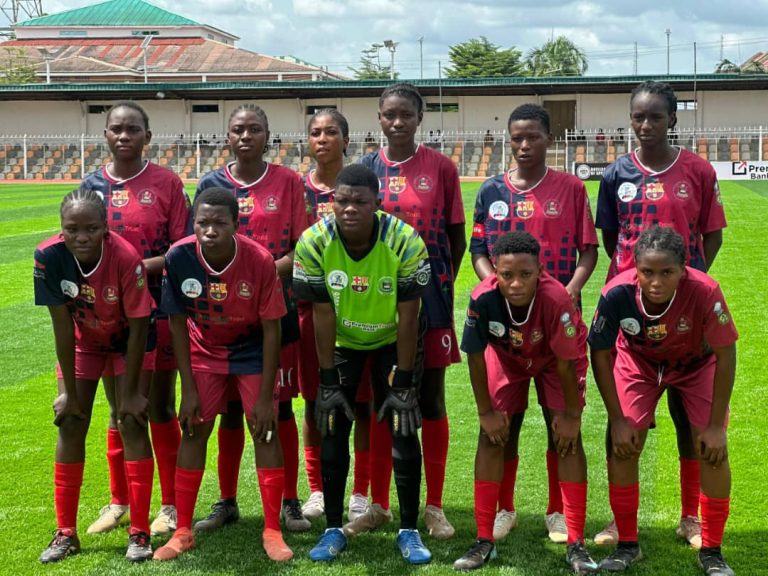
Okoroma United of Okoroma in Nembe Local Government Area, Active Ladies Football Academy of Agudama have both qualified for the men and women’s final in Nigeria’s biggest grassroots football fiesta, the Bayelsa Governor’s Football Tournament, tagged the Prosperity Cup.
Nembe LGA champions, Okoroma United overpowered entertaining Mountain of the Lord Deliverance Ministry, MLDM FC by three goals to two in an encounter decided at the Samson Siasia Stadium to reach an historic tournament final.
A hat trick from Noble Erasmus on 5, 54, 73 minutes and midfielder Omoro Bright’s 45 minutes, as well as James Ofiefemote’s goal just before the final whistle for MLDM FC were not enough to see them through to the final of the competition.
Okoroma United will now face the winners of the second semi-final tie between Krosaders FC of Peretorugbene and Akinima/Biogbo of Ogboloma on Tuesday, 5th May at the Samson Siasia Stadium at 4.00pm
Active Ladies FA in the first semi-final of the women’s tournament beat last year’s finalists, Ezougha Queens 3-0 on penalties after a barren draw in regulation time to reach their first Prosperity Cup final.
The second semi-final fixtures will come up on Tuesday, 5th May, 2026 as defending champions, Afini Ladies of Amarata tackle Bayelsa Stars at 2.00pm while the men’s semi final will kick-off at 4.00pm at the Samson Siasia Stadium, Yenagoa.
Earlier in the day, the three-day FC Barcelona/Prosperity Cup scouting programme, aimed at discovering budden talents, got underway.
The exercise monitored by FC Barcelona officials led by FC Barcelona Directors, Bernat Villa Gorriz and Alberto Lafuente, saw Mustapha FA triumphing three nil over Yenagoa City FA in the U-15 category while Bayelsa Starlets played out a barren draw with Silina FC in the U-19 category.
The Prosperity Cup/Barcelona FC partnership, which was facilitated by Sylvester Okonkwo of Whiz-kid Ventures of the Netherlands, will culminate into the establishment of a world-class football academy in Yenagoa, where products of the Bayelsa Governor’s Football Tournament would be nurtured and mentored as the historical MoU signing gets underway this weekend.
The Member representing Sagbama Constituency 3 in the Bayelsa State House of Assembly, Mrs Ebizi Ndiomu-Brown, noted that the Prosperity Cup has improved the quality of women’s football in the State, adding that she was optimistic that products of the tournament will soon graduate into the national teams.
Mrs. Ndiomu-Brown reaffirmed her continued commitment to youth empowerment and community development through sports.
She lauded the governor, Senator Douye Diri and his Deputy, Dr. Peter Akpe for their invaluable contributions to the development of sports in the last six years of the Prosperity administration.
Victorious coach of Okoroma United, Ebinimi Festus in his post match reaction, said his team came prepared for the tournament, pointing out that their aim was to go home with the 30,000,000 prize money of the tournament.
Also, coach of MLDM FC, Collins Robert, attributed his team’s defeat to their poor outing in the first half and costly mistakes by the goalkeeper, maintaining that the team did not play to his instructions.
NDDC Reaffirms Commitment To Institutional Reforms
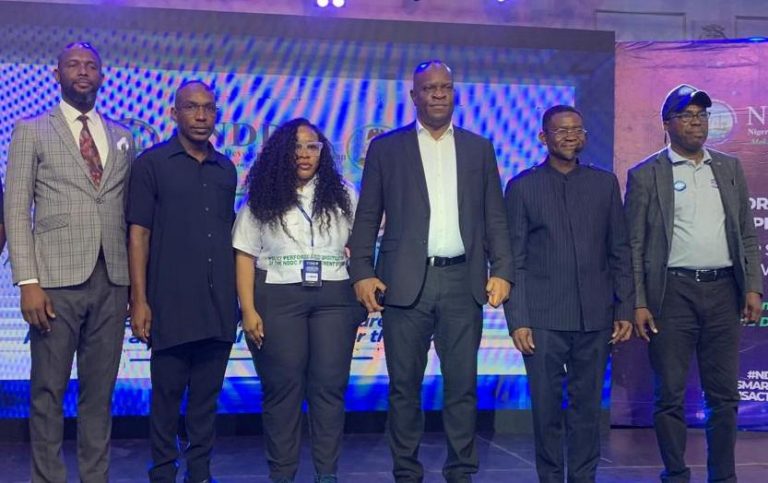
The Niger Delta Development Commission, NDDC, has reaffirmed its commitment to implementing the Federal Government’s digital transformation policy, particularly regarding procurement reforms, as part of efforts to promote transparency, efficiency, and accountability within the Commission.
Speaking during a Stakeholders and Service Providers Sensitisation and Training Workshop in Warri, Delta State, the Director, Procurement Department, NDDC, Dr Chuks Osuji, said the initiative was meant to educate key stakeholders, including government officials, procurement officers, consultants and contractors, private-sector vendors, and civil society organisations, on recent reforms and the transition to a fully digitised procurement framework.
A statement by NDDCs Director, Corporate Affairs,Seledi Thompson-Wakama noted that Osuji, who was represented by the Deputy Director, Procurement, Mr Tumi Grant, said that the NDDC was determined to adopt global best practices and improve service delivery. He underscored the importance of equipping stakeholders with the knowledge and tools needed to engage effectively with the digitised procurement system.
He noted: “This effort is part of a broader commitment to modernised procurement practices, which reduces inefficiencies and ensures value for money. Digitisation will make the work easier; you can do your bidding from anywhere, without the bottleneck of the manual process. It will end nepotism, bureaucracy, and illegality in the process.”
In his remarks, the NDDC Director, Delta State Office, Engr. Onoriode Omo-Udoyo, stated that the Federal Government’s directive on the digitisation of operations of all Ministries, Departments, and Agencies, MDAs, must be fully implemented. He observed that procurement, as a key interface between the Commission and contractors/service providers, had its own specific digital template.
He explained that the workshop was organised to sensitise and educate stakeholders on the Commission’s digitised procurement process, ensuring proper understanding and seamless integration into the new system.
He further highlighted that the digitisation of procurement would improve efficiency, enhance transparency and accountability, and reduce delays and irregularities associated with manual processes. He urged participants to actively engage and take full advantage of the workshop as the Commission transitions to a more efficient and accountable procurement regime.
Presenting a paper on policy reform and transparency in procurement, one of the resource persons, Dr Rex Ugulu, a Research Coordinator in Procurement Management at the Federal University of Technology, Owerri, outlined the concept and importance of public procurement in economic development, service delivery, and accountability.
He emphasised the need for the transition from traditional procurement methods to digital systems, noting that procurement automation enhances transparency, reduces corruption, and improves efficiency.