Saturday, June 13, 2026
Home Blog Page 231

Ward Delegate Election: Edo PDP commends NWC, electoral C’ttee, others for peaceful process

0

The Edo State People’s Democratic Party, PDP, has commended the National Working Committee (NWC) of the Party, the Electoral Committee and other organs of the Party for conducting a peaceful and successful Ward Delegates Election.

A press statement signed by the Edo State PDP Organising Secretary, Mr. Tony Anenih Jnr., on 4th of February, 2024 said that the process which was observed by the Independent National Electoral Commission (INEC) and various civil society groups was reported to be mostly peaceful across the State with only one incident at Jattu, the hometown of the Deputy Governor, Rt. Hon. Philip Shaibu, where eight of the officials heading to Etsako Central Local Government Area for the election were abducted.

“The ward delegate election to elect the three adhoc delegates have been concluded across the 18 Local Government Areas (LGAs) and 192 wards in the State.

“The electoral officers who concluded the elections have since returned with results from the election handed over to the electoral committee set up by the National Working Committee of the party.

“The process which was observed by the Independent National Electoral Commission (INEC) and various civil society groups was reported to be mostly peaceful across the State with only one incident at Jattu, the hometown of the Deputy Governor, Rt. Hon. Philip Shaibu, where eight of the officials heading to Etsako Central Local Government Area for the election were abducted.

“The party hereby calls on the Inspector General of Police (IGP) to order a swift investigation of the incident and promptly ensure the release of the affected officials, whose families are troubled by the fate of their loved ones.

“Edo State chapter of the PDP by this medium express profound gratitude to leaders of our great party, the National Working Committee, the Ward Electoral Committee and all organs of the party for their keen supervision of this process that has resulted in a successful ward delegate election.

Over 50% Certificates Of Imported Pharmaceutical Products Fake — NAFDAC

0

The National Agency for Food and Drug Administration and Control said more than 50 per cent of certificates of pharmaceutical products that are imported into Nigeria are fake.

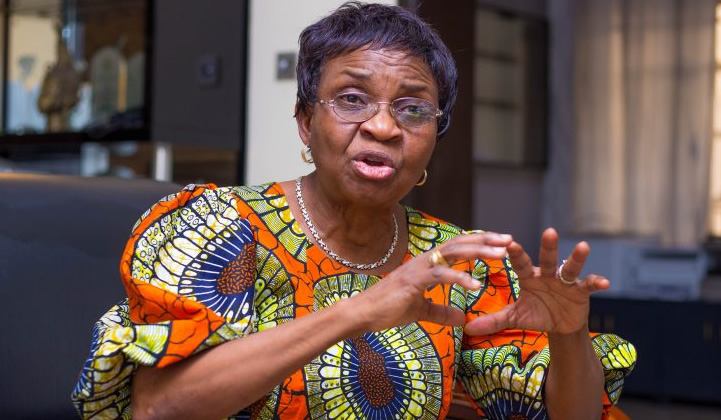
The Director-General of NAFDAC, Prof Mojisola Adeyeye, disclosed this at the stakeholders’ engagement meeting with regulators, policymakers, and law enforcement agencies on Monday in Abuja.

The certificate of a pharmaceutical product is issued in the format recommended by the World Health Organisation, and it establishes the status of the pharmaceutical product and the applicant for the certificate in the exporting country. It is for a single product only since manufacturing arrangements and approved information for different dosage forms and different strengths can vary.

Adeyeye said the goal of the engagement meeting with the stakeholders is to ensure that medical products in circulation are of the right quality, safe, and efficacious.

She said that substandard and falsified products threaten access to safe efficacious and affordable medicines, and undermine the achievement of universal health coverage in Nigeria, and Africa.

“We have 55 countries in Africa and we belong to the Member States globally and we agreed to ensure that products coming to the region are of quality and WHO created a scheme called certificate of pharmaceutical product, and what this means is that if we send a certificate of pharmaceutical product out to another country, we are assuring the receiving country that it will be of quality.

“Most of our medicines come from South East Asia and we belong to the member states too. We have a scheme where before medicines that were approved leave that part of the world, we do pre-shipment testing, and that comes with CPP to assure us of quality, but that is not the case, because through our scheme we have been able to stop over 140 products that were approved from coming in.

We found out that more than 50 per cent of the CPPs that come into our country are fake. Part of the responsibility is our people that go to China or India and we are going to deal with it. It’s a Member States issue, and we are going to deal with it.

“We are very stringent than ever and there is no cutting of corners, we have blacklisted many companies, we have sanctioned them because we want people to respect our people. Trade is a mutual agreement and if that agreement is harming one part of the agreement, we will stop it. If a company is suspected to be compromising, in two hours we will be there, and we will shut the company down,” she noted.

The NAFDAC boss lamented that the relatively high prevalence of substandard and falsified medicines in Africa is a major threat to public health.

According to her, the prevalence of substandard and falsified medicines in the region is due to limited regulation processes.

“Only about 10 per cent of national regulatory agencies have attained maturity level three. What leads to maturity level three is market control, and that is one of the nine models of maturity level three, so we have a lot of work to do in Africa.

“The NAFDAC’s mandate puts a burden on us to see a reduction in substandard and falsified medicines, both the ones that are locally manufactured and the ones that are imported.

“NAFDAC is doing its best to fight substandard and falsified medicines and products based on three thematic areas, which are to prevent, detect, and respond. It is a community effort to fight this and we seek partnership to find out lapses so we can fight it,” she stated.

In 2022, the WHO certified NAFDAC as a stable, well-functioning, and integrated regulatory system maturity level 3 rating scale of the Global Benchmarking Tool.

According to WHO, NAFDAC is eligible for inclusion into the transitional WHO Listed Authority, a list that will comprise the world’s regulators of reference – that is, regulatory authority that should be globally recognised as meeting WHO and other international standards.

The ML 4 status is the highest in the WHO’s classification of regulatory authorities for medical products.

AFCON: Nigeria High Commission Issues Advisory To Nigerians In South Africa

0

Avoid wild celebrations

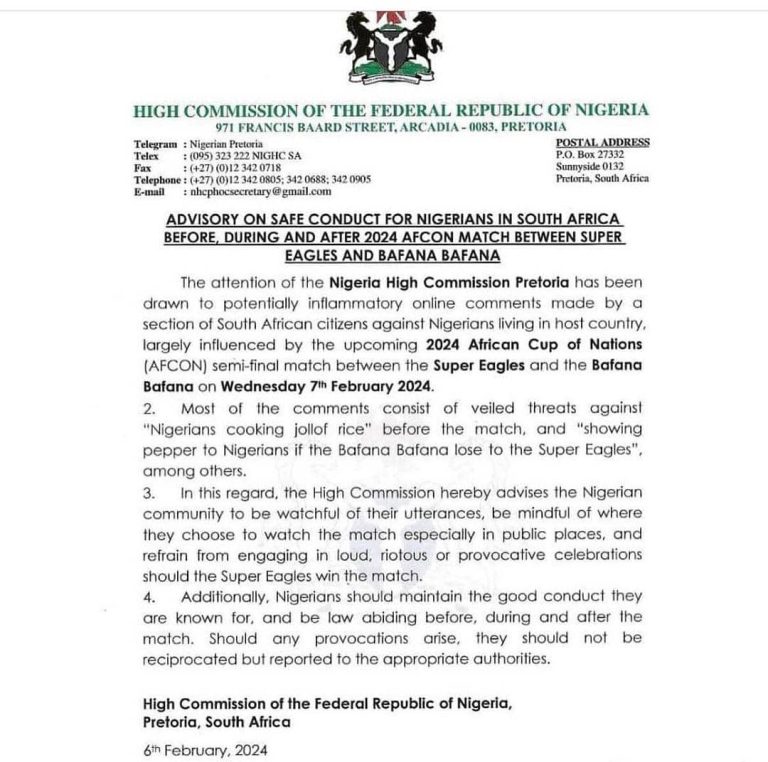
HIGH COMMISSION OF THE FEDERAL REPUBLIC OF NIGERIA 971 FRANCIS BAARD STREET. ARC:ALMA -11083. PRETORIA

ADVISORY ON SAFE CONDUCT FOR NIGERIANS IN SOUTH AFRICA BEFORE, DURING AND AFTER 2024 AFCON MATCH BETWEEN SUPER EAGLES AND BAFANA BAFANA

The attention of the Nigeria High Commission Pretoria has been drawn to potentially inflammatory online comments made by a section of South African citizens against Nigerians living in host country, largely influenced by the upcoming 2024 African Cup of Nations (AFCON) semi-final match between the Super Eagles and the Bafana Bafana on Wednesday February 2024.

2. Most of the comments consist of veiled threats against “Nigerians cooking jollof rice” before the match, and “showing pepper to Nigerians if the Bafana Bafana lose to the Super Eagles“, among others.

3. In this regard, the High Commission hereby advises the Nigerian community to be watchful of their utterances, be mindful of where they choose to watch the match especially in public places, and refrain from engaging in loud, riotous or provocative celebrations should the Super Eagles win the match.

4. Additionally, Nigerians should maintain the good conduct they are known for, and be law abiding before, during and after the match. Should any provocations arise, they should not be reciprocated but reported to the appropriate authorities.

High Commission of the Federal Republic of Nigeria, Pretoria, South Africa
February, 2024.

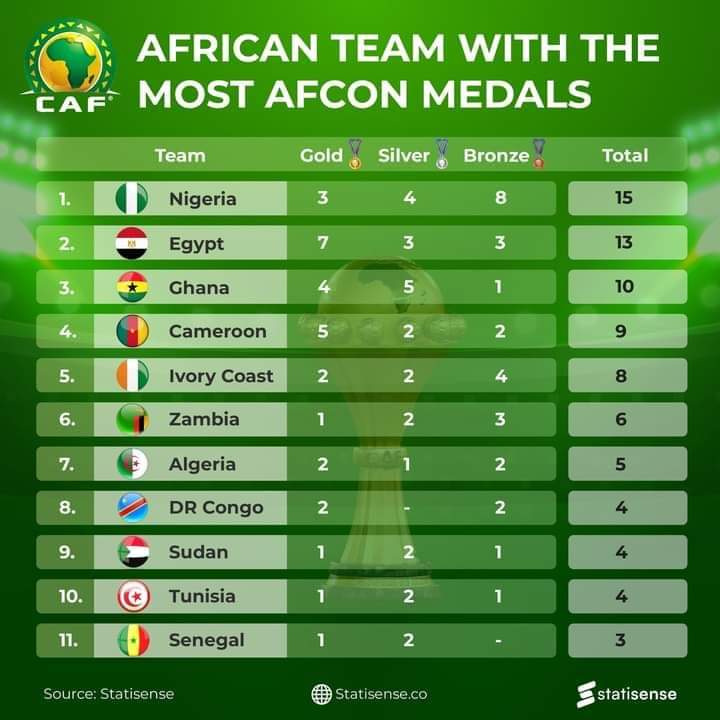
African Teams With The Highest AFCON Medals In History

0

Nigeria has now qualified for its 16th Semi-finals of AFCON.

Played in 7 Finals 👏

Won 3 (1980, 1994, and 2013)

2nd Place 4 times (1984, 1988, 1990, and 2000)

3rd Place 8 times (1976, 1978, 1992, 2002, 2004, 2006, 2010, and 2019)

15 AFCON MEDALS…
Winner: 🏆🏆🏆
2nd Place: 🥈🥈🥈🥈
3rd Place: 🥉🥉🥉🥉🥉🥉🥉🥉

#Statisense
We are winning the edition too 🇳🇬⚽🏆

#ATM https://www.facebook.com/story.php?story_fbid=pfbid02u9mJMd9QTmz4Nwqef9XY9VivT9pZMjVhgNvNgLNXrpTWwmDVKfVcbNNeKiqZywV3l&id=545422658&post_id=545422658_pfbid02u9mJMd9QTmz4Nwqef9XY9VivT9pZMjVhgNvNgLNXrpTWwmDVKfVcbNNeKiqZywV3l&mibextid=Nif5oz

19 Likes

NIGERIA’S PREVIOUS AFCON GLORIOUS OUTINGS

-1). Nigeria 1980 AFCON

https://www.youtube.com/watch?v=-NkbsIoJLtU?si=0sJrAaaZzV5TqIAQ
-Scoreline: Nigeria 3 – Algeria 0
-Winners: Nigeria
-Team Lineup:
Goalkeepers: Best Ogedegbe, Emmanuel Okala, Moses Effiong

Defenders: David Adiele, Johnny Orlando, Sylvanus Okpala, Okey Isima, Tunde Bamidele, Godwin Odiye, Christian Chukwu

Midfielders:  Mudashiru Lawal, Alloysius Atuegbu, Henry Nwosu, Kadiri Ikhana, Frank Nwachi

Forwards: Ifeanyi Onyedika, Segun Odegbami, Adokiye Amiesimaka, Martin Eyo, Charles Bassey, Shefiu Mohammed

Coach: Otto Gloria.

-2). Tunisia 1994 AFCON:

https://www.youtube.com/watch?v=3TX3TU5KpJk?si=NkPKLHcOjZWzHADl
Scoreline: Nigeria 2 – Zambia 1.
-Winners: Nigeria.
-Team Lineup:

Goalkeepers: Peter Rufai, Wilfred Agbonavbare, Alloy Agu

Defenders: Stephen Keshi, Austin Eguavoen, Uche Okafor, Uche Okechukwu, Isaac Semitoje, Ben Iroha, Nduka Ugbade

Midfielders: Sunday Oliseh, Mutiu Adepoju, Edema Fuludu, Thompson Oliha, Austin Okocha, Efan Ekoku

Forwards: Rashidi Yekini, Samson Siasia, Daniel Amokachi, Emmanuel Amuneke, Victor Ikpeba, Finidi George

Coaches: Clemence Westerhof, Bonfere Jo.

-3). South Africa 2013 AFCON:

https://www.youtube.com/watch?v=T1aadEHqBbQ?si=Spq7NaehDwhlkOaK
-Scoreline: Nigeria 1 – Burkina Faso 0.
-Winner: Nigeria.
-Team Lineup:

-Coach: Late Stephen Keshi.

8 Likes 2 Shares

The Nigerian national team

King Charles III Diagnosed With Cancer

0

King Charles has been diagnosed with a form of cancer, says Buckingham Palace.

It is not prostate cancer, but was discovered during his recent treatment for an enlarged prostate.

The type of cancer has not been revealed, but the palace said the King began “regular treatments” on Monday.

Buckingham Palace says the King “remains wholly positive about his treatment”. He will postpone his public engagements, with senior royals expected to stand in for him.

The King “looks forward to returning to full public duty as soon as possible”, the palace said.

No further details are being shared on the stage of cancer or a prognosis.

The King informed both his sons personally about his diagnosis and Prince William was said to be in regular contact with his father.

Prince Harry, who lives in the United States, spoke to his father and will be travelling to the UK to see him in the coming days.

Statement in full: King diagnosed with cancer
William to return to work after Kate’s surgery
The King, 75, returned to London from Sandringham in Norfolk on Monday morning and the palace says he has commenced treatment as an outpatient.

Although he will pause his public events, the King will continue with his constitutional role as head of state, including paperwork and private meetings.

There is a constitutional mechanism for when the head of state is unable to carry out official duties – in that circumstance “counsellors of state” can be appointed to stand in for the monarch.

At present that includes Queen Camilla, Prince William, Princess Anne and Prince Edward, with Prince Harry and Prince Andrew no longer to be called on as non-working royals.

Prince William had also temporarily withdrawn from public engagements while he helped his wife Catherine, the Princess of Wales, as she recovered from “abdominal surgery”.

But it was announced earlier on Monday he would return to public duties later this week.

https://www.bbc.com/news/uk-68208157?xtor=AL-72-%5Bpartner%5D-%5Bbbc.news.twitter%5D-%5Bheadline%5D-%5Bnews%5D-%5Bbizdev%5D-%5Bisapi%5D&at_ptr_name=twitter&at_format=link&at_campaign_type=owned&at_bbc_team=editorial&at_link_type=web_link&at_link_origin=BBCWorld&at_link_id=DA066118-C450-11EE-98A3-6E93D0B4AF07&at_campaign=Social_Flow&at_medium=social

Osun To Partner State University on SDGs

0

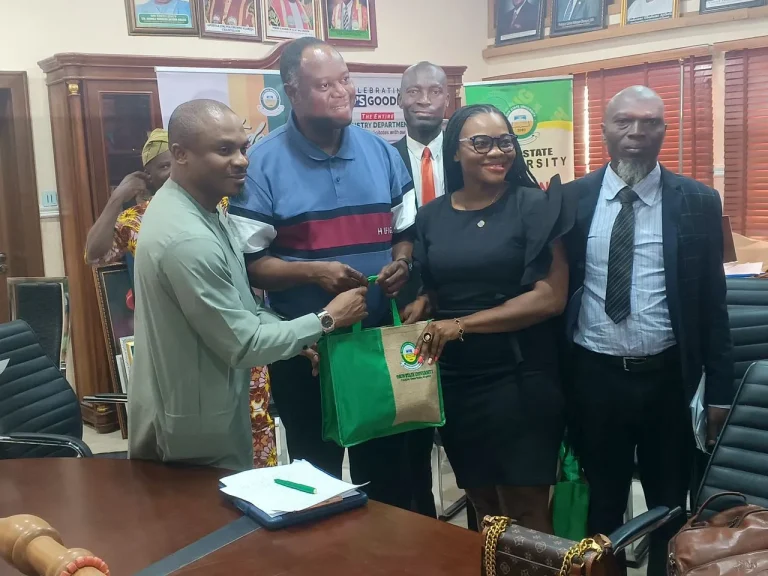
The Osun state government has finalized plans to partner with University of Osun state to deliver the United Nations 17 world development goals called Sustainable Development Goals to the people of Osun.

This was disclosed at the meeting between a delegation of the Osun state government led by the Special Adviser to Governor Adeleke on Sustainable Development Goals and Multilateral relations, Mr Bamikole Omishore, the consultant to Osun State government on Climate Change, Professor. Chinwe Obuakwu and the management of the University of Osun led by the Vice Chancellor of the institution, Professor. Odunayo Clement Adebooye.

UNIOSUN according to Prof. Adebooye is well positioned and ready to infuse her capabilities and technical personnel on Sustainable Development Goals into the state program to aid the government actionable plans on SDG.

He disclosed that the University which recently emerged as the best state university with the highest amount of funding from the National Research Fund with seven (7) grants out of over 500 state universities, polytechnics and colleges of education, a feat that underscores the university’s capacity to drive innovation to deliver all the United Nations 17 developmental goals.


Expressing the readiness of the government to partner the university, Mr Bamikole Omishore emphasized that the aim of the meeting is to discuss ways the school can support the state government with expertise and personnel needed to deliver all the SDG goals to the people of the state.

“The aim of this meeting is to solidify and partner with the school to help the government deliver on all SDG goals to the state. Specifically, we are looking at ways the university can support with expertise needed to deliver on these goals”.

Earlier in the meeting, Prof. Adebooye expressed the readiness of the school management to support the state with Human Resource capacity in areas of healthcare sustainability being driven by awareness campaigns; nutritious food production; climate change awareness campaigns that is focused on clean environment etc.

Mr Omishore assured the school management that the state government through the office of Sustainable Development Goals is focused on creating local solution for the state through “osun solution for osun state” campaign that will leverage on local resources and personnel to solve most problems facing the state in the area of sustainable development goals.

FG bans alcoholic beverages in small sachets

0

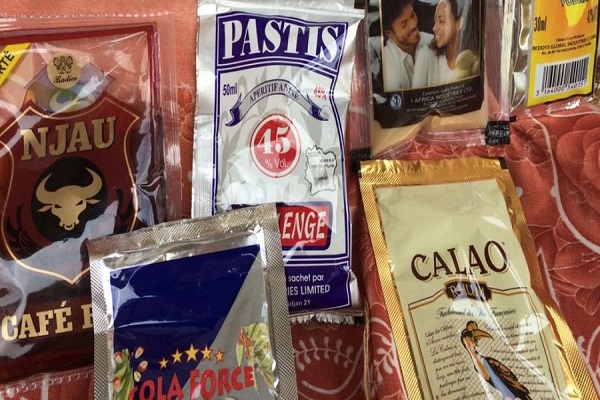
The National Agency for Food and Drug Administration and Control (NAFDAC) has banned alcoholic beverages produced in sachets less than 200ml. Disclosing this to newsmen, the director-general of NAFDAC, Prof Mojisola Adeyeye, said the five-year window given to the manufacturers of the products to stop producing the drinks in sachets and pet bottles which began in 2028 elapsed on January 31, 2024.  She said enforcement of the ban commenced on February 1, 2024.


According to her, the agency took the decision to ban the production of the drinks in such sachets because of the negative effects on underage children. She said because the drinks come in pocket-friendly sizes, accessible and affordable, children easily fell for the packages only to face the consequences in the future.


“This decision was based on the recommendation of a high-powered committee of the Federal Ministry of Health and NAFDAC on one hand, the Federal Competition and Consumer Protection Commission (FCCPC), and the Industry represented by the Association of Food, Beverages and Tobacco Employers (AFBTE), Distillers and Blenders Association of Nigeria (DIBAN), in December 2018.

As a commitment to the decision reached at the end of this Committee meeting, producers of alcohol in sachets and small volume agreed to reduce the production by 5 percent with effect from 31st January 2022 while ensuring the product is completely phased out in the country by 31st January 2024”.


According to her, the future of the country supersedes other considerations in the enforcement of the policy. Noting that saving Nigerian children and protecting the health of the larger society is paramount, Adeyeye said


“The people who are mostly at risk of the negative effect of consumption of the banned pack sizes of alcoholic beverages are the under-aged and commercial vehicle drivers and riders. The World Health Organization has established that children who drink alcohol are more likely to: use drugs, get bad grades, suffer injury or death, engage in risky sexual activity, make bad decisions and have health problems.

The World Health Organization also stated that harmful consumption of alcohol is linked to more than 200 health conditions including infectious diseases (tuberculosis and HIV/AIDS) and non-communicable conditions (liver cirrhosis and different types of cancer). It is also associated with social problems such as alcohol addiction and gender-based violence.

To curb the menace of abuse of alcohol, the World Health Organization recommended some actions and strategies to Policy-Makers that have shown to be effective and cost-effective, which include: regulating the marketing of alcoholic beverages (in particular to younger people) and regulating and restricting the availability of alcohol.”


She said in the course of enforcing the ban it was discovered that some manufacturers were still in production of the banned products and still had stacks of both finished products and packaging materials of the products in their possession.


“This situation is of course not acceptable, and the Agency views this as flagrant disobedience to the laws of Nigeria. NAFDAC views this matter seriously and will engage all statutory means, which may include prosecution, to deal with the matter”.


She warned that there is no going back on the decision.


“I want to use this medium to ask all holders of alcohol in sachets, PET and Glass bottles, empty sachets, PET bottles, empty Glass bottles, and other packaging materials of these banned products to immediately report to the Investigation and Enforcement Directorate of NAFDAC for hand-over of same to NAFDAC for destruction, to prevent sterner measures including prosecution.

NAFDAC is resolutely committed to the strict implementation of the regulations and regulatory measures towards safeguarding the health of Nigerians, particularly the vulnerable youth, against the dangers of reckless consumption of alcohol.”

Dangote Refinery Crude Import From US will Increase Prices Of Petroleum Products

0

The Independent Petroleum Marketers Association of Nigeria (IPMAN) has said the resort of the 650,000 barrel-per-day Dangote Refinery to the United States for crude importation will increase the prices of petroleum products in the country. IPMAN’s National Public Relations Officer, Mr. Ukadike Chinedu, in an interview with Sunday Telegraph over the weekend, decried that Nigerians were currently suffering from sky- rocketed fuel pump price as a result of the unilateral removal of fuel subsidy by President Bola Tinubu during his inaugural speech on May 29, 2023. According to him, hopes were high that with local refining, prices of petroleum products would be reduced. He, however, said that it was worrisome for Dangote to buy crude from the US. He noted that with the crash of the Naira and the high cost of freight and other associated charges involved in international shipping and business, Nigeria could witness more increases in the prices of petroleum products. Chinedu said: “It will increase the price of petroleum products.

The problem we are facing is policy making and implementation. What is the essence of building Dangote refinery and we still go to the US to buy crude? It is very unfortunate and not good for us. It also means that we are not robbing Peter to pay Paul. The product is being exported from here to other countries. Still, we are now going to US to import crude when Nigeria is an oil producing state. It is very ridiculous. I believe that in the earliest distance, Nige- ria should rethink and talk about it.” Bloomberg had reported that Dangote Refinery was planning to import crude oil from the United States in the forthcoming months. Blomberg, quoting traders familiar with the matter, had said that Trafigura Group has sold 2 million barrels of WTI Midland to the Dangote refinery for delivery by the end of February, which will mark the first time the refinery bought non-Nigerian crude.

Reacting to the development in an interview with Sunday Telegraph, Group Head, Corporate Communications at Dangote Group, Anthony Chiejina, said the refinery resorted to crude oil importation from the US because there was not enough crude for its purpose in the country. He, however, said resorting to the US for crude imports may not increase prices of petroleum products, as according to him, prices will be determined by the inter- national market.

Chiejina said: “If you have this, why should somebody go elsewhere and pick? It is NNPC Ltd you should be asking. “I do not know about that. Even if you are buying it from Nigerian National Petroleum Company Limited (NNPC Ltd), is it going to be cheaper? It is international market price determined.”

The Executive Secretary, Major Energies Marketers Association of Nigeria (MEMAN) formerly Major Oil Marketers Association of Nigeria (MOMAN), Mr. Clement Isong, opined that prices of petroleum products may not go up in Nigeria because Dangote bought crude from the US. According to him, the choice of US crude may be informed by technical consideration and commercial competitiveness. Isong said: “Dangote has done their mathematics and based on what is currently available in the mar- ket and the grade of crude that they are looking for, in order to blend the various crude blends in their facility, that this is the best deal they could have gotten in the market at this point in time even with the transportation calculated. Nigeria’s crude is Bonny light. It is not cheaper. There is a blend of crude that they use depending on what they want to produce. I am 100 percent sure that this is the best price they could have gotten. We need to trust them. “In any case, we must remember that it is a refinery.

There are two ways you can work in a refinery. Somebody can buy, refine and sell, depending on what the person wants. Refinery is just a tool for refining. Everything that goes into and comes out of the refinery does not neces- sarily mean that it must be- long to Dangote. “The refinery belongs to him and we do not have that information. You can rest assured from his history that they have done the best possible pricing of the prod- uct and that the price is very competitive from where it could have bought it from, based on the kind of grade that it uses.” He added: “I would not worry about that. Remember that a lot of crude in Nigeria is committed. So, the commission is investing in trying to make sure that everybody gets as much crude as it needs from the different refineries that are operating in Nigeria. We are still in the process of finding our feet with respect to the supply chain. I believe that it becomes more efficient as time goes on.

“Because of the grade you are looking for, the grade may not be what they want- ed. You know we have light sweet; they may be looking for a higher grade. We do not know. “Secondly, even if NNPC Ltd could supply him, if the one he has gone to buy is cheaper, if he buys in dollars, you do not know. So, you can not presume any- thing. You need to ask them if you want to understand why they went to America. I will not be surprised if it is cheaper. There are technical and commercial reasons that have caused them to go and buy from the US. I have no doubt about that. “It may not make the price go up. Whatever will make the price jump up, those conditions are already in place.” There are also reports that Nigeria had pledged a total of 164.25 million barrels of crude oil — at 90,000 barrels per day — starting from 2024 to repay a loan through Project Gazelle Funding Ltd, a Special Purpose Vehicle (SPV) incorporated in the Bahamas for the PxF.

The loan is o $3.3 billion “pre-export finance facility” (PxF) facilitated by the Nigerian National Petroleum Company (NNPC) Ltd and arranged by Afrexim Bank. The NNPC Ltd also pledged 38.58 per cent of five years’ worth of tax and royalty oil to secure the loan. Nigeria has been consistently unable to meet its crude quota by the Organisation of Petroleum Exporting Countries (OPEC). Nigeria’s daily crude oil production jumped to 1.4 million barrels per day (mbpd) in December 2023 from 1.319mbpd in November, using secondary sources, while, using direct communication, Nigeria production from 1.250mbpd in November to 1.335mbpd in December. Sources told Bloomberg that part of the current oil production cuts only started at the beginning of January, adding that OPEC+ will need more time to review and assess what impact the output reduction has had on market balances.

Nigeria had been restricted to 1.5 million barrels per day target in 2024 during the 36th OPEC and non-OPEC Ministerial Meeting (ONOMM), held via videoconference, on November 30, 2023. The development was precipitated to a meeting in June where OPEC+ agreed a complex deal that revised production targets for several members. The oil cartel had contracted three consultancies – IHS, Rystad Energy and Wood Mackenzie – to verify production figures for Nigeria, Angola and Congo. As a result of the reports of the consultants, it gave Nigeria a 2024 target of 1.5 million barrels per day (bpd), Congo a target of 277,000 bpd and Angola one of 1.11 million bpd, who by then had not exited OPEC. In June 2023, it had been agreed, pending the assessments by the consultancies, that Nigeria could produce Nigeria 1.38 mbpd and possibly as much as 1.58 million bpd but Nigeria had not met previous quotas.

Dangote Petroleum Refinery had before commencement of operation received six crude shipments. On January 9, it received the sixth one million barrels of crude oil. It disclosed that the product was supplied by the Nigeria National Petroleum Company (NNPC) Limited, and got discharged at the single point mooring (SPM-C2) of the Dangote offshore oil terminal (DOOT). According to the state- ment, the fresh one million Agbami barrels of crude via MT ALMI SUN is the last cargo to complete the initial scheduled six million barrels consignment to be delivered to the Dangote facility.

Supreme Court Spent N12bn Illegally In 5 Years — Audit Report Reveals

0

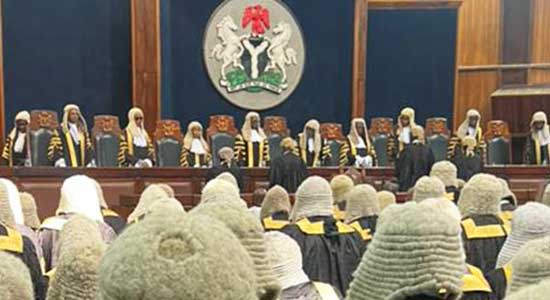
THE NIGERIAN SUPREME COURT SPENT N12BN ILLEGALLY IN 5 YEARS, AUDIT REPORT REVEALS.

Nigeria’s Supreme Court spent over N12 billion in breach of financial regulations for five years, the latest audit report of the Office of the Auditor-General of the Federation (OAuGF) has revealed.

The funds should be recovered and remitted to the treasury by the Chief Registrar of the court, the audit report, released in December 2023, recommended.

The report essentially covers the expenditures and finances of ministries, departments and agencies of the federal government for the 2020 fiscal year, but for the Supreme Court, it stretches forward and backwards to touch on some major payments and transactions executed from 2017 to 2021.

The current Chief Registrar of the Supreme Court, Hajo Sarki-Bello, assumed office in 2021, a year after the alleged infractions took place under Hadizatu Uwani-Mustapha.

Mrs Uwani-Mustapha, who was the Supreme Court’s chief registrar for most of the period when the flagged transactions took place, retired from the court as Chief Registrar in June 2021.

Walter Onnoghen, who was the Chief Justice of Nigeria (CJN) between 2016 and 2019, and his successor Tanko Muhammad, who was CJN between 2019 and 2022, oversaw the Supreme Court during the period of the controversial payments and transactions spotlighted by Nigeria’s auditor-general.

Mr Muhammad abruptly resigned from office, citing health issues in June 2022, amid a raging, unprecedented protest from his colleague justices of the Supreme Court about his handling of the finances and other affairs of the court at the time.

Highlights of the issues raised concerning the transactions totalling N12.335 billion in the 2020 audit report include – payments for contracts without budgetary provisions, diversion of government assets for private use, inflation of contract price, irregular award of contracts and overpayment to contractors, among others.

In one of the key violations of extant regulations, the report revealed that the Supreme Court appropriated and received the sum of N645 million for the procurement of broadcast equipment in 2017.

However, the court failed to produce “relevant documents such as vouchers, vote book, store receipt vouchers, store ledger and invoices” for audit.

Following the silence of the court to provide any explanation for its failure to tender the documents, the audit report attributed the “anomalies” to “weaknesses in the internal control system at the Supreme Court.”

Also, the report said, contrary to constitutional provisions and financial regulations, the court funnelled over N10.223 billion through 124 vouchers to “various beneficiaries” in 2020. But the paid vouchers and other supporting documents were not presented for audit, the report said.

Citing a case of irregular award of contract and overpayment to a contractor, the report requested the Chief Registrar to justify the sum of N826.75 million to the National Assembly.

In addition, it asked the Supreme Court’s chief registrar, who is the accounting officer of the court to recover the N826.75 million and remit it to the national coffers, as failure to do so would attract statutory sanctions in the Financial Regulations (2009).

Narrating the circumstances around the issue of overpayment to a contractor, the report revealed that a contract was awarded for the construction of an access road to justices’ quarters (Yellow Houses) in Abuja in April 2021, the twilight of Ms Uwani-Mustapha’s exit from the Supreme Court.

The contract was awarded at the cost of N990 million (N990,494,207.80 in total). The level of work done was valued at 50 per cent, which should have amounted to N495 million (N495,247,103.90).

But “the contractor was paid N827 million (N827,075,713.04 in total) being 83.5 per cent of the contract sum resulting in an overpayment of N331,815,559.61,” the report said, adding that the court offered no explanation for the violation.

In another instance, the court awarded contracts totalling N371.5 million (N371,541,636 in total) for supplies, works and services in 2017 without budgetary provisions.

However, payments amounting to N112 million (N112,117,106.37) were made in 2018, 2019 and 2020 “with no evidence of appropriation.”

The report also uncovered the sale of four landed properties belonging to the court in Lagos.

The plots of land located at 72 Alexander Avenue, 2 Club Road, 20 Cameron Road and 15 Ikoyi Crescent, all in Abuja, were “disposed of without following due process.”

It added that “evidence of the disposal such as authorisation, report from board of survey, engagement of auctioneers, advertisement, proceeds from disposal, among others were not produced for audit.”

In a case of illegal possession of government property, the report said the Supreme Court paid over N3 billion for 45 vehicles between the 2017 and 2021 fiscal years.

Giving details of the vehicle purchase, the report disclosed that 18 of the 45 vehicles costing over N515 million were attached to seven justices of the Supreme Court for official use.

But after the justices retired from the court, the official cars attached to them were not returned for inspection, a scenario the report described as “diversion of government assets for private use.”

In the myriad of violations detailed by the audit report, the court management responded to the issue of justices’ retirement with official vehicles attached to them.

“The vehicles are part of Supreme Court justices’ entitlements,” the court responded in the report.

But it kept mum on other egregious violations in the report.

Lawyers and anti-corruption activists have questioned the illegality of the National Judicial Council (NJC) in concealing the judiciary’s budget details from public scrutiny, even sometimes doing so in resistance to Freedom of Information requests.

The extent of NJC’s desperation to keep details of its finances away from the public became clearer in 2022, when the then Attorney-General of the Federation and Minister of Justice, Abubakar Malami, challenged it to open its budget for the sake of transparency.

Amid the secrecy of the budgets and finances of the judiciary which the NJC helps to sustain, allegations of corruption and mismanagement of funds, sometimes coming from highly placed insiders, hover over the judiciary.

In May 2022, a retiring Justice of the Supreme Court, Ejembi Eko, in his valedictory speech, lamented the corruption in the handling of the finances of the judiciary.

He, therefore, called on anti-graft agencies to probe the financial records of the judiciary.

“Nothing stops the office of the Auditor-General of the Federation, the ICPC and other investigatory agencies from opening the books of the judiciary to expose the corruption in the management of their budgetary resources,” Mr Eko had said.

“That does not compromise the independence of the judiciary. Rather, it promotes accountability.”

It would take just a month after Mr Eko’s invitation to the anti-corruption agencies to probe the finances of the judiciary for internal rumblings about corruption and suspicions of financial mismanagement within the Supreme Court to implode.

In June 2022, in an unprecedented protest letter to then CJN, Tanko Muhammad, 14 Justices of the Supreme Court demanded “to know what has become of our training funds,” and asked rhetorically, “Have they been diverted, or is it a plain denial?”

Later that year in September, one of the justices who authored the protest letter, Abdu Aboki, took advantage of his valedictory speech while retiring from the Supreme Court bench, to press for financial transparency and accountability in the judiciary.

Under the part of his valedictory speech which he sub-titled, ‘My valedictory messages to the nation and judiciary in particular,’ Mr Aboki called on “those in charge of administering the funds allocated to the judiciary” in Nigeria “to be prudent, transparent and accountable.”

In a more direct and critical tone, another Justice of the Supreme Court, Dattijo Muhammad, while retiring as the second most senior justice of the court in October 2023, alleged widespread corruption in the Nigerian Supreme Court and down the hierarchy of the judiciary.

Mr Muhammad was one of the 14 Supreme Court justices who authored the protest letter sent to then CJN, Tanko Muhammad, in June 2022. But as of the time of Dattijo Muhammad’s retirement in October last year, Olukayode Ariwoola, who led the pack of the 14 protesting justices more than a year earlier, had taken over from Tanko Muhammad as the CJN.

Turning on the handlers of the funds allocated to the judiciary in his valedictory speech last October, Dattijo Muhammad said despite the “phenomenal” increase in the judiciary’s budgets over the years, there had been no commensurate improvement in the welfare of judges.

He similarly called for a probe of the judiciary’s handling of its funds.

He said, “unrelenting searchlight need to be beamed to unravel how the sums are expended.”

With the Supreme Court’s silence over the infractions highlighted in the latest audit report, Nigeria’s auditor-general’s office requested the chief registrar to account, recover and remit the funds into the federation account.

It specifically asked the chief registrar to show proof of compliance with the recommendations to the Public Accounts Committee of the National Assembly.

But this is not the first time the office of the Auditor-General of the Federation has indicted ministries, departments and agencies of government over serious violations of financial regulations.

But the recommendations of the audit reports are never implemented by the National Assembly, or taken up by Nigeria’s law enforcement agencies, a development that has emboldened public institutions to perpetrate grand corruption in the form of diversion of public funds.

Industrial Court dismisses entitlement claim against OOU

0

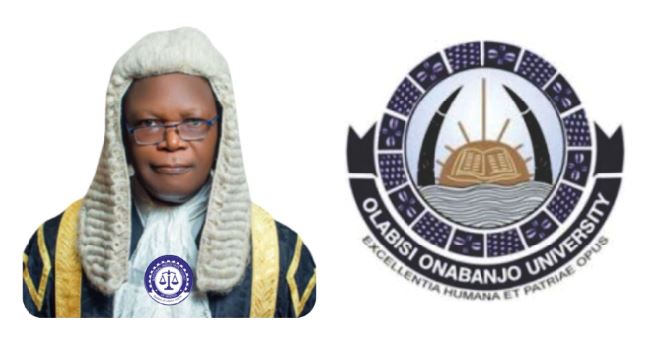
The Presiding Judge, Ibadan Judicial Division of the National Industrial Court, Hon. Justice Dele Peters has dismissed the entitlement claim filed by former Olabisi Onabanjo University Primary School teacher, Mr. Olusegun Yaya against Olabisi Onabanjo University in its entirety for lack of proof.

The Court held that Mr. Yaya has not proved the claim sought as required by law and no cogent, credible and admissible evidence were led in support of same.

From facts, the claimant- Mr. Olusegun Yaya had submitted that he worked with Olabisi Onabanjo University Primary School for about 18 years; that the Defendant terminated his appointment; and failed to transfer his Legacy Funds for the years 1996 – 2015 and also failed to pay his gratuity having served the Defendant for nineteen years.

In defense, Olabisi Onabanjo University denied being the employer of Mr. Yaya; that the School Management Board is solely responsible for the management and operation of the Primary School which is the employer of Mr. Yaya and that it is in no way liable for the reliefs sought.

The University averred that Mr. Yaya upon cessation of employment in 2015 was paid his terminal benefits and neither did he reject nor refund same to the University. There is also no evidence that he contested or protested the sums of money paid to him as his terminal benefits.

Counsel to Olabisi Onabanjo University urged the Court to dismiss the case of Mr. Yaya as his claims are fundamentally contradictory and unsustainable in law for the absence of pre-action notice amongst others.

In opposition, Counsel to Mr. Yaya submitted the fact that Olabisi Onabanjo University pursued its defence from beginning to end without any objection to the jurisdiction of the Court is a clear evidence of a total submission to the jurisdiction of the Court.

Counsel to Mr. Yaya further urged the Court to declare Olabisi Onabanjo University Law which requires pre-action notice as being inconsistent with the Constitution of the Federal Republic of Nigeria.

Counsel averred that his client is entitled to claim for N574,382 being funds deducted for pension purposes between 1996 and 2007, and N10,724.083.60 being shortfalls of Claimant’s remuneration with the yearly steps and promotion between 1st June 2001 and May 2015

Delivering judgment, the presiding Judge, Justice Dele Peters held that the requirement of pre-action notice is not in any way an inhibition to the right of individuals to approach the Court for the ventilation of their constitutional rights but affirmed that there is sufficient evidence that Mr. Yaya’s pre-action notice was duly served on the office of the Vice Chancellor.

On the entitlement claim, the court held that the document which Mr Yaya alleged to have been issued bringing his employment to an end with the University was not tendered, and there is nothing before the Court linking the University with the termination of his employment.

Justice Peters stated that Mr. Yaya is expected to lead evidence as to from which incremental step to which is the shortfalls complained off and also expected to lead evidence as to when he was promoted and from what salary grade level to what salary grade level.

The Court held that No cogent, credible and admissible evidence is led in support of same and questioned how Mr. Yaya arrived at the figure claimed as his gratuity, that Mr. Yaya only averred that he served the University for nineteen years and that he is entitled to the sum of N2,442,039.60 as gratuity.

“Where is the letter of promotion for which he claims financial benefits? Aside from all this, how did the Claimant arrive at the sum of N10,724,083.60?  In any event, the sum claimed is a sum certain. This relief is therefore in the nature of a claim in special damages. To succeed in same the Claimant must specifically plead and strictly prove his entitlement.

“Aside from failing to specifically plead his entitlement to this relief, the Claimant also failed to strictly prove as required by law. The relief sought is not proved. Accordingly, the relief sought is not granted. It is refused and dismissed.” The Court ruled.


Visit the judgment portal www.nicnadr.gov.ng/judgement for full details