Thursday, May 14, 2026
Home Blog Page 224

Publish Monthly Allocation To States, LGAs – Falana Tells AGF

0

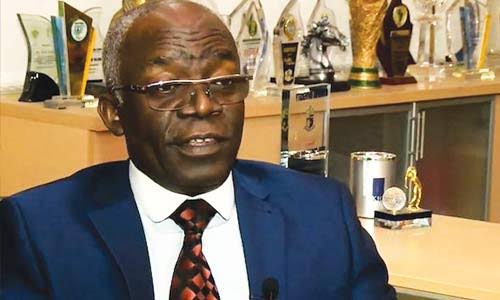
A human rights activist, Femi Falana (SAN), has asked the office of the Accountant General of the Federation to publish the monthly allocation to states and local governments.

Falana made this call in an interview on Channels Television on Tuesday.

He noted the government must be transparent to convince Nigerians what it is doing with the proceeds from the removal of oil subsidy.

The senior lawyer urged the media to always demand the monthly allocation to every tier of government.

He said, “We are demanding that on a monthly basis that the Office of the Accountant General of the Federation be publishing what goes to every tier of government.

“That was the culture in the past. At a stage we were told the government was going to be run in a transparent manner.

“Section 22 of the constitution states that the media should promote transparency and accountability in the government.

So the media is compelled to demand on a monthly basis what goes to every tier of government and to compare what was being earned before fuel subsidy removal and what is going to the federal government account after the subsidy removal.

“For almost a year, the NNPC did not remit any money to the federal account. But now we are told that they are no longer subsidizing fuel.

“They should tell us what they are making per month. The government said that it would be paying N35,000 wage award to workers every month; but now we are told only some months were paid.”

House Of Reps Order FCT Chief Judge To Halt Recruitment Of Staff

0

The House of Representatives has ordered the Chief Judge of the Federal Capital Territory (FCT) to immediately halt the recruitment process for the 12 vacancies in the Territory’s High Courts until there is compliance with the Federal Character principle and quota system.

This was a sequel to a motion of urgent national public importance, brought by Rep. Igariwey Iduma-Enwo (PDP, Ebonyi) at Tuesday’s plenary.

While presenting the motion, the lawmaker noted that the High Court is one of the Judicial bodies in the FCT established by Section 255 of the constitution of the Federal Republic of Nigeria, 1999.

He recalled that in the past few days, the media and the civil society community had expressed serious concerns and protestations over the proposed list of states to fill the 12 vacant positions in the High Courts of the Federal Capital Territory.

He also observed that information in the public space is to the effect that the proposed list is expected to be sent to the National Judicial Council by February 19, 2024, for vetting by the NJC, and subsequently to the Senate for confirmation.

According to him; “under the High Court of the Federal Capital Territory, Abuja (Number of Judges) Act 2003, the principle of Federal character of Nigeria, shall be applied in the appointment of Judges of the Court; implying that the number of judges of the FCT High Court must always reflect the 36 states and the FCT.”

Iduma-Enwo expressed concern that while every state of the federation has judges from their respective states appointed in the FCT High Court system, four states, namely, Ebonyi, Abia, Imo, and Bayelsa, do not have a single indigene from their states appointed and sitting in the FCT High Court system.

“Worried that Ebonyi State, in particular, is doubly discriminated against in that it has none of its judges appointed in the High Courts of the FCT, and yet was not listed as one of the states to apply for the vacant 12 positions sought to be filled.

“Further aware that according to the FCT website, at least 7 Magistrates from the four unrepresented states of Ebonyi, Abia, Imo, and Bayelsa are currently qualified, and working in the FCT Court system as Magistrates, in addition to qualified private legal practitioners from these states who are willing and eager to apply to fill these vacant positions.

“Concerned that the non-representation of judges from 4 states in the High Court System of the FCT, when some others have as many as 3 judges representing them, is a gross violation of S14(3) of the 1999 constitution which requires staffing from the 36 states and the FCT.

“Cognizant of the fact that the underlying philosophy of the Federal Character Commission principle is to provide equality of access in public service representations, curb dominance by one or few sections of the country, promote inclusiveness and national unity. Violation of this principle of our constitution may not only be destabilising but could open the floodgates to litigation,” he argued.

While ruling on the motion after the adoption, the presiding officer, Deputy Speaker Benjamin Kalu referred it to the Committees on FCT Judiciary and Judiciary for investigation of the Federal Character approval granted for the purpose and the extent of compliance thereto.

Bolanle Ambode At 60: APC Professionals Council Distributes Food Items

0

APC Professionals Council has distributed food items in honour of former First Lady of Lagos State, Bolanle Ambode as she clocks 60

Bolanle Ambode, wife of the immediate past Governor of Lagos State His Excellency Akinwumi Ambode has continued to receive goodwill messages in celebration of her diamond Jubilee anniversary.

APC Professionals Council says the distribution of the food items is in consolidation of her ideals towards touching lives and bringing succour especially to less privileged persons.

At the distribution of the food items and relief materials which include, rice, beans, garri, yam, oil and some fabrics, the National Director General of APC Professionals Council, Dr. Seyi Bamigbade hailed the Lagos former First Lady, describing her as a mother to many who has through her philanthropic gestures

Dr. Bamigbade expressed gratitude to God for using the former Lagos First Lady as a vessel to drive new humanitarian frontiers in Lagos and beyond, praying God to spare her life for more of her services to the country.

The beneficiaries could not hide their joy as they thanked the Council and the former First Lady for bringing smile on their faces.

Kidnapping: Residents Express Shock, Alarm As Wike Approves Motor Parks In Residential Estate In Abuja 

0

Residents of housing estates in Karsana District, Abuja, have been thrown into panic as the Minister of the Federal Capital Territory, Nyesom Wike May have approved the establishment and operation of motor parks in between residential estates in the area.

Residents of Mab Global Estate and Queens Estate are shocked that the Minister who vowed to fight the terrifying insecurity in the FCT could grant approval to establish a motor park in between their residential estates.

When the Network visited the area on Monday, the alarmed residents expressed the fear that the Minister’s action if true will attract kidnappers and other perpetrators of violent crimes to their door steps.

They said that the approval granted a private firm would portray the minister as insincere and insensitive to the precarious security situation in the area.

A home owner, Mr James Adebayo, who spoke to the Network recalled how the wife of a permanent secretary was kidnapped and a ransom of N100 million paid to kidnappers in the area in November 2023.

He noted that there are sincere fears that the motor park would attract all manner of criminals to the strictly residential area wondering how the FCT administration which is believed to be battling insecurity would have taken decisions that would clearly worsen the bad security situation in the area.

He urged the minister to have a rethink (if true) and withdraw the approval granted to operators of motor packs whose operations would clearly aggravate the security woes in the area.

The purported approval letter dated May 25, 2023, four days to the end of the Buhari administration was signed by Abdullahi Adamu Candido, the Secretary, Transportation Secretariat.

However, the date of the letter granting approval to the firm has raised concern about the genuineness or otherwise of the approval.

There are indications that the FCT administration under Wike might have adopted the curious approval granted four days to the end of the Buhari administration going by the action of the firm.

The letter reads, “The Federal Capital Territory Administration granted the curious approval to develop the motor park in a letter of May 25, 2023, to the Managing Director, Fasaha & Sons Global Services Nig. Ltd, Mabglobal by Queen Estate Abuja.

“I am pleased to inform you that approval has been given to your Company for its engagement as Manager of Temporary Off-Street Parking at Karsana East by Mabglobal, Queen Estate, FCT Abuja, for a period of Five (5) years.

“Your engagement as a Manager for the period stated above is subject to renewal at the discretion of the Secretary, Transportation Secretariat.

“The structures to be erected at the Park shall be as approved by the Federal Capital Territory Administration.

“This Engagement is Subjected strictly to the attached conditions.”

Meanwhile, aggrieved residents of the affected estates have vowed to take the matter to the Minister saying it is doubtful and curious, that Wike would grant such an approval to undermine his own efforts against insecurity.

Lagos APC Leader, Olusi Pays Condolence Visit To Gbajabiamilas

0

The Leader of the Governance Advisory Council (GAC), the apex leadership of the All Progressives Congress (APC) in Lagos, Prince Tajudeen Oluyole Olusi has paid condolence visit to the family of Chief Abdulfatai Gbajabiamila.

This is following the death of their patriarch, Alhaji Chief Abdulfatai Ishola Gbajabiamila at the graceful age of 87.

The late octogenarian is the father of Ayisat Gbajabiamila Foundation, a foremost support group in the governing All Progressives Congress APC.

Prince Olusi and his entourage was received by Ayisat Gbajabiamila.

The late Alhaji Chief Abdulfatai Ishola Gbajabiamila is uncle to Chief of Staff to President Bola Tinubu, Rt. Hon. Femi Gbajabiamila a former Speaker of House of Representatives.

The APC leader acknowledge the numerous contributions of late Pa Gbajabiamila towards the development of his community and providing sound advice and leadership during his life time.

Prince Olusi also described him as a bridge builder, a lover of peace and a father figure to many who used dialogue to broker peace even in seemingly difficult situations.

While receiving Prince Olusi, Ayisat Gbajabiamila expressed gratitude for the visit, saying the family has taken solace in the legacy left behind by their late patriarch.

[JUST IN] Industrial Court sets aside Class Teacher’s 12 years employment termination, orders immediate reinstatement

0

The Presiding Judge, Awka Judicial Division of the National Industrial Court, Hon. Justice John Targema has declared the dismissal of Class Teacher Mr. W. G. Onoriose from the Federal Civil Service as unlawful, and inconsistent with the Civil Service Rules and the provisions of the 1999 Constitution on fair hearing.

The Court set aside Mr. Onoriose’s letter of suspension, reports of the panel of inquiry, and letter of dismissal; and ordered the Federal Civil Service Commission and Honourable Minister of Education to immediately reinstate Mr. Onoriose to his corresponding position of his mates in terms of his employment before the letter of dismissal with payment of all salaries and allowances from the 5th of October 2012 till the date of his reinstatement.

From facts, the claimant- Mr. Onoriose had submitted that he had been the form teacher since the 2011/2012 academic session and during his 24 years of service, he had never received any complaints or queries regarding his performance; that on July 11, 2012, he was summoned by the senior staff on allegation of misconduct and was suspended thereafter.

He stated further that while hoping and waiting that the Minister of Education would review his suspension; he received a dismissal letter dated 02/4/2013 effective from 5th October 2012.

The plaintiff argued that the Federal Civil Service Commission and the Minister of Education did not comply with relevant laws and regulations before suspending and dismissing him from service.

In defense, the 2nd defendant- the Honourable Minister of Education urged the court to dismiss the suit with substantial cost that the disciplinary committee, constituted followed all due procedures before dismissing Mr. Onoriose from the Federal Civil Service, urged the court to dismiss the case in its entirety.

In opposition, the counsel to Mr. Onoriose argued that the Federal Civil Service’s failure to afford his client the opportunity to be tried in the regular courts before finding him culpable of criminal misconduct is contrary to the Constitutional provisions.

Counsel averred further that the Federal Civil Service Commission, ought not to have acted on the recommendation of the Honourable Minister of Education without first hearing from Mr. Onoriose as prescribed by the Federal Civil Service Rules.

Delivering the judgement, the presiding Judge, Justice John Targema held that it is therefore erroneous for Mr Onoriose’s counsel to contend that once a crime is detected, the employer cannot dismiss the employee unless he is tried and convicted first.

However, the Court held that the Minister of Education could not claim to have followed the Public Service Rules when they did not refer to it before taking disciplinary action against Mr. Onoriose.

Justice Targema stated that Mr. Onoriose presented evidence that clearly shows that the Federal Civil Service Commission and Minister of Education did not follow the procedures outlined by the Public Service Rules and termination or dismissal cannot be retrospective.


Visit the judgment portal for full details

Harsh Economy and Osun Health Insurance Scheme (OHIS) option for your health

0

The prevailing economic situation has given rise to a raging question about access to quality healthcare. Rising costs of normal day-to-day necessities like food and transportation mean that for many, there is not as much money left to take care of their health. And to compound the problem is the astronomical increase in the cost of drugs and medicare, putting a lot of people in dilemma on how to meet their healthcare needs.

Of course, this is a troubling situation and will most definitely trigger the wave of concerns that funding healthcare at a time like this has provoked. But looking broadly, especially in Osun state, there is an option available for the people to explore for qualitative healthcare. And this is not something complex or requiring much effort to do, yet, it is a definite answer to the question of accessing healthcare.

What could this be? I’m sure that would be the question raging your mind. But the the answer is in plain sight, although, only a few people pay attention to it. This is no other but the OHIS, a simple and comprehensive healthcare coverage for the people.

OHIS is a short form for the Osun Health Insurance Scheme, and in a real sense, it offers a lifetime opportunity to prospective subscribers to enjoy qualitative healthcare. OHIS was established in Osun state in 2018 and structured to avail individuals and families with a partner that shares the burden of their healthcare needs with them. Yes, you heard me right, a partner or maybe, a buddy that is tasked with getting you the healthcare needs you deserve.

The good thing about this partnership is that it is reliable, dependable, and extremely cheap. Yet, OHIS shares the substantial costs of funding your healthcare, totally eliminating the pressure of healthcare on subscribers. To put things in the right perspective, OHIS will bear the burden of at least 90% of your healthcare costs at any given time, while you pay for the balance 10%.

Let us, for instance, assume that the cost of a caesarian operation is N300,000, then what an active subscriber on the OHIS plan will be required to pay will not exceed N30,000 in any registered medical center while the OHIS pays the balance of N270,000. And this does not stop with medical bills, but the coverage of OHIS extends to the cost of drugs, which just like medical bills, will only cost subscribers 10% of the total cost.

This sounds incredible yet unbelievable. But this is just a minute of the extent of support that the OHIS avails its subscribers in the area of accessing qualitative healthcare. Once you are a subscriber, you are open to an unimaginable cover against the burdening financial cost required to get the best of healthcare.

The impressive thing about this is that the healthcare plan offered by the OHIS is all-encompassing, meaning that all strata of society can benefit from it and a wide range of health issues is covered. Whether you’re in the formal or the informal sector; educated or illiterate; the rich and the poor; fit or physically challenged, there is always a plan for you to enjoy a qualitative healthcare service alongside members of your family.

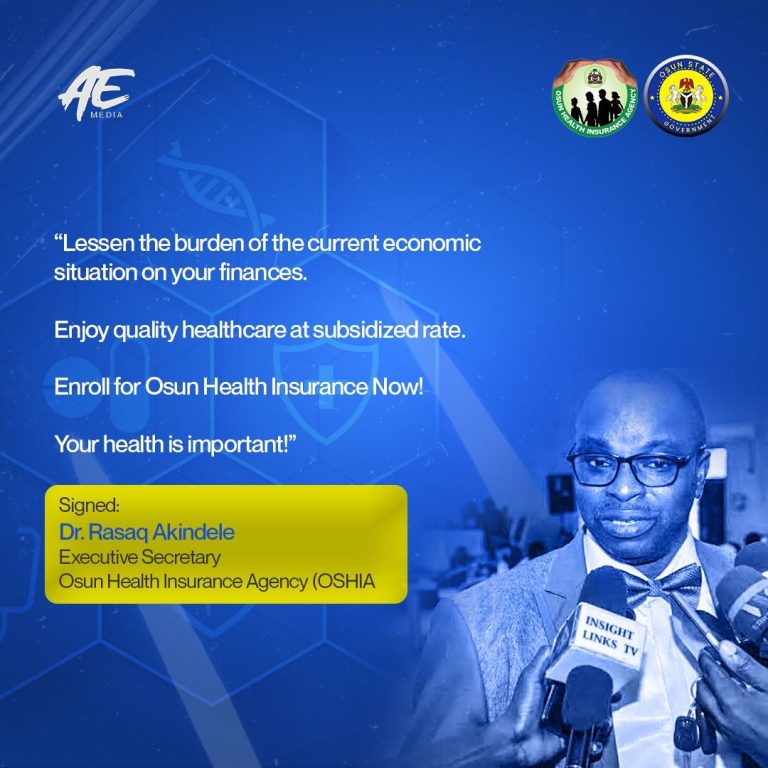
All that is required to unlock the immense benefits that the OHIS offers is to pick up a subscription by visiting any of its offices across Osun state or its headquarters in the State Secretariat, Osogbo. The subscription is structured to accommodate all social classes of people to ensure that no one is left behind. As an individual, you can enjoy the benefit of a qualitative healthcare service for a whole year at the sum of N12,066. Yes, you are not mistaken, with N12,066.00 you can enjoy an all-year-round healthcare service through the OHIS.

With N57,600, a family of six can get the benefit of good healthcare for a whole year on the family package. This means that the father, mother, and four biological children or legally adopted under the age of 18 years will be covered by the OHIS plan for one year that the subscription will last. Isn’t that incredible?

What the above simply pointed out is that, while maintaining your health could be costly, the OHIS is offering to share in the burden just to ensure you stay healthy. As an enrollee, you will no longer have to worry about how to handle the bill for your health needs or any of your family members included as a beneficiary for basic ailment, because the OHIS got you covered.

There is one aspect of OHIS that some may still not get. Through OHIS, corporate bodies, organizations, and wealthy individuals can support a lot of people in accessing qualitative healthcare services. All they need to do is to pay the premium for the targeted beneficiaries, and they will contribute to the healthy living of the people, which will improve economic activities.

Even the diasporans can explore the OHIS option to provide parents, siblings, relatives, and friends with the healthcare coverage that guarantees them of quality healthcare service at any point of need. It could be a form of empowerment or a safeguard from the pressure that comes from funding health challenges, but what is certain from the OHIS healthcare coverage subscription is that it is the surest bet to achieving good health without the burden of cost.

At the moment, the OHIS is in partnership with up to 432 healthcare facilities across Osun state. The list of healthcare facilities is comprised of 332 focal primary healthcare facilities, 17 public healthcare facilities inclusive of the University of Osun Teaching Hospital formerly known as LAUTECH, and 82 accredited private healthcare facilities. What this means is that wherever you are in Osun state, you will be able to access the services offered by the OHIS.

• Sarafa Ibrahim writes from Osogbo, Osun State.

Aircraft Model Used By Wigwe Crashed 5 Times In 2023

0

Eurocopter EC 130B4, the aircraft model that crashed on Friday and claimed the lives of Herbert Wigwe, Access Holdings CEO, his wife, son and three others, suffered five crashes last year alone, FIJ has learned.

Since 1975, 100 crashes involving the aircraft and previous models manufactured by Airbus Helicopters SAS have been recorded.

Wigwe died in a helicopter crash near Interstate 15 in Southern California’s Mojave Desert, and questions arose over the circumstances surrounding the crash.

FIJ has gathered that a similar crash occurred on December 1, 2023, involving the same Eurocopter EC 130B4, which struck power cables during takeoff and crashed into a ball of flames near Ex Hacienda el Hospital, Cuautla, Morelos in Mexico. Three people died in the accident, and it was the last of 11 crashes involving Airbus models in 2023.

The same aircraft model crashed in the Grand Canyon in 2018 and claimed the lives of five people.

Scott Booth, who piloted that flight and managed to survive, told investigators that the aircraft encountered a violent gust of wind before spinning uncontrollably and crashing into flames.

The parents of Jonathan Udall, one of the passengers on the flight, who was on a honeymoon with Eleanor, his wife, filed a lawsuit against Papillon Airways Inc., the company that owned the aircraft, and the manufacturer.

These plaintiffs argued before a Nevada judge that the aircraft was unsafe for air travel as it did not have a crash-resistant fuel system, which was why it regularly burst into flames upon crashing.

In January, the court ordered that Papillon pay them $24.6 million and Airbus pay $75 million for the loss of their son.

Speaking to the Associated Press after the ruling, Gary Robb, the family’s lawyer, said, “They don’t want anyone else to go through what their son went through in an otherwise survivable accident — not a broken bone. He would have walked away.”

His statement was a nod to the fact that Jonathan did not die as a result of the direct impact of the crash but suffered burns in the explosion, which caused his death days later.

Among the 100 crashes the Airbus aircraft have suffered since 1975, many have been without casualties, but Friday’s incident claimed the most lives in one crash.

Nigerians Turn To Traditional Healers As Prices Of Drugs Go Out Of Reach

0

VICTOR AYENI writes about how traditional medicine is enjoying growing patronage in light of the skyrocketing prices of orthodox drugs in the country and the immense potential of research that lies in alternative medicine

In the busy Sango Ota market, in the Ado-Odo/Ota Local Government Area of Ogun State, Mrs Ayoni Oladipo graciously showcased her array of herbal products. Across the wooden table in front of her shop were plastic bottles of different shapes labelled according to the ailments they were prepared to cure.

Weekly, clients from the area and other towns and cities visited the shop of the Osogbo indigene whose knowledge of herbal concoctions she admitted was learnt from her mother.

The 41-year-old woman was in a cheery mood when Saturday PUNCH visited her shop on Tuesday morning and asked for herbal mixtures to treat diarrhoea and malaria.

“I get much patronage and I have clients even outside Ogun State. People come to me from Lagos, Ibadan, and even Abuja. They contact me for a variety of reasons and request herbs to cure diarrhoea, back pains, and general body weakness,” Oladipo said with a genuine grin that evinced happiness and sincerity.

When our correspondent expressed some scepticism about the efficacy of herbal products, Oladipo gave some instances to accentuate the potency of her herbal preparations.

She explained, “Just recently, they called me to help a white man around here whom we call ‘Baba Mighty.’ He works in a company not too far from here but he came down with a stroke.

“His condition was made worse when he fell to the ground while at work and his colleagues were watching him like a pack of fowls. I took care of this man with my herbs and he is better now.

“Unfortunately, his people didn’t deliver all of my money to me, they kept part of it because they had thought herbal medicine would be as expensive as orthodox medicine.”

Not sure our correspondent was convinced, she continued, “There was a lady whose menses stopped and her husband came and confided in me when he saw some people buying some herbs from me. The couple had gone to Lagos University Teaching Hospital, Federal Medical Centre, and another medical facility but nothing changed.

“So, I gave him a half bottle of herbs from the shop for his wife. When his wife started seeing her menses again, he returned here to thank me. The lady later conceived and gave birth to twins. I also sell herbal preparations that cure weak erections or impotence.

“I often mix atori odo (Tiliaceae) with alligator pepper and instruct the man to take the mixture. It will awaken his erection, except if it is a spiritual attack, and that is beyond what I cure.”

Sunday PUNCH gathered that the prices of the herbs sold by Oladipo ranged between N3,000 to N5,000, a development she blamed on economic inflation.

“For now, things are generally expensive so the prices of my herbs range from N3,000 to N5,000. Those herbs in bigger plastic bottles are N5,000,” she said, pointing at some bottles in a corner of her shop.

“They are so efficacious that you can’t even finish their content before the condition goes away. I now enjoy better patronage because people have realised that herbal medicine is cheaper than Western medicine.

“Another advantage is that herbs don’t expire. One of the reasons it doesn’t work for some people is when roots are used in place of tree bark during preparation. When people are advised to use local eggs, they use eggs from layers instead; there’s no way such a herb will work,” she added.

Like Oladipo, another herb seller in Ofada, in the Obafemi Owode Local Government Area of Ogun State, Mrs Kemisola Banwo, said that despite the negativity that traditional medicine used to evoke among the populace, it had gained a more positive image in recent times.

“Gone are those days when people spoke ill of our trade as it used to be. Now, we have educated people who patronise us.

“This is not a joke, you can ask anyone who sells herbs, people from all walks of life to troop to us when they need a cure.

“Our industry is now acceptable and even the government recognises our effort. We aim to heal people, we are not sorcerers or fetish people. We make use of the plants and roots that God has given us to treat illnesses just as the whites have done. People now see this,” Banwo averred.

Solace from inflation

Sunday PUNCH gathered that an increasing number of Nigerians are turning to herbal medicines and alternative therapies with the rise in prices of modern drugs, some of which are imported.

Popularly known among the Yoruba as ‘elewe omo,’ traditional healers are known to sell plant-based herbs to clients to cure a wide range of illnesses that affect infants, children, and adults.

According to data from the International Drug Centre, drug prices are set to remain high in 2024 as import prices of pharmaceutical products may hit over N900bn due to the depreciation of the naira.

This has been said to further mount pressure on Nigerians who grappled with high drug prices in 2023 since the country imports most of its pharmaceutical products from India, China, Malaysia, Netherlands, and Belgium.

In August 2023, a pharmaceutical company, GlaxoSmithKline Consumer Nigeria Plc, disclosed intentions to cease its operations within the country and shift towards employing a third-party direct distribution model for its pharmaceutical products.

Three months after GSK made the announcement, a French pharmaceutical multinational, Sanofi, also announced its plans to exit and adopt a third-party distribution model in the country. It stated that its third-party distributor would begin to handle its commercial portfolio of medicines in February 2024.

Since then, according to SBM Intelligence, the cost of drugs has surged above 100 per cent in sync with Nigeria’s biting inflation and foreign exchange crisis which have put a strain on businesses and consumers, including the pharmaceutical industry.

Consequently, more citizens have found themselves seeking solace in the curative powers of traditional herbs which they consider to be more accessible and cheaper than orthodox medicine.

An Ibadan-based chef, Taiwo Divine, in a chat with our correspondent, admitted that he now relies fully on herbal concoctions which he said meet his family’s health needs.

“Whenever people tell me that herbs don’t work, I always point out to them that orthodox medicines also do not always work. I once had malaria and took an anti-malaria tablet, yet I felt no relief until I took a herb prepared for me by a family friend to treat fever and it worked.

“Now, if you want to treat malaria, you will spend about N3,000 whereas it used to be N1,400 a few years ago. This is not sustainable at any level, so I would prefer to take traditional medicine than waste money on Western medicine that might not even work for me,” Divine stated.

Expressing the same sentiment, a marketer at a Lagos-based firm, Treasure Etteh, said the hike in the cost of modern medicine had made him embrace herbs.

He noted, “I now take herbs whenever I feel symptoms of illness. I don’t like taking injections and with the price of drugs now, it’s not affordable. How much is my salary that I’d be spending so much on medications?

“I have a trusted herb seller around here that I patronise because I am not used to taking it initially; I’m adjusting to it. The seller often mixes some of the herbs with soft drinks to make them more palatable for me.”

An unexplored market

Although Nigeria is known to have a diverse array of natural herbs and plants, experts have stated that the country has yet to properly harness the potential of its traditional and complementary medicine, which has been estimated to be a lucrative market worth billions of dollars.

A report by Future Market Insight, disclosed that the traditional medicine market is dominated by China, India, the United States, Germany, and Thailand, among others.

The market has been projected to reach $199.07bn in 2023 and $417.99bn by 2033, and is growing at a compound annual growth rate of 7.7 per cent, according to the FMI report.

It added that South Asia could become the third most profitable market for traditional medicine by 2031, with India accounting for more than 74 per cent of the market.

According to the World Health Organisation, herbal medicine is used by about 60 per cent of the world’s population for primary health care, and about 80 per cent of Africans seek solace in traditional medicines for their fundamental health needs.

The international agency, however, noted that the research, local manufacturing, and commercialisation potential of traditional medicine, remain untapped, especially in developing countries like Nigeria.

A study conducted in Lagos in 2019 and published in the Journal of Family Medicine and Primary Care showed that until recently, many Nigerians often co-utilised herbal medicines with orthodox medicine, with a majority indicating a preference for the latter.

A trader, Emmanuel Ibekwe, who sells Chinese herbal mixtures from his shop in the Lagos Island axis of Lagos State, told our correspondent that his customer base had increased over months due to the economic condition of the country.

“More people are asking for these products even though they are more expensive than the local herbs, but then I think our government can also invest in local herbal medicine the same way the Chinese have done.

“They are exporting their products and selling them here (in Nigeria). There is a woman who sells herbs around me, she is also enjoys patronage, but what differs is the packaging.

“The Chinese ones are more tailored towards educated people and they have a kind of appeal the local ones don’t have. I think our leaders should also be looking at how they can tap into this thriving venture,” Ibekwe added.

A blogger, Editi Peter, who described her mother as an herbalist, also pointed out the economic and health potential inherent in herbal medicine.

She said, “The ingredients my mother uses are 100 per cent herbal which I can’t disclose entirely. My mum uses seeds to prepare her herbs and they are water-based. She uses her herbs to cure different kinds of diseases and infections.

“There are many diseases that Western medicines can’t cure such as a stroke, hepatitis, diabetes, Herpes Simplex Virus, Human Papillomavirus, and gonorrhoea. My mother has been using herbs to save lives since the 1990s.

“This is an area that the country needs to patronise well to attain wellness and complement Western medicine.”

A medical doctor and Chief Executive Officer of Lifebox Labs, Dr Olusina Ajidahun, in an interview with Sunday PUNCH, explained that with the skyrocketing prices of drugs and poverty in the country, many patients are unable to afford orthodox medicines.

He stated, “Some medicines that used to cost N5,000 or N8,000 have even gone up to N40,000. Essential medical supplies like asthmatic inhalers, and antibiotics, among many, have also gone up.

“It’s so bad that when patients come to the hospital, a lot of them can’t afford these drugs because there is huge poverty in the land, so many people turn to unorthodox medicine.

“Unorthodox medicines are very cheap, affordable, and everywhere, but, unfortunately, patients don’t follow up their treatment by coming to the hospital. We cannot deny that more people are beginning to embrace herbs; it’s something we can’t stop.

“The big question is: are herbs in their entirety dangerous? The answer to that is no. A lot of drugs are plant-based even if some are synthesised in laboratories, so herbs have a potential benefit for therapy and treating diseases.”

He, however, called for standardisation.

“We should look at what other countries like China, India, and Japan have done. We need to have protocols that will stipulate the active ingredients, dose, and side effects of these herbs. People should know when they should use these herbs and let them know the interactions of these drugs with other drugs which can make them deadly or of no effect.

“We also need to have standardisation. We shouldn’t just have someone saying, ‘My grandfather was a popular herbalist and he has passed this down to me and I just concoct root, leaves, and barks and make it into a drink and it will work.’

“No, because what we are going to be having in the case of herbs is that you are taking an elixir or poison, and either way, it can kill you since you don’t know if you are overdosing or underdosing,” he added.

FG, stakeholders laud complementary medicine

During the commemoration of the 2023 African Traditional Medicine Day in Abuja, the Minister of State for Health and Social Welfare, Dr Tunji Alausa, disclosed that 80 per cent of Nigerians used traditional medicine as a primary form of health care.

Alausa, who was represented by the Director of Human Resources Management at the Federal Ministry of Health and Social Welfare, Hassan Salau, said traditional medicine was accessible, culturally acceptable, and trusted by a large number of people.

“With about 80 per cent of the rural population using traditional medicine as a primary form of health care, traditional medicine has made an invaluable contribution to the health and well-being of all.

“Studies have shown that traditional medicine use in Nigeria is as high as 81.6 per cent, and this is not expected to be on the decline shortly, especially in the face of the predicted increase in the global burden of diseases,” he said.

However, the WHO Regional Director for Africa, Dr Matshidiso Moeti, said member states needed to scale up efforts to implement evidence-based traditional medicine approaches to achieve health-related Sustainable Development Goals and promote health and well-being for all at all ages.

“Establish a high-level consultative mechanism with indigenous knowledge holders to guarantee their full participation and consultation in adopting and implementing relevant policies and actions associated with biodiversity management and traditional knowledge.

“Facilitate effective integration of traditional medicine into national health systems contributing to achieving universal health coverage and all health-related sustainable development goals,” she added.

The Federal Ministry of Health and Social Welfare, in one of its stated objectives on its website sighted by our correspondent, disclosed that it would preserve cultural heritages with respectable traditional practitioners through the integration of tradition and alternative medicine with orthodox medicine.

Pay Us Our January Salaries, Nigerian Federal Workers Lament

0

Workers in different federal establishments across the country have bemoaned the delay in the payment of their January salary, describing the action of the government as insensitive considering the current economic situation in the country.

Some of the workers said the delay is the worst in recent years, worse than they experienced during the COVID-19 pandemic when workers were asked to stay at home.

PREMIUM TIMES learnt that a memo from the Office of the Accountant General of the Federation had earlier notified the workers of the delay.

According to the memo, the accountant general’s office was working on finalising the 2024 Appropriation on the GIFMIS platform, and as a result the Personnel Warrant for the month of January 2024 was yet to be released.

The memo, it was learnt, stated that the delay would cut across Ministries, Departments and Agencies (MDAs). It urged the affected members of staff to exercise patience while the issues were being sorted.

In Ekiti State, some of the workers who spoke with PREMIUM TIMES included staff of the Federal University, Oye Ekiti (FUOYE), Federal Polytechnic, Ado Ekiti; Federal Radio Corporation of Nigeria (FRCN); National Orientation Agency (NOA), and Federal Ministry of Information, among others.
An official of FUOYE, Wole Balogun, said that with the hardship being faced by the people, it was inconceivable that salaries could be delayed longer than necessary.

Mr Balogun, who blamed the delay on an unnecessary bureaucratic bottleneck associated with the payment platforms, urged the federal government to expedite action on the payment, “because the situation is becoming unbearable.”

A staffer of the Federal Polytechnic, Ado Ekiti, Folashade Daramola, also lamented the delay. She noted that many members of staff have loan obligations that they ought to have paid as at when due, which have remained pending.

We are finding it difficult to even go to work; after all, we depend on our salary to be able to transport ourselves, not to talk of feeding our families. We are tired of excuses, let them pay our salary, Mrs Daramola said.

Also, Owoeye Ilesanmi, who is a staffer of the National Orientation Agency (NOA), said that in addition to delay in the payment of January salary, the federal government has reneged on the payment of the wage award.

“We have only received a wage award of two months, while three months is outstanding. The whole thing boils down to insensitivity on the part of the government. How do we survive without our salary and the wage award? I think the government should show empathy by paying us all the money they owe us, he said.

The wage award is the allowance that the federal government promised to pay federal workers for six months to assuage the impact of the removal of subsidy on petrol. Following the subsidy removal and other government policies, prices of goods and services have more than doubled despite the non-increase in wages for many workers.

In Ibadan, Oyo State, another federal civil servant, Idris Badiru, while lamenting the delay in payment of January salary, described the situation as pathetic.

“January the 39th! Alagbase ti si oko gba bayi,” he wrote on his Facebook page, using a Yoruba terminology to indicate the lamentation of an unpaid worker.

In Katsina State, many federal workers spoken to also said they had not been paid their salary and palliatives support from the government.

Some of the affected workers told PREMIUM TIMES that the delay was affecting their work schedule, as they now find it difficult to go to work, especially those living in areas far from their offices.

“I work in a department that requires me to go to the office every day, but I’ve finished my savings and I’m finding it difficult to travel to Dutsin Ma to undertake my responsibility,” Faruk (surname withheld), who is an engineer with the department of Physical Planning and Works at the Federal University, Dutsin Ma, said.

“Things are hard, but we have no option than to oblige,” he added.

Mr Bala travels to and from Dutsin Ma from Katsina metropolis, a 68-Kilometre journey, every working day.

“On these travels, I can spend a whole month’s salary not to talk of the foodstuffs and other basic necessities,” he said.

Others told our reporter that the situation was making life difficult for them as prices of foodstuffs keep increasing.

Another non-academic worker of the Federal Polytechnic, Daura, who asked not to be named for fear of victimisation, said the delay in salary payment is affecting her activities, especially because she travels daily from Katsina to Daura.

“The polytechnic is new so there are no houses for staff, most of us travel to the school on a daily basis, which compounds our situation.

“Though, we’ve been notified by the management of the salary delay, I think it’s unfair for the government, especially because January is usually a long month,” the official, who works in the Students’ Affairs department said.

On the palliative support, most of them said they only received the palliative for two months – October and November, 2023.

A staffer of the National Population Commission in Katsina State said he has since stopped going to the office “because several of my colleagues are no longer going too.”

An official of the Nigerian Television Authority (NTA) in Edo State, Jude Abugu, described the delay in payment of salaries as commonplace in recent months. He said there has been frequent delays in payment of salaries of federal civil servants since the new administration came onboard last month.

Mr Abugu said he received his January salary on 2 February.

“I think that was the earliest that they have paid us a salary. There are times when our salaries will come in during the first or second week of the next month,” he said