



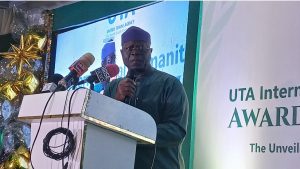
Chairman of the occasion and former Commandant of the National Defence College, Rear Admiral Samuel Alade (Rtd), has called for a shift from emergency humanitarian relief to interventions that empower vulnerable people and provide lasting solutions to humanitarian crises.
Alade, who is also the Balogun of Akure Kingdom, made the call while delivering his opening remarks at a humanitarian gathering organized by the United Towns Agency (UTA), where the UTA Social Centre was unveiled as a platform for skills development, youth engagement, healthcare support, welfare services and opportunities for less privileged members of society.
Alade described the gathering as a significant occasion for reflecting on the responsibilities of individuals and institutions towards humanity, stressing that humanitarian service must extend beyond providing immediate relief to people affected by war, displacement, disasters and other crises.

The event attracted prominent personalities, including Vice President Kashim Shettima, Zamfara State Governor Dr. Dauda Lawal, UTA Global Secretary General Ambassador Dr Eya Essif, UTA Country President Ambassador Abigail Amalaha, Comptroller General of Customs Bashir Adewale Adeniyi, NEMA Director General Mrs Zubaida Umar and other government, security, humanitarian and traditional leaders.
Alade stressed that humanitarian challenges cannot be effectively addressed by one institution or country, and advocated stronger collaboration among government, local communities, traditional rulers, women, youths, humanitarian organisations, and other stakeholders. He emphasized that sustainable impact would only be achieved when affected communities are empowered to rebuild their lives.
He identified the public lecture, “Breaking the Cycle: Creating Lasting Solutions to Humanitarian Crises,” and the unveiling of the UTA Social Centre as key highlights of the programme. He urged participants to view the gathering not merely as a ceremony but as a renewed commitment to improving the lives of vulnerable people and creating a lasting legacy for future generations.

In his goodwill message, Vice President Kashim Shettima, represented by NEMA Director General Zubaida Umar, called for collective responsibility in tackling conflict, insecurity and displacement. He stressed that humanitarian interventions must address livelihoods, education, justice, public trust and local governance, while strengthening early-warning and early-action mechanisms.
Zamfara State Governor Dauda Lawal, represented by his Chief of Staff, Mouktar Mohammed Lugga, emphasised the need to link humanitarian assistance to recovery, resilience, and sustainable development. He stressed that displacement should not become permanent and highlighted the importance of security, social cohesion, economic revitalisation and durable solutions for internally displaced persons.
UTA officials, including Ambassador Dr Eya Essif and Ambassador Abigail Amalaha, reaffirmed the organization’s commitment to humanitarian cooperation, dignity, community empowerment and sustainable development. Customs Comptroller General Bashir Adewale Adeniyi also highlighted the Nigeria Customs Service’s role in facilitating the clearance of humanitarian materials and supporting affected communities through its corporate social responsibility initiatives.
The event concluded with the presentation of humanitarian awards to individuals and institutions for their contributions to vulnerable communities, including Rear Admiral Alade, Custom CG Bashir Adeniyi, Governor Lawal, the DG National Human Rights Commission and the National Commission for Refugees, Migrants and Internally Displaced Persons.
The gathering ultimately reinforced the message that humanitarian service must move beyond sympathy and emergency relief to practical action, empowerment, peace-building and sustainable solutions that leave communities stronger and more resilient.


