


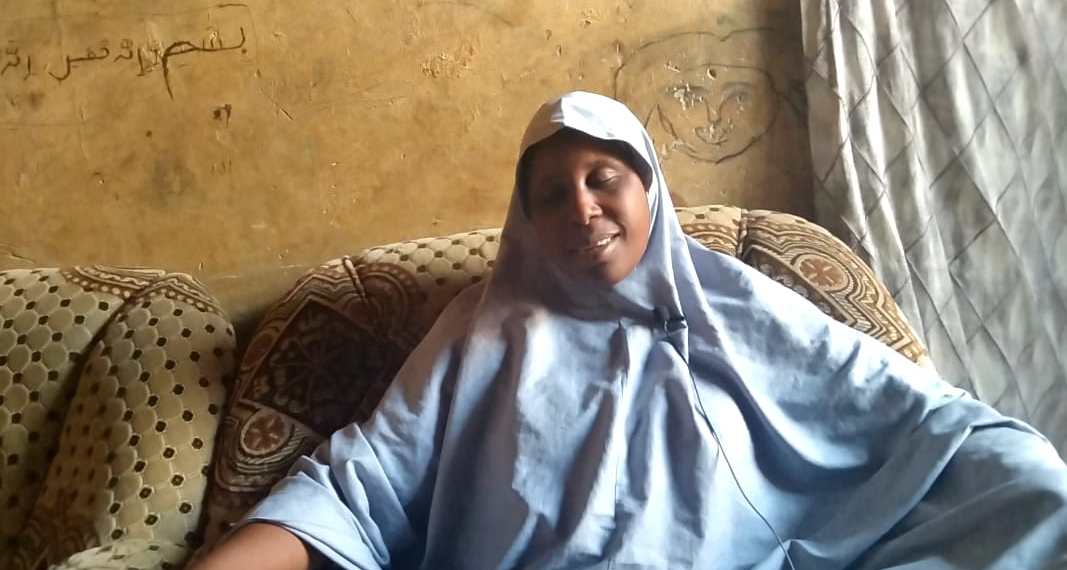
It was love at first sight in June 2018 when Halima Salisu, 16, met Abdullahi at Gosa market in Mpape, a settlement that expands to the urban fringe of Nigeria’s national capital. It was a surreal encounter between her, a food seller, and him, a meat seller.
Ms Salisu, who simply identified Abdullahi, now her ex-husband, by his first name, said they were so much in love that they could not wait to settle down together. She told her parents about him and within three months of meeting they were wedded according to Islamic rites.
But the ecstasy of love made her neglect a vital issue. Abdullahi’s mother did not support the marriage because their tradition in Soba, Kaduna State requires a male child to marry his first wife from the community. He had earlier married a lady from there but divorced her because he was not interested in the marriage, Ms Salisu told PREMIUM TIMES.

Ms Salisu, now 19, hoped that once she had settled in her husband’s house, her mother-in-law would come to terms with the new reality. Unfortunately, it was not so as she continually pressured her son to divorce his new wife.
But one year into the marriage, the pressure persisted despite the couple having a child. Abdullahi eventually succumbed and divorced her while she was nine months pregnant with their second child.
According to an Islamic belief, at the choice of the husband, divorce may be in oral or written form and can be done in the absence of any witness. The procedure of the divorce pronouncement is أنتِ طالق (you are divorced), or فلانة طالق (‘so and so’ is divorced), or هي طالق (she is divorced).
Contrary to the repeated oral divorce pronounced thrice at once by Abdullahi, known as Talaq Bid’a (irregular divorce), an Islamic scholar, Bashir Umar, told PREMIUM TIMES that it ought to take place one after the other, and includes several conditions.
The Quran allows for divorce as a last resort if all remedies have been pursued with no solution and this can be done on three occasions after which both parties can no longer be together, the cleric said.
In fact, Sunan Abu Dawud, one of the six major hadith (sayings and deeds of the Prophet) collections in Islam, Book 6 Number 2173, quotes Abdullah Ibn Umar, one of the first compilers of the hadith, as quoting Prophet Mohammed as saying: “of all the lawful acts, the most detestable to Allah is divorce.”
But in the case a divorce has to occur, Chapter 2 verse 229 of the Holy Quranstates that “the divorce is twice, after that, either you retain her on reasonable terms or release her with kindness.” Verse 230further says: “And if he has divorced her (the third time), then she is not lawful to him thereafter until she has married another man”.

But in all the interviews with women in Mpape, they complained that men flagrantly flout this provision of the Quran, pronouncing their divorce three times at once as against based on occasions.

“It was on the 14th of April, 2020, at 5:30 p.m., he wrote on a paper that he had divorced me and said it orally thrice. He told me to pack my load and return to my parents’ house, then he left the house. I was still packing my load at 3 a.m. when the contractions commenced,” the mother of two said.
With no help in sight and not having a phone, Ms Salisu tried calling out to neighbours for help from her bed but got no response. As she prepared for the delivery by herself, she stood to fetch some items when her baby dropped to the floor. Fortunately, it was not injured. In pain, tears and blood, she cut the umbilical cord and bathed her daughter.
The following morning, when her husband returned, she pleaded with him to take her back but he insisted she must leave after the naming ceremony of the child, a week later.
But since her return to her parents’ house in Berger Quarry, also within Mpape, Abdullahi stopped communicating with her, neglecting his responsibility of catering for his two daughters, aged three and one. The responsibility now solely lies on Halima with the little she gets from her food business.
This, however, contravenes the provisions of the Quran on divorcing a pregnant woman. Chapter 65 verse 6 states: “and if they are pregnant, provide for them maintenance until they have delivered their burden.
“And if they suckle your offspring whom they bore you, then give them due recompense, and graciously settle the question of compensation between yourselves by mutual understanding”.
Divorce, separation rampant in Mpape
Ms Salisu is just one of the many women in this settlement who have either been divorced or abandoned by their husbands.
The Chief Imam of the community, Haruna Idris, told PREMIUM TIMES he noticed the “alarming” trend in 2019 when cases of family conflict that he intervened in, grew.
According to him, before 2019, he had at most two family conflict issues but now he gets at least 10 cases every month. Out of these, he succeeds in solving at most four while six or more families break up.

Similarly, the woman leader of the community, Aisha Saidu, lamented the growing menace. She said from the cases reported to her this year, six women were divorced between January and February 14 and there were several others unknown to her.
Unfortunately, there are no data on the divorce rate in Nigeria. But Kano State in the North West region is unofficially tagged the country’s divorce capital with about 1.7 million registered divorcees as mentioned by Atine Abdullahi, the Executive Director of Kano-based Voice of Widows, Divorcees and Orphans of Nigeria, in a Daily Trust article.
Mpape community leaders indicated that most cases of divorce or abandonment occur among Muslims, which Mrs Saidu attributed to a lack of punitive measures on the men who neglect their responsibilities for “absurd reasons”.

“It is not right to divorce a woman except she has wronged you severally and you have warned her and she did not change or she cheated then you can divorce her. But it is not the same with what is happening currently”, she said to PREMIUM TIMES.
The imam explained that the causes of divorce in Mpape vary according to gender. For the women, he said the desire to live above the family’s income causes conflict in homes. Parental negligence in training the children was another factor he raised.

“Normally, every family ought to groom their children to be great spouses for their partners. They (girls) should be taught how to cook, relate and pet their husband, learn to be courteous and not use an authoritative tone when demanding things from their husbands. Also, some women do not know how to tolerate their husbands’ family”, the cleric said.
The men live a lax lifestyle and are not content, the religious leader noted, as they shift their responsibility on their wives, disregard them and pursue other women. These, he pointed out, are the most recurring features among all the cases he had treated.
For a divorce to take place in Islam, it has to be on the grounds of physical, mental or emotional abuse, failure to fulfil the purposes for which marriage was initiated and marital infidelity. But among several Muslim women interviewed in Mpape and from the community leaders, the reasons for divorce in this settlement are not in accordance with Islamic provisions.
Divorced with eight children
Her ‘mysterious’ attraction to her husband made Maimunat Ibrahim choose him over two other men that wanted to marry her while they were in Nigeria’s north-central state, Plateau. After he met her parents and requested her hand in marriage, they got married in 1981 and relocated to Kano, 301 kilometres from Plateau.
Before moving to their new location, Mr Ibrahim was a driver but could not get a job in the new state. To support the family, Ms Maimunat started selling ‘kose’, fried beans cake, and reared chickens and goats. From her proceeds, she provided for the family till 2000. Concerned about her husband’s joblessness, she then gave her savings to him to relocate to Abuja to look for a job.

Like Ms Salisu’s husband, after Maimunat’s husband left, he stopped relating with her and the children. Two years later, the worried 23-year-old mother left Kano with her seven children and embarked on a six-hour trip to search for her husband. Through the help of her nephew, she located him in Mpape and discovered that he had married another woman.
Shortly after their reunion, Mr Ibrahim, who was then said to be the personal driver of former President, Olusegun Obasanjo, orally divorced his new wife and sent her away with the daughter they had.
Ms Maimunat and her husband then jointly acquired three flats in a compound in Gwari village of Mpape. Months later, he married another woman in 2017. They lived with his first family in the same compound and she had a daughter for him. He abandoned his first wife again but this time with another child and an oral divorce said three times.
“He stopped providing for me and my children and he kept saying he does not have money although he was working as the personal driver of the former President Olusegun Obasanjo. Meanwhile, he was spending his money outside,” she said.
The reporter’s next question roused her as she recounted how she decided to face her reality and started selling ‘Zobo’, hibiscus tea, which her children sold on the streets. When her sales increased, she added buns and fried beans cake.
Mr Ibrahim divorced his third wife and married the fourth in June 2021. At this point, Maimunat and her ex-husband were only flatmates with no relationship. Their children who were equally affected by this sordid situation either did not attend a school or dropped out because of their mother’s limited funds spent solely on their feeding.
ALSO READ: Divorce: Nigerian films distorting reality, misleading Nigerians – Lawyer
In Islam, this is wrong Mr Umar, the scholar, explained. He said that in divorce, while it is the responsibility of the mother to keep the children, the father must provide for their upkeep till they can fend for themselves – for a boy, till they reach adolescence and for a girl when she marries.
Divorced over child’s preferential treatment
Unlike Ms Salisu and Maimunat who were divorced in Abuja, Adama Usman, a 57-year-old Jigawa-born, was divorced by her husband in Makurdi, Benue State where they met as cloth sellers and married in 1980.
The marriage was rosy until Mr Usman married a second wife in 1994, which she had no issue with until he stopped caring and providing for her and their seven children. He finally divorced her in 2019 because of their son, she told PREMIUM TIMES.

According to Ms Adama, the new wife noticed how her son cared for her more than his father by giving her the proceeds of his trade and then decided to poison the mind of her ex-husband who at the time was already tired of his first marriage. He pronounced divorce thrice and told her to leave with the children.
She lived with some friends but with life becoming unbearable, relocated to Abuja in 2021 with two children. Through the help of a Samaritan who gave out her uncompleted building in Mpape, Ms Adama camps there with her children (15 and 13 years) to date.
“To survive, I wash clothes in people’s houses and they offer me whatever they can. My last two children with me also do menial chores around the community to help the family,” she said.
Christians too
In the Mpape settlement, although divorce and separation are said to be rampant among the Muslims, the menace equally affects some Christians living there. An example is the case of Pauline Ezekiel who resides in Ruga, an area in the community.
‘For better or worse’, part of the vow exchanged in a Christian wedding was gladly said on the day Ms Pauline and her second husband wedded in 2013. But the practicality of these words meant nothing when he later abandoned her in 2015 after discovering their newborn was mentally impaired.
She had first married in 1986 in Yobe State but her first husband died 26 years later from an unknown illness. They were unable to bear children during the period.

Ms Pauline, after her studies at the School of Nursing in Yobe State, started practising there but relocated to Abuja in 2009 due to the Boko Haram insurgency. She luckily got a job in a hospital and met her second husband who was working as a contractor in Mpape.
A year and nine months in marriage, she took in and delivered her first child. But trouble came knocking when she noticed that the neck of her three-month-old daughter was not firm and then the harrowing journey of moving in and out of hospitals began.
Constantly, wiping tears with a brown and black shawl wrapped around her head and shoulder, the 52-year-old mother recounted, “She got really sick and started behaving like an imbecile. I took her to hospitals in Maitama, Gwarimpa, Wuse, Bwari and the University of Benin Teaching Hospital. It was only one hospital that said it was malaria after doing a brain scan. They even advised me to go spiritual because it did not feel ordinary.”
Her husband refused to care for his sick child and told her he could not start his life with many expenses. Then he left her and married another woman in the community and they currently have two children.
In the process of seeking a cure, Ms Pauline lost her job, resorted to private treatment around her community to earn money enough to feed but was unable to send her daughter to school. Her health gradually deteriorated with partial paralysis and constant eye twitches.
“That period, I felt like a mad woman and did not want to lose my child for anything. People were even mocking me that my daughter is a snake and that I should throw her in a river but I refused. To the glory of God, my child got miraculously healed”, the Edo-born woman said.
Ms Pauline said her husband lives in the same community but pretends like they are not existing even when they accidentally meet on the road. He also has never asked about his daughter despite knowing she has recovered from her ailment.
Her daughter, whom Pauline asked to conceal her identity, is now seven and hopes to be a doctor and a pastor because both roles played an important part in her recovery.
“I want to be a doctor because I like the work and a pastor because God set me free,” the girl said.
Solving divorce surge menace
When a family conflict arises in Mpape, the leaders mediate by bringing both parties together to hear their stories, correct either party on their faults and try to provide succour, depending on the situation. Despite this measure, cases continue to soar.

While Mpape continues to grapple with the rising divorce cases, Sokoto State in North-west Nigeria says it has found a way to minimise divorce in the state.
In a telephone interview with PREMIUM TIMES, Habiba Ahmad, Director of Gender in the state Ministry of Women Affairs, said they commenced an intervention in 2019 with the introduction of call lines that women use to directly lodge their complaints.
Then, they reconcile marriages by equipping women with empowerment skills and give start-up grants to them to commence businesses because some of the causes of family conflict are finance-based. They continually follow up on the women by visiting their homes to find out about their progress.
“The cases are reducing because there is intervention. From January this year till date, I have had just one complaint. Before the intervention, the ministry has at least five cases in a month,” Mrs Ahmad said.
The government official said part of the success of the intervention is as a result of the support from traditional and religious leaders like the Sultan of Sokoto with constant sermons and sensitisation on the matter.
Another reason why she believes the intervention helped is that women have been vocal about their issues. She advised for this approach to be replicated in other areas bedevilled by the disturbing trend.
“If the women come out to complain directly, there is going to be an intervention. Usually, they leave the matter within the family and come to us when their family cannot settle them well. Since the husband is no longer taking care of them, we provide empowerment for them,” the government official said.
The ministry also plans to go to the state House of Assembly during the forthcoming International Women’s Day for the lawmakers to create legislation that can support the intervention.
Exploring re-marrying option
Being divorced does not stop one from having their desired love life. Although Maimunat and Adama cited their age as a limiting factor, 52-year-old Pauline still hopes to remarry.
For Ms Salisu, 19, it is a different case. With brightened eyes and a coy smile, she gushed about her new boyfriend and her journey to finding love again.
“I have moved on from my first husband. I am currently dating someone from Kano State. I met him in GRA Lugbe where he sells fabrics, in September 2019,” she narrated with glee.
She told him about her story and it did not discourage him. Before they met, he did not disclose his interest to her but met her parents privately to inform them. They notified her and arranged for them to meet in their home and again, it was love at first sight for her as she accepted his request to date him.
“He accepted me completely and even constantly contributes to my children’s upkeep, although, I am not happy that another man is taking care of my children and not their father,” she said.
She notified this reporter of her plan to marry him when her second daughter who is currently one, turns three and when she is more financially stable, as she hopes to start selling clothing materials if she gets support.
“This Report was Produced with support from the Africa Women’s Journalism Project (AWJP) in partnership with the International Center for Journalists (ICFJ) and through the support of the Ford Foundation”.


